
 Volodymyr Lukaniuk
Quick answer: A useful association roofing bid request fixes the scope before anyone prices it: squares per building, the exact shingle and accessories, the warranty tier, unit prices for what nobody can see yet, and the insurance endorsements. Three bids written against a fixed specification can be compared. Three bids written against a phone call cannot.
Most boards we meet have already done the hard part. They know the roofs are due, they have a reserve line for it, and someone has been told to go get three prices. Then three numbers come back — say $186,000, $241,000 and $308,000 for the same six buildings — and the board spends two meetings arguing about which roofer is honest. That argument cannot be won, because the three companies were never asked to price the same roof. The fix is upstream: a roofing bid request that pins down the work before anyone puts a number next to it.
We are a family-owned Illinois roofing contractor in Lincolnshire, and we bid multi-building properties across the north and northwest suburbs. What follows is what we wish every board handed us on day one — written from the board's side of the table, including the parts that are inconvenient for us.
What should an association's roofing bid request actually contain?
Eight things: measured squares per building, the named shingle and its accessory package, the warranty tier you require, ventilation to be installed or reused, flashing scope, unit prices for concealed conditions, the insurance and license documents, and the payment and lien-waiver schedule. Anything left out of that list is a place where three bids will quietly diverge.
A specification exists so that when the prices come back, the only variable left is the price. If your request says "replace the roofs on Buildings 1–6," you have asked three companies to invent six different projects and then compete on the cost of their own inventions.
| Fix this in the request | What happens if you don't |
|---|---|
| Squares per building, stated by the bidder | You cannot compute cost per square, so you cannot compare anything |
| Exact shingle line and color | One bid prices a builder-grade shingle, one prices a laminate, both say "architectural" |
| Accessory package (starter, ridge cap, underlayment, leak barrier, ventilation) | The accessory count is what qualifies the warranty tier — see below |
| Warranty tier, by name | Every bid says "Lifetime" and means something different |
| Ventilation: replaced or reused, and to what target | One bid replaces the vents, one reuses them, and both write "ventilation" |
| Flashing: reuse none, replace all step and counter flashing | Flashing reuse is a real cost difference that never shows up in the total |
| Unit prices for decking, fascia, boots, chimney work | Concealed work becomes a change order priced after you have no leverage |
| Insurance endorsements and lien waivers, named by form | You collect certificates that cannot give the association the status it needs |
Two of those deserve their own sections, because they are where the money and the risk actually sit.
Why do three roofing bids for the same buildings come back so far apart?
Because each bidder made a different set of choices about what the job includes. Shingle grade, underlayment, ice-and-water coverage, flashing reuse, ventilation, decking assumptions, dumpster placement, and crew size all move the number. On a single-family house the spread is annoying. Across six buildings it compounds into six figures.
The published range for a full tear-off and architectural shingle replacement in the Chicago suburbs runs roughly $450–$1,150 per square, and a "square" is 100 square feet of roof surface. That range is real, and it is wide for honest reasons: pitch, height, layers, cut-up geometry and access all live inside it. Which means a bid at the bottom of the range is not automatically a bad bid, and one at the top is not automatically a padded one. You cannot tell from the total. You can tell from the per-square number and the unit prices behind it.
So the first thing to do with three bids is stop reading the totals and normalize them. Require each bidder to state squares per building in their proposal, then divide.
| Worked example (arithmetic only, not a real quote) | Bid A | Bid B | Bid C |
|---|---|---|---|
| Total price, six buildings | $186,000 | $241,000 | $308,000 |
| Squares the bidder measured | 318 | 412 | 415 |
| Price per square | $585 | $585 | $742 |
| Decking allowance included | None | 20 sheets | 40 sheets |
| Warranty tier offered | Manufacturer only | System Plus | Golden Pledge |
The moment you do that arithmetic, the fight changes. Bid A is not cheaper than Bid B by $55,000 — it is the same price per square, measured against 94 fewer squares. One of those two measurements is wrong, and the board's next job is to find out which. Bid C is genuinely more expensive per square, and now the board can ask the only question that matters: is the extra buying a warranty tier and a decking allowance we actually want?
Our own guide to reading a roofing estimate line by line covers the same problem from a homeowner's side. The board version has one extra trap: a measurement error on a single-family house costs a few hundred dollars, while a measurement error across six buildings is worth tens of thousands of dollars.
Which unit prices belong in the bid form?
Every price for work nobody can see until the tear-off starts. Decking is the big one, and it is the only line on a roofing project that genuinely cannot be measured in advance. Get the rate in writing before you sign, and a bad surprise becomes arithmetic instead of a negotiation with a crew already on your roof.
In the north and northwest suburbs the going rate for replacing a bad 4x8 sheet of decking runs about $75–$120 per installed sheet, including the panel, the labor to cut out the rot and nail in the new, and disposal. If you ask for that number in the bid form, all three bidders have to commit to it in a competitive moment. If you ask for it with the shingles already off, you get whatever it costs then. We wrote a whole piece on what roof decking replacement actually costs and why it cannot be pre-measured; for a board the only change is the multiplier.
| Unit-price line | Why the board wants it fixed |
|---|---|
| Roof decking, per installed 4x8 sheet | The one quantity nobody can know before tear-off; ~$75–$120 in this market |
| Full re-deck, per square | A whole slope should be re-priced by the square, not by multiplying the patch rate |
| Fascia board replacement, per linear foot | Rot found behind the gutter line, building by building |
| Pipe boot / vent collar, each | Cheap to replace during a tear-off, expensive to chase later |
| Chimney flashing and counter flashing, per chimney | Varies enormously between buildings on the same property |
| Skylight reflash or replace, each | Easy to leave out of a scope written from the ground |
| Additional layer of tear-off, per square | Older buildings on the same site often differ from each other |
Note the second line. If a bidder finds one chronically wet slope and prices the whole slope at the patch rate, the number is wrong in their favour — a crew sheeting a whole slope works far faster than one cutting a patch into a live roof. Asking for both rates in the bid form is how a board catches that without knowing anything about roofing.
What warranty tier should the specification name, and what does "Lifetime" mean on your buildings?
Name the tier, not the word. On a condominium or association building GAF's Lifetime coverage does not apply at all, and the enhanced tiers pay out for materially fewer years than the same tiers on a detached house. If your specification just says "manufacturer's Lifetime warranty," you have specified something that does not exist for your property.
This is worth reading in GAF's own words. Their published warranty comparison defines the term like this: "The Lifetime warranty is applicable only to shingles and accessories installed on a single-family detached residence owned by individuals. For any other type of owner or building, such as a corporation, governmental entity, religious entity, condominium or homeowner association, school, apartment building, office building, or multi-use structure, the length of the warranty is 40 years."
Condominium and homeowner association are named explicitly. GAF publishes a separate warranty table for commercial and multi-family properties, and on that table the shingle term is 40 years across every tier, while the non-prorated period — the years in which a claim is paid in full rather than reduced for the use you have had — drops from 50 years to 20 or 25.
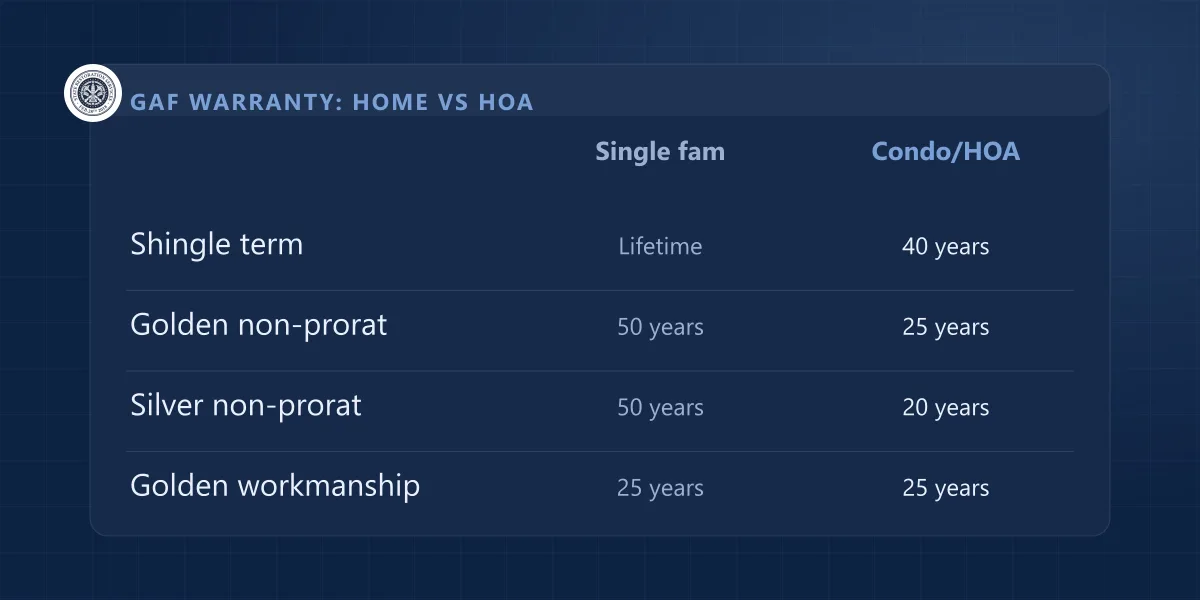
Here is the tier structure as GAF publishes it for multi-family and commercial buildings. Read the last two columns together, because they are the reason to specify a tier at all.
| Tier | Accessories required | Contractor must be | Non-prorated | Workmanship (Timberline HDZ) |
|---|---|---|---|---|
| GAF Roofing System | 3 | Anyone | 10 years | Not covered |
| System Plus | 3 | GAF Certified or above | 20 years | Not covered |
| Silver Pledge | 4 | GAF Certified Plus or Master Elite | 20 years | 10 years |
| Golden Pledge | 5 | GAF Master Elite | 25 years | 25 years |
Workmanship is the column that decides whether the manufacturer stands behind the installation. A manufacturer warranty covers a manufacturing defect in the shingle. Workmanship coverage is the manufacturer standing behind the installation — misapplied shingles, and flashings at valleys, dormers, chimneys and plumbing vents. It appears only at Silver Pledge and above, which means it is unavailable unless the contractor holds the matching certification. Specifying "Golden Pledge" is therefore also a prequalification: it decides who is allowed to bid before anyone submits a price.
Two honest caveats. First, the tier costs money — five accessory products and a certified installer are not free, and a board should decide whether twenty-five years of workmanship coverage is worth the premium on their particular buildings. Second, we install GAF, Owens Corning and IKO systems, and this article quotes GAF because GAF publishes the multi-family definition in plain text where anyone can check it. Ask whichever manufacturer your specification names for their own written definition of the warranty term on an association-owned building, and put the answer in the bid packet.
There is a side benefit for a board that a homeowner does not get. A property with sixty roofs on it is a far bigger target than a single house, and after a serious hail event it will hear from companies that arrived with the storm and plan to leave with it. Naming a warranty tier that requires a manufacturer certification takes most of them out of the conversation before anyone has to be impolite about it. We wrote about that pattern in storm chasers vs a local roofer.
What insurance and license documents should the board require before signing?
A certificate of insurance, the additional-insured endorsements by form number, workers' compensation, and the Illinois roofing license number. A certificate is evidence that policies existed on the day it was issued. It cannot make the association an additional insured, no matter what is typed into its remarks box.
ACORD, which publishes the certificate form itself, puts it plainly in guidance quoted by the International Risk Management Institute: "A Certificate of Insurance is NOT an insurance policy, and does not serve to provide, endorse, amend, extend or alter in any way the terms of an insurance policy. Only an endorsement, rider or amendment to the policy can effect changes in coverage. Reference to a contract between the client and a third party on a certificate does not provide coverage."
So ask for the endorsements themselves. Two matter, and boards almost always get only the first. Form CG 20 10 grants additional-insured status for ongoing operations — while the crew is on your property. Form CG 20 37 grants it for completed operations, after the job is done. They are separate endorsements, and a roof defect claim by definition surfaces after completion. A board that collects only CG 20 10 has cover while the crew is on site and none for the years afterwards, which is when those claims appear.
| Document | What to require | Why |
|---|---|---|
| Certificate of insurance | Association named as certificate holder | Evidence only; proves nothing about your status |
| CG 20 10 endorsement | Association named as additional insured, ongoing operations | Covers the association during the work |
| CG 20 37 endorsement | Association named as additional insured, completed operations | Covers the association after the work, when defect claims appear |
| Workers' compensation certificate | Active policy covering every worker on site | An uninsured fall on association property becomes the association's problem |
| Illinois roofing license number | Verified at IDFPR, not read off a truck | The license carries insurance and bond minimums with it |
| Subcontractor list | Names, and the same insurance package from each | The general contractor's policy may not follow the sub who does your roof |
On limits: Illinois sets minimums of $500,000 in general liability and $250,000 in property damage for a licensed roofer, plus workers' compensation, and the state license requires a surety bond of $10,000 for a Limited license or $25,000 for an Unlimited one. Those are the numbers required to hold a license. They are not the numbers a board should accept on a project worth several hundred thousand dollars, and the association's own insurance agent is the right person to say what the limits should be. Look up any bidder's license yourself at IDFPR; our own numbers are published in plain text on our licensed and insured page precisely so nobody has to take our word for it. The full vetting checklist lives in our guide to licensing and insurance when hiring an Illinois roofer.
How does an unpaid roofer's lien reach individual units?
It reaches them directly, and in proportion to each owner's share. Under the Condominium Property Act a lien cannot attach to the property as a whole after the declaration is recorded — it attaches to individual units. When the board authorizes work on the common elements, the statute treats every owner as having authorized it too, which is how an unpaid subcontractor ends up on an owner's title for a roof that owner never voted for.
765 ILCS 605/9.1(a) says it this way: "If the performance of the labor or furnishing of the materials is expressly authorized by the board of managers, each unit owner shall be deemed to have expressly authorized it and consented thereto, and shall be liable for the payment of his unit's proportionate share of any due and payable indebtedness as set forth in this Section."
The same section gives an individual owner a way out. Where a lien covers two or more units, an owner "may remove such unit and the undivided interest in the common elements appertaining thereto from such lien by payment of the proportional amount of such indebtedness attributable to such unit." That is useful if you are an owner trying to close a sale, and cold comfort if you are the board that let it get that far.
The board's protection is a payment schedule tied to paperwork rather than to calendar dates: a contractor's sworn statement listing every subcontractor and supplier with their contract amounts, and signed partial lien waivers from each of them covering every dollar already released, before the next draw goes out. A retainage — a share of each payment held back until the punch list is closed — gives the association leverage at exactly the moment it usually has none. Our homeowner's guide to mechanics liens on an Illinois roof job walks through the notice deadlines and the sworn-statement mechanics in detail; a board should read it as a description of what happens to every owner at once.
What does Illinois law actually require of the board when it awards the contract?
Illinois requires no bidding at all, and it does require the award vote to happen in the open. There is no competitive-bidding requirement anywhere in the Condominium Property Act. There is a hard rule about where the award happens, a records rule that lets any owner read the contract, and a fiduciary standard that sits over all of it.
Start with the verified negative, because it saves arguments. The Act does not require three bids, two bids, or any bids. The three-bid convention comes from declarations, bylaws, management-company policy and plain prudence — all good reasons, none of them the statute. Read your own declaration; if it sets a dollar threshold above which bids are required, that threshold is binding on you and the statute's silence is irrelevant.
Where the statute is specific is the meeting. 765 ILCS 605/18(a)(9)(A) lets a board close part of a noticed meeting to "discuss the appointment, employment, engagement, or dismissal of an employee, independent contractor, agent, or other provider of goods and services" and to "interview a potential employee, independent contractor, agent, or other provider of goods and services." Then it closes the door on the shortcut: "any vote on these matters shall take place at a meeting of the board of managers or portion thereof open to any unit owner." Interview the three roofers privately. Award the contract in front of the owners paying for it.
Townhome and common-interest communities get the same rule in slightly broader language. 765 ILCS 160/1-40(b)(5) permits closing a portion of a meeting to "discuss third party contracts" as well as to interview a provider, and ends identically: "Any vote on these matters shall be taken at a meeting or portion thereof open to any member." The same section also requires the board to reserve part of the meeting for member comments. Which of the two Acts governs your property is not always obvious — we untangled it in who pays for a condo or townhome roof in Illinois.
After the award, the contract is a record. 765 ILCS 605/19 requires the association to keep "all contracts, leases, and other agreements then in effect," and any member may inspect them on written request. Failure to make requested records available within 10 business days is deemed a denial, and an owner who prevails in an action to compel inspection can recover attorney's fees and costs. Write the roofing contract on the assumption that every owner will read it, because every owner may.
Over all of it sits 765 ILCS 605/18.4: "In the performance of their duties, the officers and members of the board, whether appointed by the developer or elected by the unit owners, shall exercise the care required of a fiduciary of the unit owners." That standard says nothing about taking the lowest number. What it requires is that the board can explain the number it did take.
Should a multi-building roof be done all at once or phased?
Phase it if the reserves require it, and price the phasing honestly. Doing six buildings in one season buys the best price per square, because mobilization, dumpster logistics and supervision are spread across the whole job. Splitting it across three years spreads the assessment instead, and costs somewhat more per building.
Three things belong in the contract if you phase. First, state how long the unit prices hold — a decking rate quoted in 2026 is not a 2029 rate, and a bidder who agrees to hold prices for one season is telling you something useful about their pricing. Second, record the exact product: manufacturer, shingle line, color name and accessory list, in writing, so phase two orders the same thing rather than the closest current match. Third, expect a visible difference between the phases.
That last point is worth being straight about. The Asphalt Roofing Manufacturers Association notes that color shading on newly installed shingles comes partly from variations in surface reflectance that "are so slight that they are difficult to detect during the manufacturing process." Two buildings roofed three years apart in the same specified color can read slightly differently in flat afternoon light, and there is nothing wrong with either roof. Worse, a color can be discontinued between phases — the problem we cover in shingle color matching on a partial roof claim. If the board's priority is uniform appearance across the property, that is an argument for one season and one order, and it should be said out loud in the meeting rather than discovered in year three.
If storm damage is what put the roofs on the agenda, the sequencing question changes again, because the carrier's scope and your specification have to agree before anyone signs. That is a different piece of work, and we describe how we handle it on our storm and insurance claim page. Illinois law bars a roofing contractor from negotiating your claim; we document damage and build a code-compliant estimate, and our partner, the licensed public adjuster State Adjusting Services, can represent the association on the claim itself.
Frequently asked questions
Does Illinois law require an association to get three roofing bids?
No. The Condominium Property Act contains no competitive-bidding requirement, and neither does the Common Interest Community Association Act. The three-bid habit comes from declarations, bylaws and management-company policy, not from the statute. Read your own declaration before you assume a number is legally required.
Can our board interview roofers and award the contract in a closed session?
You can interview in closed session. Under 765 ILCS 605/18(a)(9)(A) the board may close a portion of a meeting to discuss or interview a contractor or other provider of goods and services, but the statute then says any vote on those matters shall take place at a portion of the meeting open to any unit owner. Interview privately, award in the open.
Can a roofer put a lien on my condo unit if the association does not pay?
Yes, on your unit specifically. Under 765 ILCS 605/9.1(a), when the board expressly authorizes the work, each unit owner is deemed to have authorized and consented to it and is liable for that unit's proportionate share. The same section lets an individual owner clear their own unit by paying the proportional amount attributable to it.
Why does the roofing warranty on our building say 40 years instead of Lifetime?
Because of what the building is. GAF defines Lifetime coverage as applying only to shingles installed on a single-family detached residence owned by individuals, and states that for a condominium or homeowner association the length of the warranty is 40 years. The shingle is identical; the warranty term is not.
Roofs due on your association's buildings? We bid multi-building properties across Lake and Cook County. We walk every roof in person, state the squares we measured, and give you a written price based on what we found — which is the same thing this article tells you to demand from everyone. See how we work on our process page, read what we do on multi-unit and commercial roofing and residential roofing, or book a free inspection and call (866) 992-2982. We serve the north and northwest Chicago suburbs during normal business hours.