
 Volodymyr Lukaniuk
Quick answer: In Illinois, a roofing contractor must hold an active IDFPR roofing license — Limited (residential, 8 units or fewer) or Unlimited (any size or property type) — and carry at least $500,000 in general liability and $250,000 in property damage insurance, with a written contract that shows the license number. Verify the license yourself at idfpr.illinois.gov before you sign anything. If you're paying with insurance money, you can also cancel within 5 business days of a claim denial or 30 days of filing, whichever comes first. Walk away from anyone who won't give you a license number or offers to cover your deductible.
We get asked how to choose a roofing contractor almost as often as we get asked what a new roof costs, and the two questions are more connected than people think — the contractor you pick decides whether that price actually holds. Most of the year it's a straightforward decision. After a hailstorm rolls through Lake or Cook County, it gets a lot harder: a wave of trucks with out-of-state plates shows up handing out door hangers before your own insurance adjuster has called back. The paperwork side of hiring a roofer isn't exciting, but almost all of it is spelled out in Illinois law, and knowing what the law actually requires is the fastest way to tell a real contractor from someone just passing through.
Does a roofing contractor have to be licensed in Illinois?
Yes. Under the Illinois Roofing Industry Licensing Act, anyone performing roofing work for pay must hold a license issued by the Illinois Department of Financial and Professional Regulation (IDFPR). There are two tiers — Limited, for residential buildings of eight units or fewer, and Unlimited, for any property type or size — and both require a state exam, a surety bond, and minimum insurance.
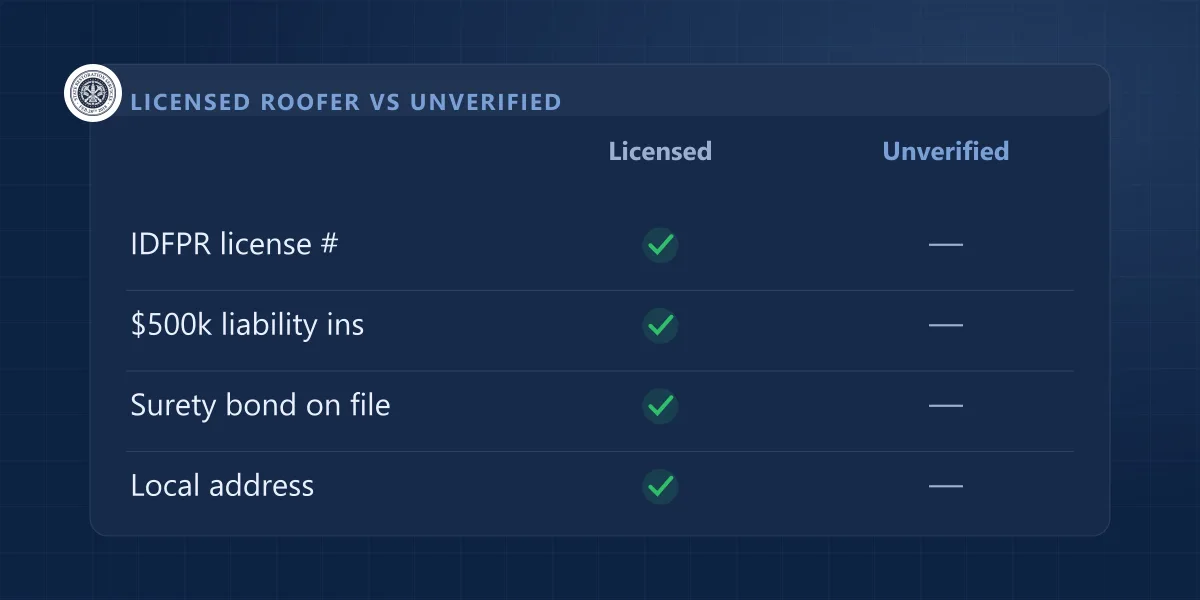
Getting licensed isn't a rubber stamp. A contractor has to pass a state licensing exam, post a surety bond — $10,000 for a Limited license, $25,000 for an Unlimited one — and carry the insurance minimums we cover below. That bond exists specifically so a homeowner has somewhere to go if a licensed contractor does the job badly or walks off with a deposit; an unlicensed operator gives you nothing to file against. Ask for the license number directly, then look it up yourself at idfpr.illinois.gov — a real license is public record and takes about thirty seconds to confirm. A contractor who hesitates, or hands you a number that comes back to a different name, has already told you what you need to know.
| License type | Covers | Surety bond |
|---|---|---|
| Limited | Residential, 8 units or fewer | $10,000 |
| Unlimited | Residential, commercial, industrial — any size | $25,000 |
What insurance should my roofing contractor carry?
Illinois sets minimums of $500,000 in general liability and $250,000 in property damage coverage for a licensed roofer, plus workers' compensation for their crew. Ask for a certificate of insurance and confirm the policy is active by calling the carrier listed on it — a certificate is easier to fake or let lapse than a license.
The insurance minimums matter for two different reasons. General liability and property damage cover your house if something goes wrong on the job — a ladder through a window, a dropped bundle of shingles through your gutters, a tarp that doesn't hold and lets water into the attic overnight. Workers' compensation covers something people don't think about until it happens: if an uninsured worker gets hurt falling off your roof, the homeowner can end up pulled into that liability. A real Illinois-licensed roofer already meets both minimums as a condition of the license, which is really why license verification and insurance verification are the same step, not two.
| Coverage | Illinois minimum | Why it matters |
|---|---|---|
| General liability | $500,000 | Covers damage to your home during the job |
| Property damage | $250,000 | Separate limit under the roofing license |
| Workers' compensation | Required for employees | Protects you if a worker is hurt on your roof |
What has to be in a written roofing contract?
Illinois requires a written contract for home repair work, spelling out the scope of work, total price, start and completion timeline, and warranty terms, with the contractor's license number printed on it. A verbal agreement or a one-line invoice doesn't meet that bar, and it leaves you nothing to hold the contractor to if the job doesn't match what was promised.
A contract that only meets the legal minimum still leaves gaps. Before you sign, make sure it also spells out the material and product line by name — not "architectural shingles," but "GAF Timberline HDZ" — whether it's a full tear-off or a layover, who's responsible for the permit, and a payment schedule tied to project milestones instead of one lump sum. It should list both warranties separately: the manufacturer's material warranty and the contractor's own workmanship warranty, which cover different things (see our breakdown of manufacturer vs. workmanship warranties). If a bid is vague on any of this, that's usually where the real price hides — we cover the specific line items to watch for in how to read a roofing estimate.
Can you cancel a roofing contract after you sign it?
Yes, and in Illinois two separate rights can apply. Any home-sale contract over $25 signed at your house carries a standard three-business-day right to cancel. If you're paying with insurance proceeds, the Roofing Industry Licensing Act adds a second right: you can cancel within 5 business days of your insurer denying the claim, or within 30 days of submitting it, whichever comes first.
That second right exists because roofing sales built around insurance money move fast, and state law built in a way out if the claim doesn't go the way you were told it would. The contractor is required to disclose this cancellation right to you in writing and give you a form to use it — if a salesperson never mentions it, that's already a sign they're not running a compliant operation. It doesn't erase your obligation to pay for work that's already been done, but it stops you from being locked into a full contract for a roof you can no longer afford once the insurance side falls through. The Illinois Attorney General's home repair guide lays out both rights in plain language if you want to read the source.
What are the red flags that mean you should walk away?
The clearest red flags are a contractor who won't give you a license number, one with no local address, high-pressure same-day-discount tactics, and anyone who offers to cover or waive your insurance deductible — which Illinois law explicitly prohibits, not just discourages.
- No permanent local address, or plates from out of state
- Can't produce a license number, or it doesn't match on IDFPR's lookup
- Pushes a "sign today for the discount" deadline
- Offers to pay, rebate, or "eat" your insurance deductible
- Wants full payment before any material is delivered
- Can't name the manufacturer certification behind their warranty claims
Most of these show up hardest right after a storm, when the trucks with out-of-state plates roll in before your adjuster has even called back — we go deeper on that specific pattern in storm chasers vs. a local roofer.
How much of a deposit is normal for a roof replacement?
There's no single legal deposit cap for roofing in Illinois, but the safe practical range most reputable contractors work in is roughly 10-33% down to cover materials, with the balance due on completion — never the full contract price upfront, and never in cash with no receipt.
| Stage | Typical payment |
|---|---|
| Signing / material order | 10-33% deposit |
| Job start / material delivery | Progress payment on larger jobs |
| Final walkthrough | Balance due on completion |
Where SRS fits on this checklist
We're licensed and insured in Illinois, based in Lincolnshire, and we're installers certified by GAF, Owens Corning and IKO — you can verify all of that instead of taking our word for it, the same way you should for anyone bidding your job. And because Illinois law doesn't let any roofing contractor, us included, negotiate your insurance claim, we document the damage and build a code-compliant estimate, and our affiliated licensed public adjuster at State Adjusting Services can represent you directly with the insurance company.
We serve the north and northwest Chicago suburbs — see our residential roofing page for what a project with us looks like, or read through our process from first call to final walkthrough. Check whether we're already working near you on our Northbrook service page.
Related reading: Storm chasers vs. a local roofer: how not to get burned after a hailstorm
Frequently asked questions
How do I verify a roofing contractor's license in Illinois?
Search their name or license number in IDFPR's public license lookup at idfpr.illinois.gov. It shows whether the license is active, which tier (Limited or Unlimited) it is, and whether there's any disciplinary history on file.
Is it illegal for a roofer to pay my insurance deductible?
Yes. Illinois law prohibits a contractor from advertising or promising to pay, waive, or rebate any part of your insurance deductible as an inducement to sign. A contractor offering this is telling you they're either inflating the estimate to cover it or breaking the law outright.
How much of a deposit should I pay upfront for a new roof?
There's no set legal cap, but a reasonable range is roughly 10-33% at signing to cover materials, with the rest due on completion. Never pay the full contract price before the work is done.
What's the difference between a Limited and Unlimited Illinois roofing license?
A Limited license covers only residential properties of eight units or fewer and requires a $10,000 surety bond. An Unlimited license covers any property type or size, residential, commercial or industrial, and requires a $25,000 surety bond.
Thinking about your roof? Book a free inspection or call (866) 992-2982 — we serve the north and northwest Chicago suburbs.