
 Volodymyr Lukaniuk
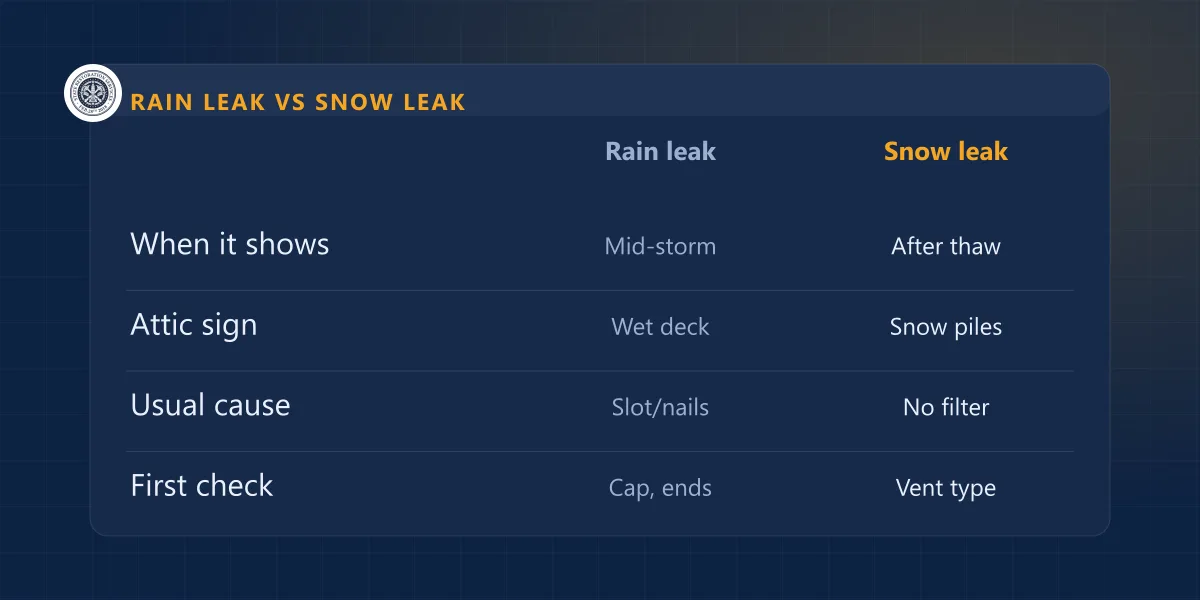
A ridge vent leaking in a storm or after a snowfall is almost always letting water in through one of five places: the open ends or joints of the vent run, the low edge where wind pushes rain up the slope, the nails that hold the vent and cap down, a slot in the roof deck cut too wide, or the vent openings themselves when wind drives fine snow through them. Which one you have depends on the weather on the day it leaked, and on what you find in the attic afterwards.
The ridge vent runs along the peak of your roof and lets warm, damp attic air out. To do that it sits over a gap cut through the roof deck, the one place on a shingled roof where there is an opening straight into the attic on purpose. Most of the time that is fine, because rain falls down and the ridge is the highest point, so very little water ever reaches it. Wind changes the direction water travels. That is why so many homeowners tell us the same thing: it only leaks when the rain blows sideways.
Where water gets past a ridge vent
Here is the peak of a typical shingled house, cut across. The vent sits on the shingles over the slot, and cap shingles are nailed over the vent so it looks like a normal ridge from the street.
- The ends and joints of the run. A slot cut right out to the end of the ridge, with nothing solid under the last piece of vent, takes water in at the end. So does a joint where two sections were left with a gap instead of butted tight. In the attic: a wet spot or stain near one end of the ridge, or at one point along it, not a stripe along the whole length.
- The low edge on the windward side. Wind blowing up the roof carries a sheet of water with it. A vent without an outside baffle, or with a baffle bent flat, lets that water ride over the edge and into the openings. In the attic: wet decking along the side of the peak that faced the wind, showing up during the storm itself.
- The nails. Every nail through the cap and the vent is a hole. Nails that are too short back out over a few winters, and the head lifts off the shingle. In the attic: drips or rusty stains in a line along the ridge, a few inches either side of the peak.
- The slot. A slot cut wider than the vent was made for leaves the edge of the opening too close to the vent's own openings, and wind-driven rain or snow has a short, straight path in. In the attic: water or snow landing right under the peak along long stretches of the ridge.
- The vent openings, in snow. Fine, dry snow blown hard across the roof can pass through a vent that has no filter inside it. In the attic: a dusting or small drifts of snow on the insulation under the ridge, and a ceiling stain days later when it melts.
There is a sixth cause that is not the vent at all. If you find frost on the tips of the roofing nails across the whole underside of the roof, or the drips appear on a cold sunny morning with no storm, the water came from inside the house as warm, moist air that froze on the cold deck. We explain that one in our article on bathroom exhaust fans that vent into the attic, which is where we find it most often.
Snow through the ridge is the north-suburbs version of this problem
Hurricane country worries about rain at the ridge. Around Lake and Cook County we see more trouble from snow. A cold, dry snowfall followed by strong wind blows snow across the peak, and a vent made for a warm climate lets some of it in. A little snow on deep insulation often turns to vapor before it does any harm. Enough of it, and you get a brown ring on the bedroom ceiling the week after the storm.
GAF's technical bulletin on snow infiltration at ridge, hip and off-ridge vents lists the leading causes: unfiltered vents, wind-driven snow, vents not installed to the maker's published instructions, and an attic without balanced intake and exhaust. The fifth item on its list is a powered attic fan working on the same roof as a ridge vent, because the fan can pull air, and snow with it, in through the ridge. GAF's own recommendation for snowy areas is a filtered vent, properly installed, in a balanced system.
The ridge does have one thing going for it in winter. Air Vent's maker says in its guidance on vents in heavy snow that "the roof typically clears at the ridge first." The same page explains why the outside baffle matters: wind pulls snow back out from behind the baffle, while a vent without one can hold snow under the cap edge, where it melts and refreezes into ice.
How wide the slot under the vent should be
This is the install mistake we can check in minutes and that almost nobody outside the trade knows about. The slot is cut before the vent goes on, so once the cap shingles are nailed down nobody looks at it again. Each vent is made for a certain opening. As one example, the ICC-ES evaluation report for Air Vent's ShingleVent II family, ESR-2071, spells it out:
The same report wants the vent sections butted together with no gaps (an 1/8-inch gap is allowed in cold weather for expansion), and the cap shingles over the vent nailed six per shingle with nails long enough to go 3/4 inch into the deck or through it. Other vents have other numbers, so the sheet for the vent on your roof is what counts. Air Vent's maker gives a rule of thumb that holds across its vents: the slot should leave 2 inches of solid deck under the vent on each side.
So a slot cut 5 or 6 inches wide "for more airflow" does not buy much. It moves the edge of the hole out toward the vent's openings, and on a windy day that is the shortest path water has into the attic. The cure is to take the vent off, add strips of decking to bring the slot back to size, and put the vent back on, or put on a new one.
What fixes each cause, and what wastes money
The fix depends on the path. A new vent is the answer for some of these and a waste for others.
| Fix | Solves | Does nothing for |
|---|---|---|
| Closing the ends and reseating loose joints | A leak at one end or one spot along the run (path 1) | Water along the whole ridge, snow on the insulation |
| Re-nailing with nails long enough to go fully through the deck, and replacing cracked cap shingles | Drips in a line at the nails, a vent lifted by wind (path 3) | A slot cut too wide, an unfiltered vent |
| Narrowing the slot with new decking strips | Water or snow landing right under the peak (path 4) | A leak at the ends or at the nails |
| Replacing the vent with a filtered model with an outside baffle | Snow blowing in, rain riding over the low edge (paths 2 and 5) | Frost from moist house air, a torn cap shingle |
| Ducting bath fans outside and adding soffit intake so intake matches exhaust | Winter frost and drips with no storm; snow pulled in by a fan or by too little intake | A vent torn loose in a windstorm |
One fix we will not do is smear sealant over the vent openings. It stops the leak by stopping the vent, and then the attic holds its moisture all winter. If the attic needs a different exhaust setup altogether, that is ventilation work, and our attic ventilation service page explains how we look at intake and exhaust together. Our guide to attic heat and roof ventilation covers why mixing a ridge vent with gable vents or a power fan causes trouble.
What to look for in the attic during the next snowstorm
If you can get into the attic safely, one look during or right after a windy snowfall tells you more than any guess in July. Go in daylight, take a flashlight, and step only on the joists or a floored walkway, never on the insulation between them.
- Shine the light along the underside of the peak, from one end of the house to the other.
- Snow lying on the insulation directly under the ridge means it came through the vent or the slot.
- Frost on the nail tips over most of the roof, not just near the peak, means moist air from the house.
- A wet patch at one end or one point means the ends or a joint.
- Take photos with something for scale in the frame. A roofer can tell a lot from them before climbing anything.
Do not go on the roof in winter to look at the vent. Snow hides the edge, and a frozen ridge is the worst footing on the house. The attic and a phone photo from the ground are enough to start.
When wind tears the vent loose
A section of vent or cap shingles lifted or blown off in a windstorm is wind damage, the same as missing shingles, and it can be part of an insurance claim. We photograph it, measure the ridge and write a repair estimate that follows the shingle and vent makers' instructions. Illinois law does not let a roofing contractor negotiate a claim for you. If you want someone on your side of the claim, our partner, the licensed Illinois public adjuster State Adjusting Services, can represent you. Our article on wind damage on an Illinois roof claim covers how adjusters judge it, and our storm damage roof repair page explains what we do after a storm.
Related reading: why ice dams form on Illinois roofs, which shares a cause with snow at the ridge: warm, damp attic air.
Questions homeowners ask about ridge vent leaks
Can a ridge vent leak even if it was installed correctly?
A vent without a filter can let fine snow in during a strong wind even when every nail and joint is right. That is a product choice for our climate, not a workmanship mistake, and a filtered vent with an outside baffle is the usual answer.
Should I just remove the ridge vent and shingle over the slot?
Not without replacing what it did. The attic still needs a way to let warm, moist air out at the top. Closing the ridge without another exhaust trades a storm leak for winter frost and wet insulation.
Why does my ridge vent only leak when the rain blows sideways?
Straight-down rain barely reaches the ridge. Wind blowing up the roof drives water toward the vent's low edge, its ends and its nails, which is where an unbaffled or loose vent lets it in.
Is a little snow in the attic a problem?
A light dusting on deep insulation often disappears without harm. Snow that drifts, comes in with every storm, or leaves stains on the ceiling after it melts means the vent, the slot or the attic's intake needs attention.
Can the vent be fixed without a new roof?
Yes, in most cases. The cap shingles and vent come off, the slot is checked and corrected, and a vent goes back on with new cap shingles. The rest of the roof stays as it is.
Water or snow coming in at the peak? Book a free inspection or call (866) 992-2982, Monday to Friday, 8:00 AM to 5:00 PM. Send us your attic photos and we will tell you what we think we are looking at before we come out. We work across the north and northwest Chicago suburbs, and you can see the rest of our residential roofing work there too.