
 Volodymyr Lukaniuk
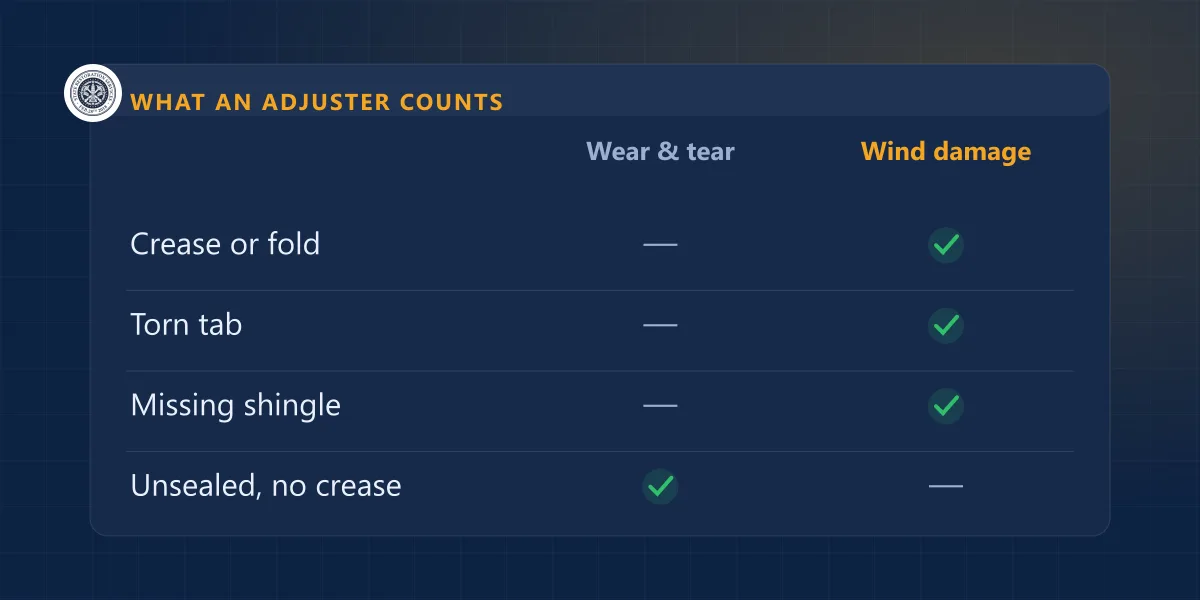
Quick answer: A wind damage roof claim in Illinois gets paid when the shingles carry physical evidence of the storm — a creased or folded tab, a torn tab, or a shingle gone altogether — tied to a dated weather event. Shingles that simply came unsealed with no crease are where claims stall, because many carriers now treat that as age-related wear.
The morning after a straight-line wind event moves through Lake and Cook County, our phone does the same thing every time. Half the callers can see shingles in the yard. The other half can see nothing wrong at all, and somebody has already knocked on the door to tell them the roof is finished. Both groups arrive at the same question about a wind damage roof claim in Illinois: what does the insurance company actually count as damage?
The answer is narrower than most homeowners expect, and it has very little to do with how the roof looks from the driveway. Here is the standard your claim will be measured against, where the industry genuinely disagrees with itself, and what that means for the photographs you take this week.
What does wind damage on a roof actually look like?
Wind damage shows up as physical deformation of the shingle: a crease or fold running across the tab, a tab torn along its edge, or a shingle missing outright. It is rarely spread evenly. It clusters along the rakes, the ridge and the slope that faced the gust, because those are the edges wind can get underneath first.
The crease is the part homeowners never see. When a gust lifts a sealed shingle, the tab folds back over itself, and the asphalt mat cracks along that fold line. Then the tab drops down again and lies more or less flat. From the ground the slope looks fine. From a ladder it still looks fine. The crack is on the underside of the fold, and it usually sits underneath the shingle in the course above — which is why any real wind inspection involves lifting courses by hand rather than photographing the surface.
Once that mat is cracked, the shingle has a hinge in it. It will not re-seal reliably, it flexes in every wind that follows, and water eventually finds the crack. A roof can therefore be genuinely damaged and still photograph perfectly from the street.
| What you see | Points to storm damage | Points to an aging roof |
|---|---|---|
| Pattern on the roof | Concentrated on one or two slopes, worse near rakes and ridge | Even across every slope regardless of direction |
| Shingle condition | Creases, folds, torn tabs, whole shingles gone | Curling at the corners, brittleness, even granule loss |
| Timing | Traceable to one dated storm | Nothing changed on any particular day |
| Rest of the property | Fence panels, screens, branches and neighbors’ roofs hit too | Nothing else on the property is disturbed |
How much wind does it take to damage asphalt shingles?
There is no single number, and anyone who gives you one is guessing. The National Weather Service classifies a thunderstorm as severe at a 58 mph gust, which is the threshold most public storm reports are built around. But a properly nailed, fully sealed architectural shingle survives well past that, while a twenty-year-old shingle whose sealant let go years ago can lose tabs in a 45 mph gust.
The ratings printed on the wrapper come from two different laboratory standards, and they do not mean the same thing. NRCA’s technical write-up of both standards is worth reading if you want the full version.
| Standard | How it tests | Classes | What it assumes |
|---|---|---|---|
| ASTM D3161 | A wall of fans blows air across sealed specimens | Class A — 60 mph Class D — 90 mph Class F — 110 mph | Method dates from the 1950s; ignores building height and exposure |
| ASTM D7158 (2016 edition) | Calculates uplift force against the strength of the seal bond | Class D — Vult to 115 mph Class G — Vult to 150 mph Class H — Vult to 190 mph | Buildings up to 60 ft, ground roughness B or C |
Two things follow from that table. First, the D7158 numbers are ultimate design wind speeds calculated for a building, not a promise about the gust on your street — and the older ASTM D3161 standard says plainly that its results “do not directly correlate to wind speeds experienced in service.” Second, and this is the one that matters for a claim: every one of those ratings assumes the sealant strip has bonded. A shingle installed on a cold December afternoon that never got warm enough to seal has the rating on paper and nothing holding it down, which is why the season a roof was installed in shows up in wind claims years later.
Why do insurers deny wind claims on shingles that clearly lifted?
Because of an evidence standard most homeowners have never heard of. Since 2017, many carriers and the engineering firms they retain have followed the Haag Engineering position that a shingle which is simply unsealed — not creased, folded, torn or missing — is not evidence of wind damage. Under that standard, a slope full of lifted-but-intact shingles gets reclassified as age-related sealant failure and excluded as wear and tear.
Haag ran shingles through a wind simulator built to comply with ASTM D3161 and reported that every shingle which unbonded during testing had, at minimum, a crease. On new, pliable shingles the crease was faint enough that it took close inspection and hand manipulation to find — but it was there. IIBEC published the full argument, and it now turns up, directly or indirectly, behind a great many denial letters.
The policyholder side disputes the physics rather than the testing. Writing on the Property Insurance Coverage Law Blog, Lewis O’Leary points out that Haag tested at speeds several times what a 3-tab seal strip is rated to hold, argues that most 3-tabs give way around 75 mph, and contends that a flexible tab failing at that speed never gets folded hard enough to leave the crease the standard demands. His other point is the practical one: the initial fold line forms hidden beneath the overlapping shingle, not at the visible lap where a quick inspection looks.
We are a roofing company, not a lab, so here is what we will say honestly: both sides are describing something real, and the argument is genuinely unsettled. Sealant strips do fail for reasons that have nothing to do with any storm — manufacturing variation, a cold-weather installation, dust or granules contaminating the strip, and years of thermal expansion and contraction. Research from the University of Florida cited in that IIBEC paper found shingles generally hold their seal for the first four to five years, with unsealing becoming more frequent as the roof ages. On a twenty-year-old roof, the wear-and-tear argument has real teeth.
What all of that means for you is simple and worth acting on: the evidence that decides your claim is under the shingle. A photograph of the top of a lifted tab settles nothing. A photograph of the fold line, taken with the course above held back, is the one that counts.
How do I prove the wind actually hit my house?
Two public sources, used together. NOAA’s Storm Events Database holds the official record for your county by date, including measured and estimated gusts. The nearest airport weather station gives you an actual anemometer reading for that hour. Neither one is your address, but together they establish that a storm capable of the damage happened when you say it did.
For the north and northwest suburbs the three useful stations are O’Hare (KORD), Chicago Executive in Wheeling (KPWK), and Waukegan National (KUGN). Pick the closest one to your street and note the peak gust and the time. Then be honest about the limits of that number in both directions: a downburst can be a mile wide, so 71 mph at O’Hare does not mean 71 mph in Northbrook, and 48 mph at O’Hare does not prove it was calm over your roof either. Treat station data as support for the physical evidence, never as a substitute for it.
| Gather this | Why it matters |
|---|---|
| The storm date, before anything else | The claim is filed against a date of loss; “sometime in June” invites a wear-and-tear denial |
| County entry from the NOAA Storm Events Database | Independent confirmation the event was recorded, with the recorded gust |
| Peak gust from KORD, KPWK or KUGN | A real instrument reading near your town on the day |
| Ground-level photos before anyone climbs up | Shingles in the yard, dented gutters, torn screens, downed branches |
| Photos of the fold line under lifted tabs | The one piece of evidence the whole argument turns on |
Our free inspection produces the last two properly, with the course held back and the damage marked and photographed slope by slope. If you want the wider version of the walk-around first, our storm-damage checklist for Chicago homeowners covers what is safe to check from the ground, and the step-by-step on filing a storm claim in Illinois covers what happens after you call it in.
Will insurance pay for the whole roof or just the damaged slope?
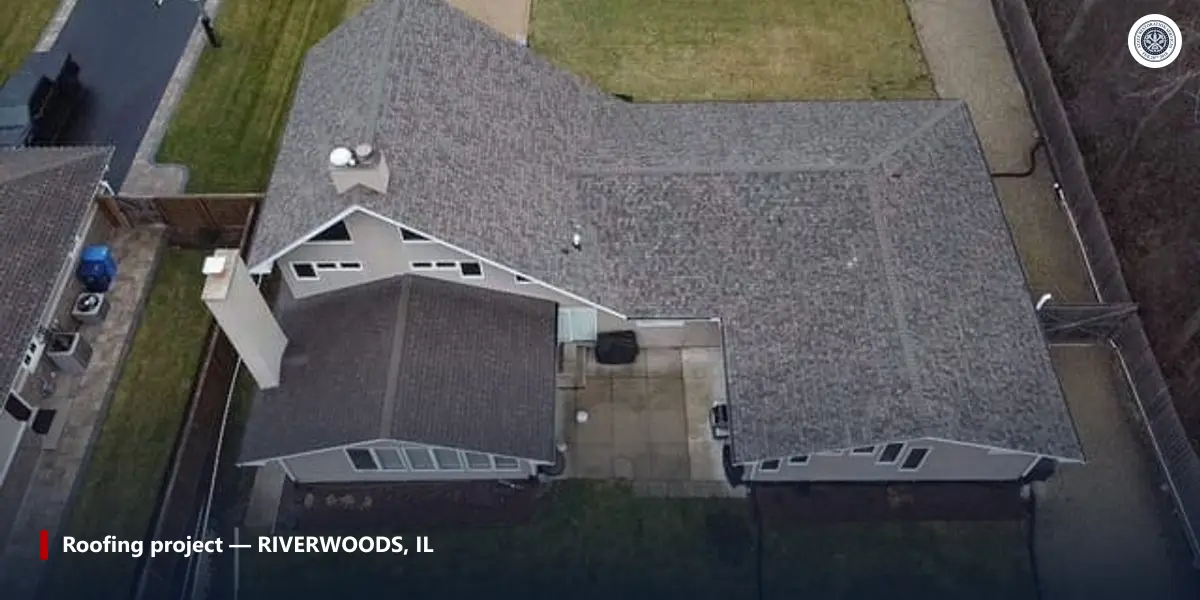
Usually the slope, not the roof. Wind is directional, so the damage lands on one or two elevations and the adjuster’s estimate follows it. A whole-roof outcome almost always rests on a matching argument rather than a damage argument: the shingle is discontinued, and no reasonable match exists for the slopes visible in the same line of sight.
That distinction decides the money, so it is worth understanding before you file. We have written the long version in our guide to shingle color matching on a partial roof claim. The short version is that a twelve-year-old shingle line has usually been revised or dropped, and proving that is a documentation job, not an argument you win by insisting.
Run the deductible math at the same time. A one-slope wind repair on a policy carrying a percentage wind-and-hail deductible can settle for close to nothing once the deductible comes out — our guide to roof insurance deductibles in Illinois explains how the flat and percentage versions differ. We would rather tell you the claim is not worth filing than take you through the whole process to reach that conclusion in six weeks.
What does wind damage repair cost in the Chicago suburbs?
Most wind repairs are genuinely small. Replacing blown-off tabs on one slope typically runs a few hundred dollars, and a repair visit that also re-secures and hand-seals a lifted section usually stays under about $1,200. It is the slope-level and whole-roof work that reaches into real money, and that is where a claim is worth having.
| Scope of work | Typical installed cost | When we recommend it |
|---|---|---|
| Replace blown-off shingles on one slope | $350 – $750 | A handful of tabs gone, everything else sealed and sound |
| Replace creased shingles and hand-seal a lifted section | $450 – $1,200 | Localized creasing on a roof with plenty of life left |
| Re-shingle one full slope (roughly 8 – 12 squares) | $4,000 – $13,000 | Widespread creasing across one elevation |
| Full architectural shingle replacement | $9,000 – $18,000 | Damage on several slopes, or a roof already near the end |
The slope figure is wide for an honest reason: it comes from the $450 to $1,150 per square range in our Chicago-suburbs roof cost guide, and the shingle line, the pitch and the access move it a long way inside that band. We will not price a slope over the phone, because until somebody has counted the squares and looked at the access, the number would be invented.
One more thing worth knowing while you are choosing shingles for the replacement: some manufacturers now tie their strongest wind coverage to installing the full system rather than the shingle alone. GAF’s WindProven limited wind warranty, for example, carries no maximum wind speed for a 15-year term, but only when a LayerLock shingle is installed with four qualifying GAF accessories. That is a real difference between two bids that otherwise list the same shingle, and it belongs in the comparison — our guide to manufacturer versus workmanship warranties covers what each one actually promises.
What we can and cannot do on your wind claim
Illinois law does not allow a roofing contractor to negotiate an insurance claim. So we document the damage, photograph the fold lines, and write a code-compliant estimate you can hand to your carrier — and if the adjuster’s number comes back short, our affiliated licensed public adjuster, State Adjusting Services, can represent you on the claim itself. We are a family-owned company based in Lincolnshire, rated 4.9 stars across 92 Google reviews, and we have been doing residential roofing and storm and insurance work in these suburbs since 2018.
Two practical notes. We keep normal business hours — Monday through Friday, 8:00 AM to 5:00 PM — and for active leaks after a storm we push those calls to the front of the schedule and get out to tarp the roof before a full repair is scheduled. And if somebody knocks on your door the afternoon of the storm offering to “handle the insurance claim” for you, that is worth a second thought — no roofer in Illinois is permitted to do it. Our piece on storm chasers versus a local roofer covers the rest of the checks worth running before anyone signs anything.
Related reading: what hail damage actually looks like on an asphalt roof and what a real free roof inspection covers.
Frequently asked questions
Does homeowners insurance cover wind damage to a roof in Illinois?
Yes. Wind is a covered peril on a standard Illinois homeowners policy. What gets argued is whether the shingles show damage caused by that wind — creased, folded, torn or missing shingles — or whether the condition is age-related sealant failure, which policies exclude as wear and tear.
How long do I have to file a wind damage roof claim in Illinois?
Policies commonly give you one year from the date of loss, and they require prompt notice besides. Read your own declarations page rather than relying on a rule of thumb, and report the storm date, not the date you noticed the damage.
Can wind damage shingles without anything blowing off the roof?
Yes. A gust can lift a tab, break its seal and fold it back before it drops into place looking untouched from the ground. The evidence is the crease at the fold line, which usually sits hidden under the overlapping shingle and only shows when a roofer lifts the course above it.
Will insurance replace my whole roof if only one slope has wind damage?
Usually not on the damage alone. Wind is directional, so the estimate follows the slope that took the hit. A whole-roof outcome normally rests on a matching argument, meaning the damaged shingles are discontinued and no reasonable match exists for the slopes in the same line of sight.
Had wind through your neighborhood? Book a free inspection or call (866) 992-2982 — we serve the north and northwest Chicago suburbs, and we will tell you honestly whether you have a claim before you file one.