
 Volodymyr Lukaniuk

Detached garage roof hail damage is covered by a standard homeowners policy, but not from the same pocket as the house. A garage that stands apart from the house falls under Coverage B, other structures, which is usually capped at 10 percent of the dwelling limit. Hail on the house and the garage in the same storm is one claim with one deductible taken from the total. For a garage roof the cap is rarely what hurts. The deductible is: a 1 or 2 percent wind and hail deductible on a $400,000 house is $4,000 or $8,000, and a whole garage roof often costs less than that.
Below is the policy wording that decides which pocket your garage is in, one storm run through the claim line by line, the garage-only claim tested against three deductibles, the garages a policy leaves out, and what to photograph before anyone comes to look.
Is your garage under Coverage A or Coverage B?
The standard homeowners form, the ISO HO 00 03 that most carriers' policies are built on, draws the line with two sentences:
"We cover other structures on the "residence premises" set apart from the dwelling by clear space."
ISO Homeowners 3 Special Form HO 00 03 10 00, sample policy published by the Insurance Information Institute, Section I, Coverage B
The next sentence of the form keeps a building in Coverage B when the only thing linking it to the house is a fence, a utility line or something like them. Coverage A, on the other hand, covers the dwelling "including structures attached to the dwelling". So what decides it is open air between the two buildings, whatever you call the garage. On the lots we see from Norridge to Mundelein, the layouts sort out like this:
- Free-standing garage at the back of the lot
- Clear space on every side, usually an alley or a driveway between it and the house.Coverage B
- Garage linked by a fence, a gate or an overhead wire
- The form names a fence and a utility line as connections that do not make it attached.Coverage B
- Garage joined by a roofed breezeway or a deck
- Experts at FC&S, the insurance industry's coverage reference, answered a subscriber's question about a garage that a new deck tied to the house: in their view the deck is not a connection like a fence, and the garage becomes part of the dwelling. Your carrier may see your layout its own way, so ask before you assume.Likely Coverage A
- Garage sharing a wall or a roof with the house
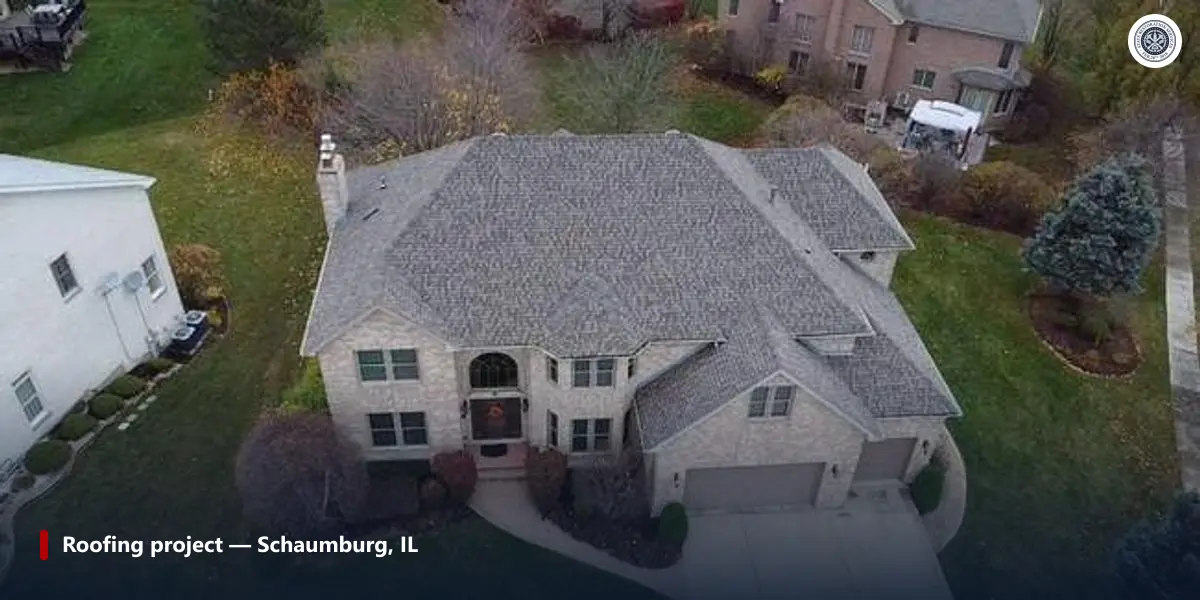
- Built as one structure, with the same roof running over both, like the house in the photo further down.Coverage A
The difference is more than a label. Under Coverage A the garage draws on the full dwelling limit. Under Coverage B it shares a smaller pocket with the fence, the shed and anything else standing apart on the lot.
One storm, three structures, one deductible
Say a June hailstorm crosses a lot with a house insured for $400,000, a detached two-car garage and a wood fence along the back. The adjuster finds hail damage on both roofs, dents in the garage gutters and two broken fence sections. This is how that claim adds up on the standard form:
| What the hail hit | Part of the policy | How it is valued | Amount |
|---|---|---|---|
| House roof, hail | Coverage A, dwelling | Replacement cost | $16,000 |
| Garage roof, 6 squares | Coverage B, other structures | Replacement cost (it is a building) | $4,800 |
| Garage gutters, 44 feet | Coverage B, other structures | Replacement cost, part of the garage | $440 |
| Wood fence, two dented sections | Coverage B, other structures | Actual cash value (not a building) | $700 |
| Total of all covered loss | Section I, both coverages added | One sum | $21,940 |
| Deductible, flat $1,000 | Taken once, from the total | One storm, one deductible | -$1,000 |
| Owed on the claim | Coverage A and B together | Depreciation paid after the repair | $20,940 |
A made-up storm on a house insured for $400,000, so the garage pocket is $40,000. Roof prices use our published range of $450 to $1,150 per square installed, gutters our $6 to $14 per foot. The fence figure is its depreciated value, not the price of new boards.
Two lines of the form explain the bottom of that table. The deductible clause says the carrier pays "only that part of the total of all loss payable under Section I that exceeds the deductible amount", so the house and the garage are added together and the deductible comes off once. And the loss settlement condition pays "structures that are not buildings" at actual cash value, while "buildings covered under Coverage A or B" are settled at replacement cost. That is why the garage roof gets the price of new shingles and the fence gets its worn value.
Replacement cost still arrives in two pieces. Until the roof is actually replaced, the carrier pays the depreciated amount and holds the rest back; our article on keeping the roof insurance money without fixing the roof follows that holdback forward. Many policies also carry a roof endorsement that pays older roofs at actual cash value or on a schedule, and it applies to the garage roof as much as the house roof.
When only the garage roof is hit
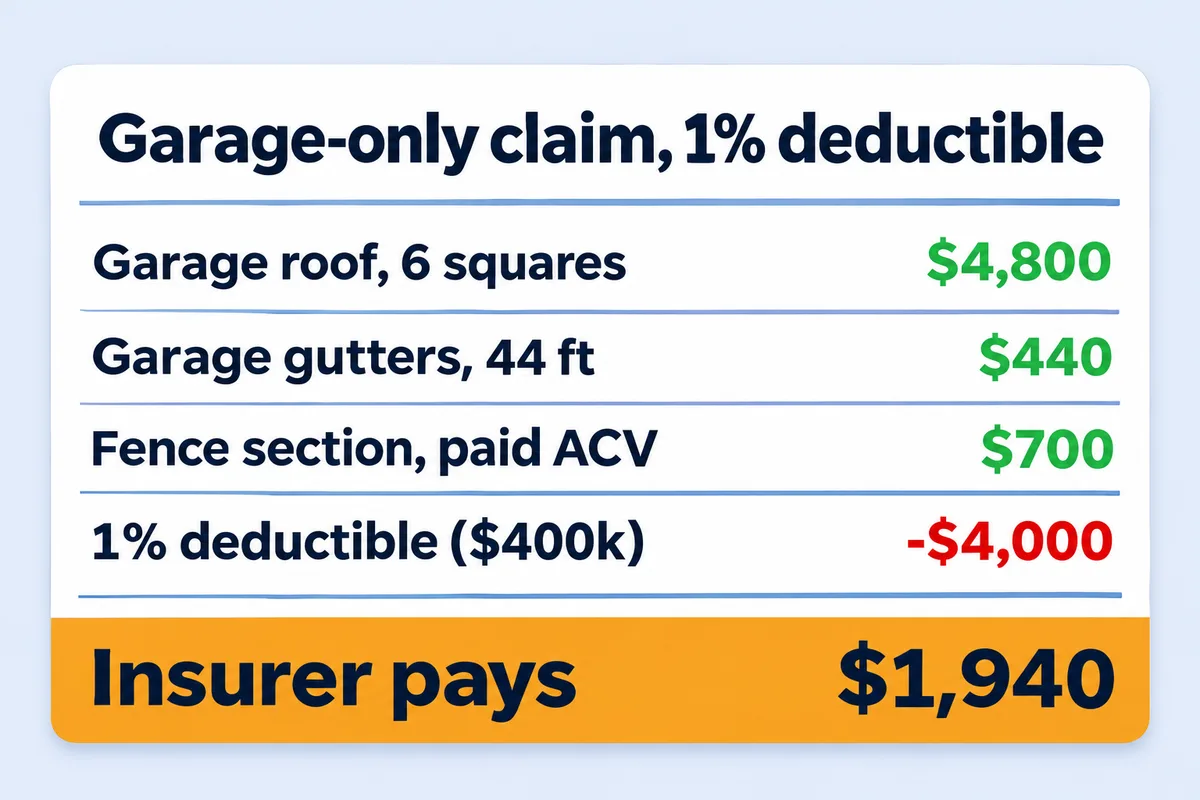
Hail falls in narrow bands, and a garage roof facing the storm can take damage while the house roof, a few yards away and at a different pitch, comes through with little. Then the claim is the garage alone, and the deductible decides almost everything. Take the same garage, gutters and fence, $5,940 in all, and run it against three deductibles:
| Flat $1,000 | 1% of $400,000 | 2% of $400,000 |
|---|---|---|
| $4,940paid on $5,940 | $1,940after $4,000 | $0$8,000 is more than the loss |
A percentage deductible is figured on the dwelling limit, not on the garage's 10 percent, which is why it can be larger than the whole garage claim. Our guide to your roof insurance deductible in Illinois shows where to find the percentage on the declarations page and how it turns into dollars.
Two things change the math. Gutters dented by hail on the garage count toward the same total, and our article on hail damage to gutters and downspouts explains which dents get paid. And if the house roof was hit too but nobody looked, the claim is smaller than the storm was, so it pays to have both roofs checked before deciding.
When the 10% limit runs out
The form caps Coverage B at "not more than 10% of the limit of liability that applies to Coverage A", and adds that "use of this coverage does not reduce the Coverage A limit". On a $400,000 house that is $40,000 for every structure standing apart, all together.
Hail on a garage roof does not come close to that. A detached two-car garage roof is typically 5 to 8 squares, which at our installed range of $450 to $1,150 per square runs from about $2,250 to $9,200. The limit becomes a real number when the garage is lost, not dented: a tree through the roof and the walls, a fire, or a new garage the size of a small house plus a long fence. Our article on a tree falling on your roof walks through that kind of bill. If your detached garage would cost more to rebuild than the Coverage B figure on your declarations page, the time to raise it with your agent is before the next storm.
Garages the policy leaves out
The same Coverage B section lists structures it does not cover at all, and a few of them fit suburban garages:
- A garage rented to someone who is not a tenant of your house, unless it is used only as a private garage. Renting a parking space keeps it covered; renting it as a workshop to a neighbor does not.
- A garage from which a business is run, such as a home auto repair shop or a woodworking business that sells its work.
- A garage used to store business property, with an exception for business property owned by you or a tenant of the house, as long as it is not gasoline or other fuel outside a vehicle's own tank.
The form's definition of business leaves out small side activities that earned no one in the household more than $2,000 in the 12 months before the policy started. Anything bigger is a conversation for your agent, ideally before a claim.
What to photograph and measure on the garage
A garage roof is easier to document than a house roof: it is lower, often visible from the alley, and usually one or two simple slopes. Before anyone comes out:
- Photograph the garage from all four sides with the date stamp on, then the gutters and downspouts up close, where hail leaves round dents in the metal.
- Look at anything soft and metal on or near the garage: the roof vent, the downspouts, the light fixture over the door, a mailbox. Fresh dents there are the easiest evidence that hail hit this building.
- Pace the garage outside walls and write down the size; that is how a carrier's estimate is checked.
- Photograph the fence sections and the gate separately from the garage. They are valued differently and belong on their own lines.
- Note the date of the storm and keep the garage door closed if any shingles are missing, so wind cannot get under the roof.
On a free inspection we look at both roofs on the same visit and document the garage as its own building, with its own measurements, photos and estimate lines for the roof, the gutters and the vents. That keeps the Coverage A and Coverage B parts of the claim from being mixed into one number. The repair itself is the same work as on any residential roof we do, with new seamless gutters where the old ones are dented. Illinois law does not let a roofer negotiate a claim, so if you want someone in your corner on the claim, our partner, the licensed Illinois public adjuster State Adjusting Services, can represent you; our storm and insurance page explains how that works.
Frequently asked questions
Do I pay two deductibles if hail damages my house and my detached garage?
No, not on the standard homeowners form. The deductible is taken once from the total of all the covered loss on the property from that storm, so the house roof and the garage roof are added together first. Check your declarations page for a separate wind and hail deductible, because that one, not the flat amount, is the figure taken when the damage is from hail.
Is a detached garage roof paid at replacement cost or actual cash value?
On the standard form a garage is a building, and buildings under Coverage A or B are settled at replacement cost, with the depreciated part held back until the work is done. Structures that are not buildings, such as a fence, are paid at actual cash value. Some policies change this with a roof endorsement that pays older roofs at actual cash value or on a schedule, so read your own policy for that line.
Does a claim on the garage reduce the coverage on my house?
No. The standard form says using Coverage B does not reduce the Coverage A limit. The garage, the fence and any shed share one pocket, usually 10 percent of the dwelling limit, and the house keeps its own full limit.
Should I file a claim if only my garage roof was hit by hail?
Work out the deductible in dollars first. If the policy has a 1 or 2 percent wind and hail deductible, multiply it by the dwelling limit; on a $400,000 house that is $4,000 or $8,000, and a garage roof with its gutters often comes in under that. If the damage is close to the deductible, get the roof measured and estimated before you call the carrier, so the decision is made on numbers.
Related reading: how to find the date of the hail storm that hit your roof and whether to file a roof claim or pay for the repair yourself.
If hail went through your yard and you want both roofs looked at before you call the carrier, book a free inspection online or call the office at (866) 992-2982. We answer seven days a week: weekdays from 7:00 AM to 7:00 PM, weekends from 9:00 AM to 5:00 PM, and our crews work across the north and northwest Chicago suburbs.