
 Volodymyr Lukaniuk
Can you keep the insurance money and not fix the roof? In most cases the first check is yours to spend, unless your mortgage company is named on it. But that check is only the actual cash value: the cost of a new roof minus your deductible and minus depreciation for the roof's age. On a replacement cost policy, the depreciation is held back until the work is done, so not fixing the roof means leaving that part with the insurer for good. And the hail damage they paid for stays on your roof, where it comes back at the next storm, at renewal and when you sell.
We inspect a lot of roofs in the north and northwest suburbs that were paid out on two or three summers ago and never touched. Sometimes it was a tight year, sometimes a door-knocker took a deposit and vanished, sometimes the roof looked fine from the driveway and the money went to the kitchen. None of that is illegal. It just has costs that nobody mentions when the check arrives, so here they are in the order they show up.
What the policy says about a roof you never repair
Most Illinois homeowners policies are built on the standard ISO HO 3 form or something close to it. Its Loss Settlement condition is short and blunt about this:
"We will pay no more than the actual cash value of the damage until actual repair or replacement is complete. Once actual repair or replacement is complete, we will settle the loss as noted in 2.a. and b. above."
ISO HO 00 03 10 00, Section I Conditions, C. Loss Settlement 2.d, from the sample policy published by the Insurance Information Institute
The same paragraph has one exception: if the whole repair is under $2,500 and under 5% of your dwelling limit, the insurer pays the full replacement cost whether you fix it or not. A full hail roof is almost never that small. The next paragraph, 2.e, lets you take actual cash value now and claim the rest later, "provided you notify us of your intent to do so within 180 days after the date of loss." Your carrier's own form may use a different number of days, so read yours. How the held-back money is released once the work is done is in our guide to recovering depreciation on an insurance claim.
One made-up hail claim, two checks
Take a 15-year-old asphalt roof, a hail claim with a replacement cost estimate of $16,000, a $1,500 deductible and $5,500 of depreciation. These numbers are an example, not a quote; your estimate will have its own.
Check one, paid now
$9,000$16,000 minus the $1,500 deductible minus $5,500 depreciation. This is the money people mean when they ask about keeping it.
Check two, only after the work
$5,500Released when the roof is replaced and the carrier sees the final invoice. Skip the roof and this check never comes.
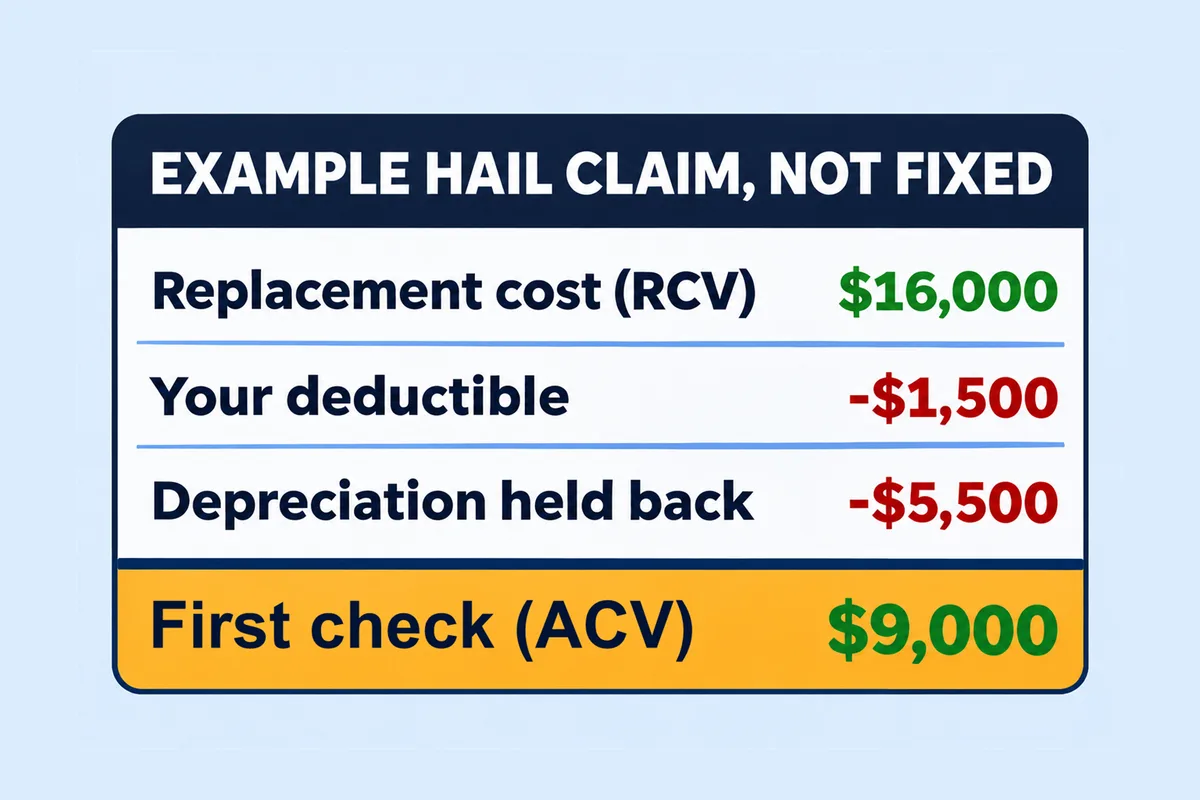
So keeping the money really means keeping $9,000 of a $14,500 settlement and still owning a hail-damaged roof. If a lender is on the check, you may not even have the $9,000: most mortgages require the money to go into the repair, which our article on the mortgage company on the roof insurance check walks through.
Four moments when the unrepaired roof comes back
- Months after the storm
The depreciation deadline passes
Once your policy's window closes, the held-back money is gone even if you replace the roof the following year. A new roof then comes entirely out of your pocket, at whatever prices are by then.
- The next hail storm
The new claim is measured against the old one
The adjuster has the first claim file, with photos of the slopes that were already paid for. Coverage editors at FC&S, asked about a roof that was paid for and never replaced before a second storm, answered that the insurer pays just the gap between what the second loss is worth and what the first settlement already covered (their answer). That is an expert opinion on one policy, not an Illinois rule, but it is how the conversation usually goes. On a roof that was already scheduled for replacement, the second storm may add very little.
- Renewal
An insurer's inspection or aerial photo flags the roof
Carriers look at roofs from the air now, and a roof with visible damage they already paid for is the easiest non-renewal there is. Your notice and appeal rights in that case are in our article on insurance non-renewal because of the roof.
- When you sell
The disclosure form asks about the roof
The Illinois Residential Real Property Disclosure Report has the seller answer "I am aware of leaks or material defects in the roof, ceilings, or chimney" (765 ILCS 77/35). Paid-for hail damage is something you know about, and a buyer's inspector or insurer can find the claim on their own. What happens to open claims at closing is covered in selling a house with an open roof claim.
Second storm on an unrepaired roof: what the adjuster sorts out
When we inspect a roof that has had two storms, the shingles tell both stories. Old hail bruises have lost granules and weathered at the edges; fresh ones are dark, clean and soft to the touch. This is what each side looks at:
| On the roof | What the adjuster asks | What helps you |
|---|---|---|
| Hits already in the first claim photos | Were these paid for before? | Nothing changes them; they were settled once |
| Fresh hits with clean, dark centers | Do they match the new storm date and hail size? | Dated photos, the storm record for your street (see finding your date of loss) |
| A leak and a ceiling stain | Did water come through old damage you left open? | Proof of when the stain appeared and where the water came in |
| Dented gutters, vents and downspouts | Are the dents new, or in the old photos? | Close-ups with a coin or tape for size |
This is where a dated inspection report from before the second storm earns its keep. When we look at a roof, the photos are timestamped, slope by slope, so later nobody has to guess which damage came when.
Is keeping the money insurance fraud?
Taking the actual cash value and not repairing is not fraud by itself; the policy plainly allows it. The line is lying about it. The same ISO form takes coverage away from anyone who has "intentionally concealed or misrepresented any material fact or circumstance" or "made false statements" relating to the insurance (Section I Conditions, Q. Concealment Or Fraud). In practice, that means three things to stay away from:
- Asking for the depreciation on work that was not done
- An invoice for a roof that is not on the house is a false statement, whoever wrote it.
- Telling the next adjuster the roof is new or was repaired
- The first claim file has the photos; the story will not survive the comparison.
- Marking "no" on the roof line of the disclosure form
- The form defines "aware" as "actual notice or actual knowledge", and its definition of a material defect only lets you off when you reasonably believe the condition "has been corrected". A roof you chose not to fix has not been.
If you still want the roof done
- Find the repair deadline in your policy's Loss Settlement condition, and if it is close, write to the carrier before it passes and ask in writing whether it can be extended.
- Get the roof inspected and photographed now, so the old damage is on record before winter or the next storm adds to it. You can book a free inspection with us.
- Price the job against the actual cash value you already have. Our roof replacement page lists the GAF, Owens Corning and IKO systems we install, and financing can cover a gap.
- If the claim itself is the problem, Illinois law does not let a roofer negotiate it. Our partner, the licensed Illinois public adjuster State Adjusting Services, can represent you with the insurer, and our storm and insurance page shows how we work alongside a claim.
Frequently asked questions
Can I keep the insurance money and not fix my roof in Illinois?
Usually you can keep the first check, the actual cash value, unless your mortgage company is on it or your policy says otherwise. On a replacement cost policy you give up the depreciation that is held back until the work is done, and the damage you were paid for stays on the roof, so the next storm claim, the renewal and the sale all have to deal with it.
How long do I have to replace the roof and still get the depreciation?
It depends on your policy, so read your own Loss Settlement condition or ask the carrier in writing. The ISO sample homeowners form gives 180 days after the date of loss to tell the insurer you intend to claim the replacement cost after taking actual cash value. Many carriers print their own deadline, and some will extend it if you ask before it runs out.
Will insurance pay again if hail hits the same unrepaired roof?
They pay for new damage from the new storm, but not twice for damage they already paid on. Coverage editors at FC&S, answering a question about a roof that was paid for and never replaced, said the insurer pays just the gap between the second loss and what the first settlement already covered. Expect the adjuster to compare the roof to the first claim file.
Do I have to tell a buyer the roof had an insurance claim that was never fixed?
The Illinois disclosure report asks the seller to mark whether they are aware of leaks or material defects in the roof, ceilings or chimney. Hail damage you were paid to fix and did not fix is something you know about. A buyer's inspector or insurer can also find the claim and the old damage on their own.
Sitting on a check and an old hail claim? Call us at (866) 992-2982, Monday to Friday 7:00 AM to 7:00 PM and Saturday and Sunday 9:00 AM to 5:00 PM, or send us a message. We work across the north and northwest Chicago suburbs.