
 Volodymyr Lukaniuk
A standard homeowners policy in Illinois usually covers ice dam damage to the house itself: the wet roof decking, the soaked attic insulation, the stained ceiling and the paint under it. It usually does not pay to chip or steam the ice off a roof that is not leaking yet, and it pushes back hardest when the roof was already worn out or the leak ran for weeks. The surprise most people meet is the furniture. On the standard form, a rug ruined by meltwater has no obvious line to be paid under. Below we follow one ice dam leak downhill, from the eave to the living room, and show at each stop which sentence of the policy decides who pays.
We are a roofing company, not an insurer or a lawyer, so read this as a map of the standard form and not as a ruling on your policy. The quotes come from the ISO homeowners form HO 00 03 10 00, the base many carriers build their own policy on, in the sample published by the Insurance Information Institute. Your declarations page names the form you actually have, and your carrier may have changed the wording.
Where the meltwater goes, and who pays at each stop
An ice dam forms when heat from the house melts snow on the upper roof and the water freezes again at the cold eave. The water that backs up behind that ridge of ice works its way under the shingles and then keeps going down. Each place it reaches is a separate question for the adjuster.
-
The ridge of ice on the eave
Usually your billIce sitting on the shingles has not damaged anything yet, and the policy pays for direct physical loss, not for upkeep. Raking the snow off and paying someone to steam the ice away before it leaks is yours.
Once water is already coming in, cutting a channel through the ice so the leak stops is a step to protect the house. The form pays "the reasonable cost incurred by you for the necessary measures taken solely to protect covered property". Ask the adjuster before you pay, and keep the invoice.
-
Shingles, underlayment and roof decking
Usually paidThe house is insured against "risk of direct physical loss", which means the insurer has to point to an exclusion to say no. The freezing and ice exclusion on the standard form names fences, patios, pools, foundations, retaining walls and docks. The roof is not on that list.
The fight here is age. Shingles that were curled, cracked or missing before the winter run into the wear and tear exclusion, and the adjuster may pay the inside damage while refusing the roof.
-
Gutters, fascia and soffit
Usually paid if the ice tore themA gutter pulled off its hangers by a foot of ice is a sudden loss to the dwelling, and gutters are not on the freezing exclusion list either. The fascia board behind it and the soffit that took the water go on the same line.
A gutter that was already rusted through or sagging is where the "rust or other corrosion" exclusion comes in. A photo of the run from the fall helps more than anything you can say in January.
-
Attic insulation, ceiling and walls
Usually paid if it was suddenWater that came through the deck and wet the insulation, the drywall and the paint is damage to the dwelling, and it is the biggest part of most ice dam claims.
Mold is the catch. The form gives hidden mold back only when the water came from plumbing, heating, air conditioning, a sprinkler or an appliance, and it states that a gutter or downspout does not count as plumbing. Mold from an ice dam leak is therefore usually yours, which is why drying fast matters.
-
Furniture, rugs and everything else you own
The weak spot, ask before winterYour belongings are covered only for a named list of causes, and none of them plainly fits meltwater that crept under the shingles. The next section shows why.
The four sentences in the policy that decide an ice dam claim
If you only read four lines of your policy before the snow comes, read these. They are quoted from the sample form; look for the same words in yours.
- "We insure against risk of direct physical loss to property described in Coverages A and B."
- This is the opening of the coverage for the house and the garage. Water getting in under the shingles is a physical loss, so it is covered unless the insurer can name an exclusion that fits. You do not have to prove the ice dam was a listed cause.
- "Freezing, thawing, pressure or weight of water or ice, whether driven by wind or not, to a: (a) Fence, pavement, patio or swimming pool;"
- The list goes on to footings and foundations, retaining walls and piers. It is the sentence people half remember as "ice damage is excluded". Read to the end and you will see it names the things around and under the house, not the roof and not the gutters.
- "(a) Wear and tear, marring, deterioration;" and "(c) Smog, rust or other corrosion, or dry rot;"
- These are the lines a denial for an old roof or a rotted fascia rests on. They are also why a leak that shows up on a ceiling you have been ignoring since last February is harder to get paid than one you report the week it appears.
- "a plumbing system or household appliance does not include a sump, sump pump or related equipment or a roof drain, gutter, downspout or similar fixtures or equipment"
- This sentence sits inside the mold exclusion. It keeps water from the roof and gutters out of the hidden mold exception, so mold that grows behind wet drywall after an ice dam leak stays excluded on the standard form.
If the claim turns on one of these lines and the insurer reads it differently from you, Illinois does not let a roofing contractor argue it for you. Our partner, the licensed Illinois public adjuster State Adjusting Services, can represent you with the insurer. Our page on whether homeowners insurance covers a roof leak walks through the wear and tear argument in more detail.
Why a rug soaked by ice dam water may not be paid
The coverage for belongings, Coverage C, works the other way round from the house: it pays only for the causes it lists. Three of them sound close to an ice dam, and each one misses on the standard form.
- Windstorm or hail does not pay for rain or snow getting inside "unless the direct force of wind or hail damages the building causing an opening in a roof or wall". An ice dam opens nothing; the water goes under shingles that are still in place.
- Weight of ice, snow or sleet means weight "which causes damage to property contained in a building". It fits a ceiling that comes down under a load. It does not describe water dripping onto a couch.
- Accidental discharge or overflow of water covers water from plumbing, heating and similar systems, and the form again says a roof drain, gutter or downspout is not one of them.
Carriers do not all read this the same way, and many write their own forms with different wording. The point is to find out now, from your agent and in writing, and not in January with a wet rug in the driveway.
The question to send your agent: "If an ice dam leaks into the house, does my policy pay for damaged personal property, and under which peril?"
What the adjuster weighs, and what you can show
Most ice dam disputes are not about whether ice dams are covered. They are about whether this leak was sudden or the end of a slow problem.
| What the adjuster weighs | Why it matters on the form | What you can show |
|---|---|---|
| Age and condition of the shingles | Wear and tear and deterioration are excluded | The install invoice or permit date, and photos of the roof from before the snow |
| How long the water came in | The form asks for "prompt notice", and a stain that grew for weeks reads as neglect | Dated photos of the first stain and the date you called the insurer |
| Whether you protected the house | Reasonable Repairs pays for protective steps; skipping them can count against you | Receipts for buckets, a tarp, ice steaming, fans and drying |
| Gutters torn by ice or rusted through | Sudden damage is covered; corrosion is excluded | Close photos of the bent hangers and torn seams, with the ice still in the trough if you can get it |
One more number to check before you file: your deductible. If the repair comes in under it, the claim pays nothing and still goes on your record. Our guide to how the roof deductible works in Illinois shows how to read a flat or percentage deductible on your declarations page.
The first day of an ice dam leak, in order
- Catch the water and move what you can out of the way.Buckets, towels, furniture pulled back from the wall. If the ceiling sags with water, keep everyone out of that room.
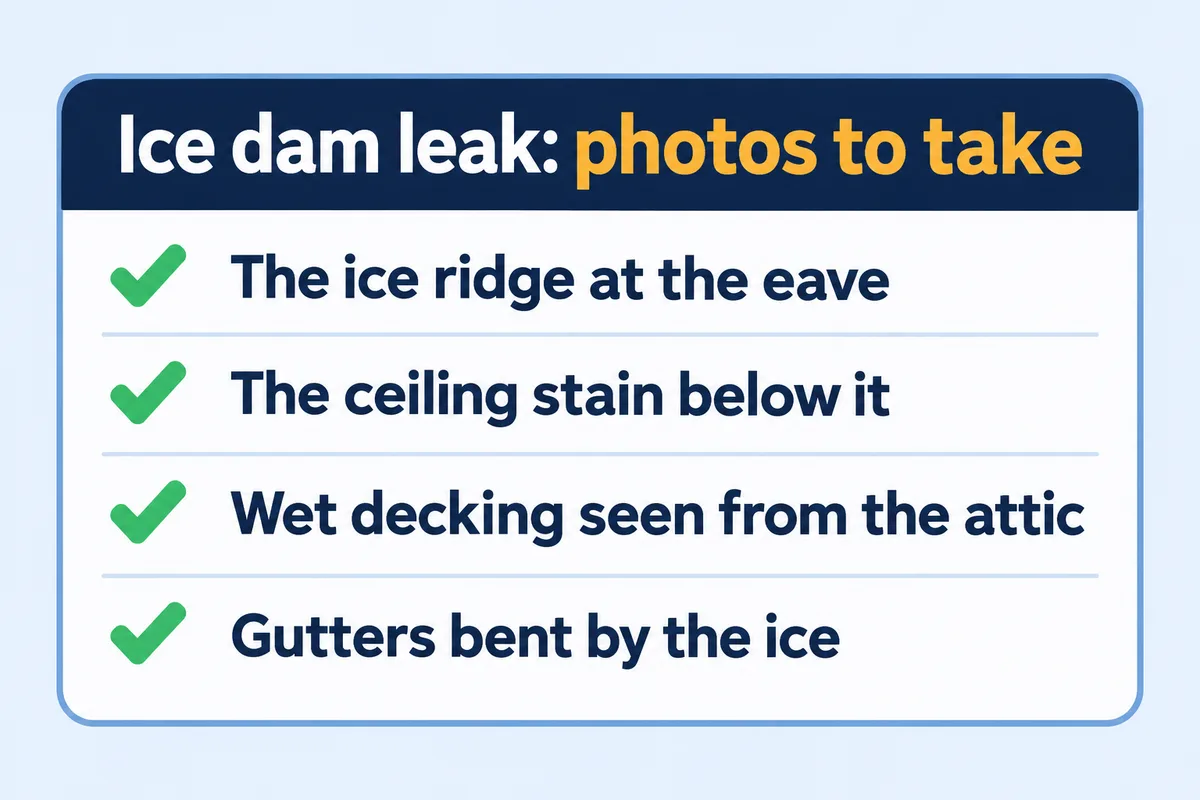
- Photograph the ice from the ground and the stain from inside, with the date showing.Get the ridge of ice, the icicles, any gutter pulled away, and the attic side of the leak if you can reach it safely.
- Stay off the roof and leave the axe in the garage.Chopping at ice cracks shingles and tears gutters, and damage you did yourself is not part of the claim.
- Call your insurer, open the claim and write down the number.Ask whether steaming a channel through the ice to stop the leak counts as a protective repair under your policy.
- Get the wet insulation and drywall dried within days.A water mitigation company handles the inside. Mold from roof water is usually excluded, so speed is what protects you here.
- Have the roof inspected once the ice is gone and get a written estimate.We document the eave, the decking and the gutters with photos and measurements and write a code-compliant estimate you can give the adjuster.
What we look at on the roof after an ice dam claim
An ice dam leak tells us two things about a roof: heat is escaping into the attic, and the eave is not sealed against water that backs up. The inside repair fixes neither, so we check both.
At the eave we look for ice-and-water shield, the self-sealing membrane that goes under the shingles at the edge. The International Residential Code (section R905.1.2) calls for it where ice has a history of forming, from the edge of the roof to at least 24 inches inside the outside wall. We note whether it is there and how far up it runs, because that decides what the new roof must include. If the claim pays for a roof replacement and the village requires the membrane on the new roof, that cost is a code item, which our page on code upgrades on a roof claim explains.
In the attic we look at the ventilation and at the warm spots that melt the snow in the first place: bath fans, the attic hatch, can lights, the chimney chase. Our guide to why ice dams form and how to stop them covers that half. And if the ice bent the gutters, we replace the run with seamless gutters as part of the same job.
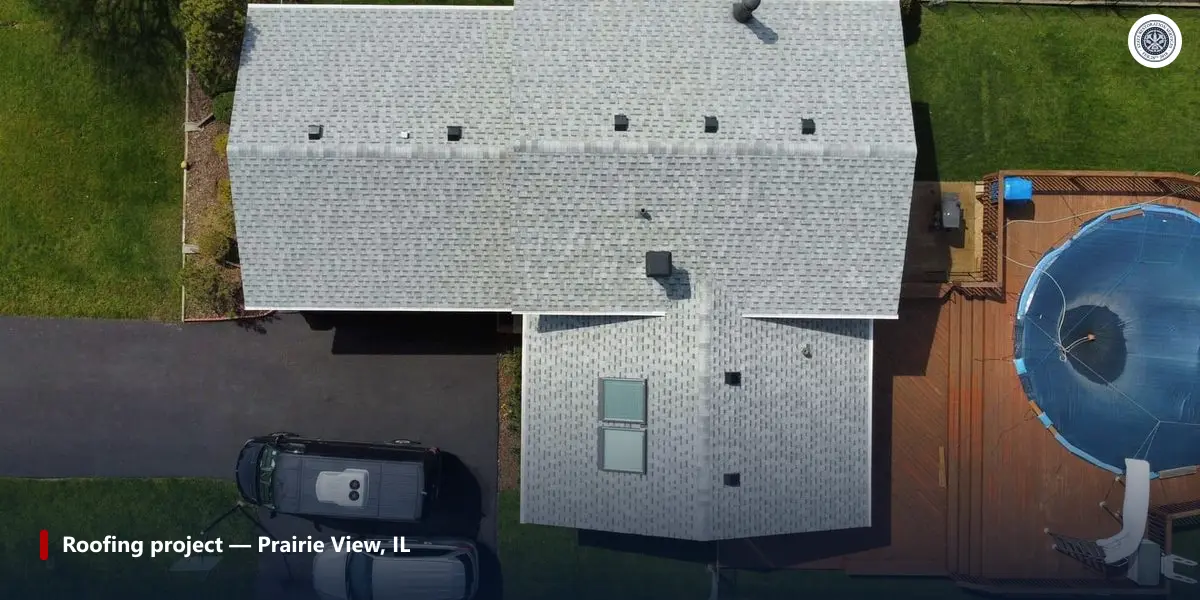
On a roof like the one above, with eaves at several heights, we check every eave and not only the one over the stain. Ice tends to build where a lower roof meets a taller wall and under skylights, and a second leak often starts there a winter later.
Questions homeowners ask us about ice dams and insurance
Does homeowners insurance pay to remove an ice dam?
Not as upkeep. Ice sitting on the eave has not damaged anything yet, and the policy pays for direct physical loss. Once meltwater is coming inside, getting a channel steamed through the ice so the leak stops is a step to protect the house, and the standard form pays the reasonable cost of necessary measures taken solely to protect covered property from further damage. Ask your adjuster before you pay for it and keep the invoice.
Will insurance pay for gutters torn off by ice?
Usually, when the weight of the ice pulled them down. The gutters are part of the dwelling, and the freezing, thawing and weight of ice exclusion on the standard form lists fences, patios, pools, foundations, retaining walls and docks, not gutters. The argument comes when the gutters were already rusted through or hanging loose before winter, because wear and tear and corrosion are excluded.
Is mold from an ice dam leak covered?
Usually not on the standard form. Mold is excluded, and the exception that gives hidden mold back applies only to water from plumbing, heating, air conditioning, sprinkler systems or household appliances. The same form says a roof drain, gutter or downspout does not count as plumbing. That is why the wet insulation and drywall should be dried or pulled out within days, not weeks.
Can I still claim ice dam damage from last winter?
Possibly, but late notice is the weak spot. The standard form asks for prompt notice after a loss, and its suit clause gives two years from the date of loss to sue, which some carriers shorten. The longer a stain sat, the easier it is for the insurer to call it repeated leaking or neglect. Report it now with whatever dated photos you have.
Related reading: how much snow a roof can hold and when to rake it and how attic heat wears out shingles.
Seeing icicles thick as your arm, or a brown ring spreading on the ceiling? Phone (866) 992-2982, seven days a week (weekdays 7:00 AM to 7:00 PM, weekends 9:00 AM to 5:00 PM), or pick a time for a free inspection online. A house that is leaking right now goes to the top of our list.