
 Volodymyr Lukaniuk
Quick answer: Code upgrade coverage (often called Ordinance or Law coverage) pays for building-code work your insurer's first estimate usually skips — drip edge, extended ice-and-water shield, a full tear-off past two shingle layers, or attic ventilation fixes. Most Illinois policies include a base amount, often around 10% of your dwelling limit, but you usually have to ask for it by name.
If your adjuster's first estimate for a storm-damaged roof came back short, code upgrade coverage might be why. Building code has changed more than once since a lot of Chicago-suburb roofs were last replaced, and the software adjusters use doesn't know your roof needs to catch up unless someone tells it. We see this gap on real claims constantly: the policy actually covers the code items, but nobody wrote them into the estimate, so the check comes in short of what the job legally requires.
What does "code upgrade" mean on a roof claim?
It means work your roofer is required to do by current building code, not by choice — things the code didn't require when your roof was last installed. On a covered claim, your policy's Ordinance or Law provision, usually just called code-upgrade coverage, is what pays for that extra, code-mandated work.
Most of the north and northwest Chicago suburbs enforce a version of the International Residential Code (IRC) with local amendments, and that code gets revised roughly every three years. A roof that was last replaced under an older cycle can be missing items the current code now requires — not because the original job was done badly, but because the rulebook moved. When a storm forces a replacement today, the new roof has to meet today's code, and your policy's code-upgrade provision is what's supposed to cover that gap.
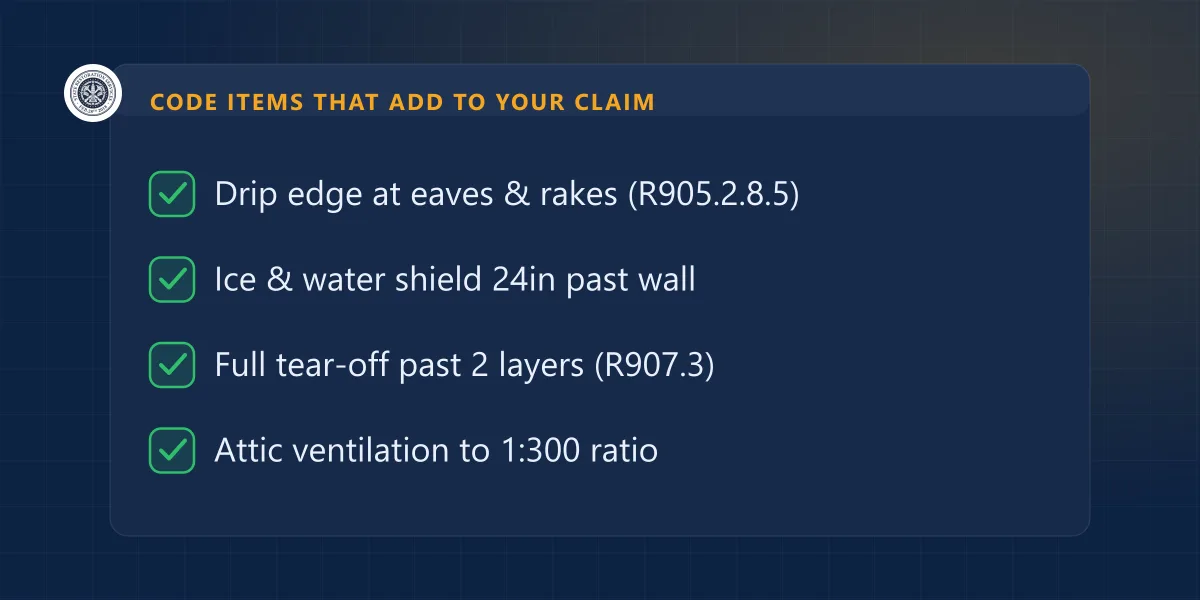
| Code item | IRC reference | Why it's often missing | Typical added cost |
|---|---|---|---|
| Drip edge at eaves & rakes | R905.2.8.5 | Added in a newer code cycle; many pre-2015 roofs never got it | $300–$600 |
| Ice-and-water shield 24 in. past the interior wall | R905.1.2 | Older roofs used a shorter run, or none at all | $400–$900 |
| Full tear-off once two layers are already down | R907.3 | Code caps re-roofing over existing layers at two | $1,500–$3,000+ |
| Attic ventilation to a 1:300 (or 1:150) ratio | R806.2 | Older homes were vented to whatever the builder felt like | $500–$1,200 |
Those are typical Chicago-suburb ranges, not a quote for your roof — your roof replacement inspection and your municipality's current code determine what actually applies to your house.
Does your Illinois homeowners policy include code-upgrade coverage automatically?
Most do, at a modest level — commonly 10% of your dwelling (Coverage A) limit — built into the policy without a separate line item. Some carriers exclude it by default and sell it as an endorsement instead. Either way, it only pays out on a covered loss, and only for work code actually requires.
Check your declarations page for "Ordinance or Law" coverage, or call your agent and ask directly — it's easy to miss because it rarely gets its own page in the policy packet. If your home is older or you've already had one re-roof over the original layer, ask whether a higher limit is available; some carriers offer 25% or 50% of Coverage A as an upgrade, which is worth the extra premium once you've seen how fast a full tear-off eats a base 10% allowance.
| Coverage level | What it typically means |
|---|---|
| Not included | Some older or bare-bones policies exclude it entirely — code items come out of pocket |
| Standard / base | Roughly 10% of Coverage A, bundled into most current HO-3 policies at no extra line item |
| Increased endorsement | 25–50% of Coverage A, worth asking about on an older home with unresolved code items |
Why code items get missed on the adjuster's first estimate
Insurance adjusters write initial estimates in software (usually Xactimate) that only adds a line item when someone tells it to. If the roofer's estimate doesn't cite the specific code section and the municipality requiring the work, the code items often never make it into the first number — and the homeowner accepts a short check without knowing why one exists. We cover the rest of that estimate-reading process in how to read a roofing estimate.
This is also where Illinois law matters: a roofing contractor is not allowed to negotiate your insurance claim for you. We can document what code requires and put it in writing, but pushing the insurer to pay for it is either your job or a licensed public adjuster's — our partner adjuster, State Adjusting Services, handles that side of things when a claim needs it.
What to do if code items are missing from your estimate
Ask your roofer to put the exact code section and your municipality's building department in writing on the estimate, then submit that documentation to your insurer as a supplement request — not a renegotiation, since Illinois law doesn't let a roofing contractor negotiate the claim directly. If the insurer still won't move, a licensed public adjuster can push the supplement on your behalf.
- Get the exact code citation in writing from your roofer
- Ask your local building department to confirm the current code — most will put it in writing at no charge
- Submit it as a supplement to the existing covered loss, not a new dispute
- Loop in a licensed public adjuster if the carrier still won't budge
- Keep every code document with your claim file in case of an appeal
We walk this process with homeowners across Lake and Cook County — towns like Arlington Heights are a good example of a suburb whose building department will confirm code requirements over the phone if you ask. See our full breakdown of filing a storm-damage roof claim in Illinois for the step-by-step on the claim itself, and our insurance claim page for how we document damage without overstepping what Illinois law allows a roofer to do.
Frequently asked questions
What is "code upgrade" coverage on a homeowners policy?
It's the part of your policy — often labeled Ordinance or Law coverage — that pays for work your roofer is required to do by current building code but that wasn't required when your roof was last replaced, like adding drip edge or extending ice-and-water shield.
Does my Illinois homeowners policy include code-upgrade coverage automatically?
Most current policies include a base amount, commonly around 10% of your dwelling coverage limit, bundled in without a separate charge. Some older or bare-bones policies exclude it, so check your declarations page or call your agent to confirm.
Will my insurer pay for ice-and-water shield or drip edge I never had before?
Usually yes, if your roof is being replaced on a covered claim and your municipality's current code requires it — but only if the estimate specifically cites the code section. It has to be documented and requested; the software won't add it on its own.
Who's responsible for getting code items onto my roof claim — my roofer or my adjuster?
Practically, it starts with your roofer, since Illinois law doesn't allow a roofing contractor to negotiate the claim itself. Your roofer documents the code requirement in writing, and you (or a licensed public adjuster) submit it to your insurer as a supplement.
Related reading: How to read a roofing estimate and filing a storm-damage roof claim in Illinois.
Not sure if your estimate is missing code items? Book a free inspection and we'll walk the roof with you and tell you straight what code actually requires — or call (866) 992-2982.