
 Volodymyr Lukaniuk
When a tree falls on your roof in a wind storm, your own homeowners insurance pays to fix the roof, the decking under it and the ceiling below, under the dwelling part of the policy. Hauling the tree off your property is paid from a separate, small allowance: on the standard form it is $1,000 per storm and no more than $500 per tree. The tree itself is not replaced, and one deductible comes off the total of everything. It does not matter whose yard the tree grew in. Below we take the bills you get after one bad night, one at a time, and show which line of the policy each one lands on.
We are a roofing company, not an insurer, so treat this as a map of the standard form, not a ruling on your policy. Most Illinois homeowners policies are built on the ISO HO 3 form, and your carrier may have changed the numbers. The paragraph to find in yours is called Debris Removal, under Additional Coverages.
What the standard policy actually says about a fallen tree
This is the tree paragraph of the ISO homeowners form HO 00 03 10 00, word for word. Your declarations page tells you which form your policy uses.
"We will also pay your reasonable expense, up to $1,000, for the removal from the "residence premises" of:
- Your tree(s) felled by the peril of Windstorm or Hail or Weight of Ice, Snow or Sleet; or
- A neighbor's tree(s) felled by a Peril Insured Against under Coverage C;
provided the tree(s): (3) Damage(s) a covered structure; or (4) Does not damage a covered structure, but: (a) Block(s) a driveway on the "residence premises" which prevent(s) a "motor vehicle" ... from entering or leaving the "residence premises"; or (b) Block(s) a ramp or other fixture designed to assist a handicapped person to enter or leave the dwelling building.
The $1,000 limit is the most we will pay in any one loss regardless of the number of fallen trees. No more than $500 of this limit will be paid for the removal of any one tree. This coverage is additional insurance."
Source: Section I, Additional Coverages, 1.b, in the sample HO 00 03 10 00 form published by the Insurance Information Institute.
Two other paragraphs of the same form finish the picture. Under Falling Objects it says "Damage to the falling object itself is not included", so the trunk is never part of the payout. And damage inside the house counts only when "the roof or an outside wall of the building is first damaged by a falling object". A limb that punches the roof and lets rain into the bedroom is covered. Rain that came in through a window you left open is a different story.
One tree, five bills: which part of the policy pays each one
After a tree comes down on a house in Arlington Heights or Northbrook, the money does not arrive as one claim. It arrives as five or so invoices from different people. Here is where each one goes.
| The bill | Who sends it | Where the policy puts it | The limit |
|---|---|---|---|
| Getting the tree off the roof | Tree service, often with a crane | The tree paragraph speaks only of removal "from the residence premises". Whether lifting it off the roof is part of repairing the house or counts toward the tree allowance is your adjuster's callAsk the adjuster which, in writing, before the crane shows up | Depends on that answer |
| Hauling the tree off the property | Tree service | Debris Removal, tree paragraph | $500 per tree, $1,000 per storm |
| Tarp over the hole | Roofer | Reasonable Repairs: measures to protect the house from more damage | Inside the dwelling limit |
| Shingles, underlayment, decking, flashing, gutters | Roofer | Coverage A, the dwelling | Dwelling limit, settled at ACV first if your policy holds back depreciation |
| Ceiling, insulation, paint below the hole | Drywall or restoration contractor | Coverage A, because the roof was hit first | Dwelling limit |
The roof line is the big one, and it is ours. Once the tree is off, we photograph and measure every slope it touched, list the broken roof decking sheet by sheet, and write a code-compliant estimate for the roof repair or replacement that you can hand to the adjuster. If a tree crushed an eave, the gutter run and the fascia board behind it go on the same estimate; we hang seamless gutters as part of the same job.
How the deductible comes off when there are several bills
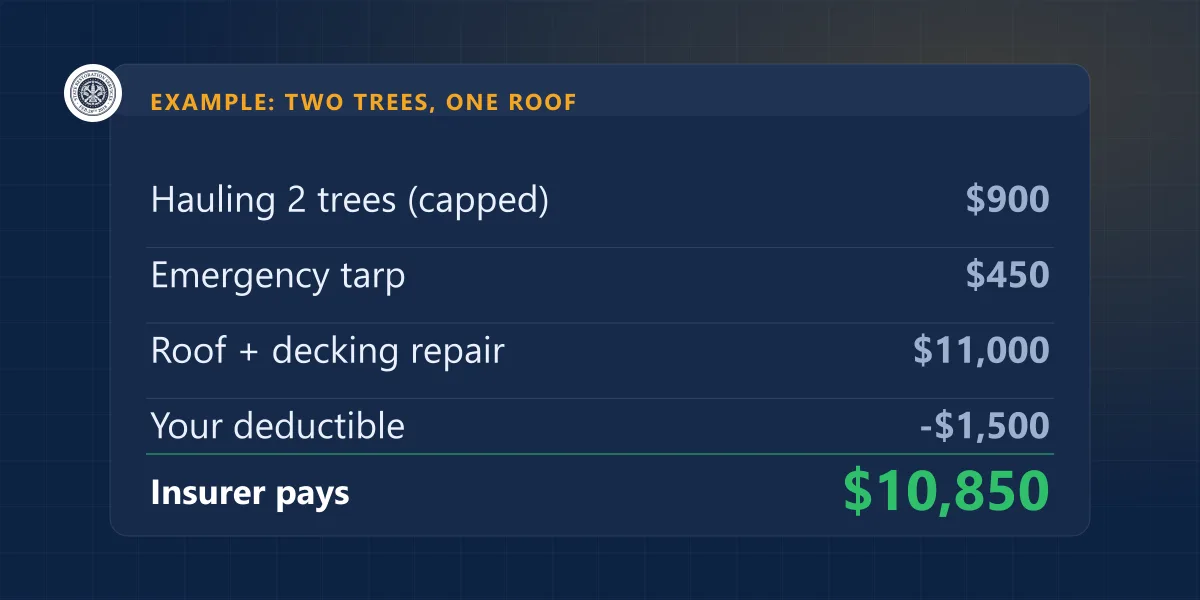
The standard form takes one deductible from "the total of all loss payable under Section I", not one per bill. That is good news: the small tree and tarp bills help you clear the deductible instead of each falling under it. Here is a worked example with round numbers. They are not from a real job, only there to show the arithmetic.
Say a storm drops two trees on one house: your own oak, which the tree service charges $800 to haul away, and the neighbor's maple, which it charges $400 to haul. The roofer tarps the hole for $450, and the roof and decking repair comes to $11,000. Your deductible is $1,500.
Two trees together stayed under the $1,000 storm limit here. A third tree would have run into it. If your policy has a percentage wind and hail deductible, the deductible line changes and the rest works the same way; our page on how the roof deductible works in Illinois shows how to read yours.
Your tree or the neighbor's tree: does it change who pays?
For your claim, almost never. You file on your own policy either way, and the form names both cases.
Your own tree
Removal is paid when it was brought down by windstorm, hail, or the weight of ice, snow or sleet. A healthy oak snapped in a July thunderstorm fits. A tree you were cutting down yourself is not on that list, and neither is one that rotted through and fell on a calm day, so hauling those is your bill even when the roof damage goes on the claim.
The neighbor's tree
Removal is paid when it fell from any cause your contents coverage insures, which includes wind. You still file on your own policy. If the neighbor had been told the tree was dead and left it standing, your insurer can go after their insurer for what it paid, and you may get your deductible back that way. That is between the two insurers and can take months.
If the tree only landed on the lawn, there is usually nothing to claim: no structure was damaged and the form does not pay to haul it. The two exceptions are written into the form: a tree blocking your driveway so the car cannot get in or out, and a tree blocking a ramp built for a person with a disability.
The first few hours, in the order that keeps the claim clean
The order matters more than the speed. Each step below protects the next one.
- Get everyone out of the rooms under the tree, and stay away from any wire it brought down.Report a line on the ground to ComEd and treat it as live. Nobody should go into the attic under a cracked rafter.
- Photograph and film the tree on the house from the ground, from every side, before anyone cuts it.Once the trunk is gone, the proof of what it hit goes with it. Get the stump and the broken limbs in the frame too.
- Call your insurer to open the claim and write down the claim number.Ask two questions: which line pays for lifting the tree off the roof, and whether they want to see the tree before it moves.
- Have a tree service take the tree off the house.A roofer cannot tarp under a trunk. Ask for an invoice that shows lifting and hauling as separate lines, and one line per tree.
- Get the hole tarped the same day if you can.That is what the Reasonable Repairs paragraph pays for. We prioritize emergency roof tarping for active leaks during business hours. Keep the receipt.
- Have the roof inspected and get a written estimate before you agree to any number.A tree often loosens shingles and nails well past the hole. If the claim gets complicated, our partner, the licensed Illinois public adjuster State Adjusting Services, can represent you with the insurer.
Storm-chasing crews love a fallen tree, because the homeowner is rattled and in a hurry. A truck with out-of-state plates offering to "take care of everything, tree and roof, for your deductible" is the one to wave on. Illinois does not let a roofer negotiate your claim, and a promise to absorb your deductible is a red flag on its own. Our storm and insurance claim page explains what we do on a claim job and what we leave to you and your adjuster.
What we check on the roof once the tree is off
The hole is the obvious part. The rest is where claims come up short, so this is what we walk the roof for:
- Every decking sheet the trunk or a limb cracked, not only the one with daylight through it. A cracked sheet under intact shingles still has to come out.
- Rafters and trusses from the attic side. A split or bowed rafter is structural work that has to be fixed before the roof goes back on, and the adjuster needs to see it.
- Shingles torn, creased or unsealed by branches dragging across the slope, often a few feet past where the tree landed.
- Ridge cap, pipe boots and vents the branches hit on the way down.
- The eave: crushed gutters, bent drip edge, a split fascia board.
- Whether the slope can be patched so it matches, or has to be replaced. Matching is its own fight, covered in our guide to shingle color matching on a partial claim.
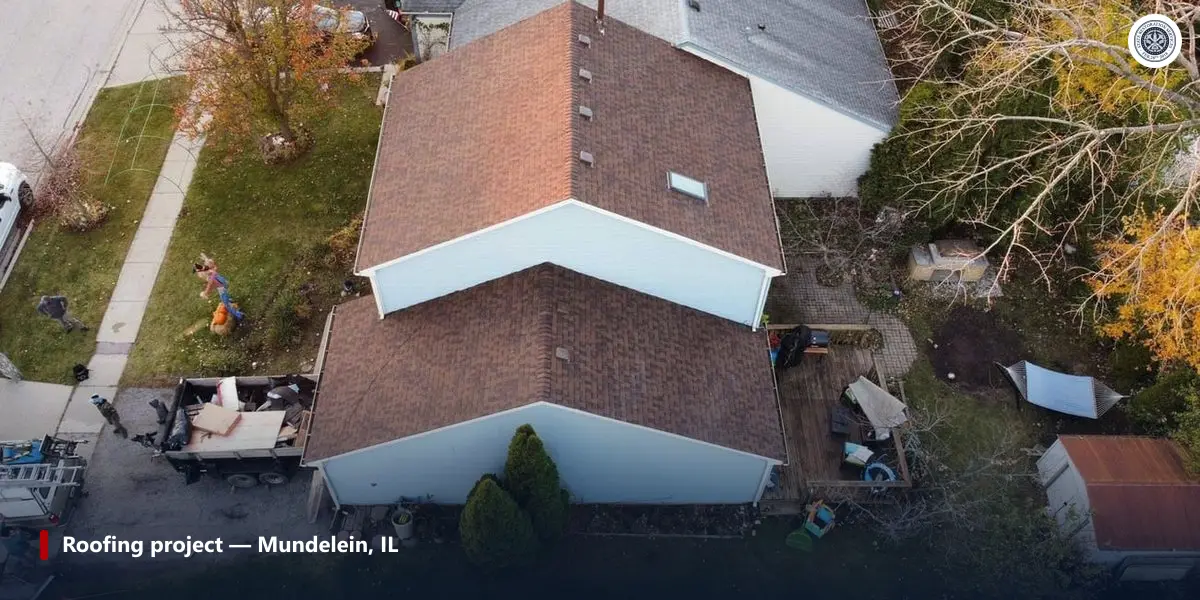
If you look at your own lot from above and see a big limb hanging over the roof, as in the photo, that limb is worth a call to an arborist before the next storm. Trimming is cheap next to a decking replacement, and it is never covered after the fact.
Questions homeowners ask us after a tree comes down
Does homeowners insurance pay if a tree falls on my roof but the roof is not damaged?
For the roof, there is nothing to pay. For the tree, the standard form pays the removal only if it damaged a covered structure, such as the house, a detached garage or a fence, or if it blocks the driveway or a wheelchair ramp. A tree lying on the lawn or across the yard is usually your own bill.
My neighbor's tree fell on my house. Whose insurance do I call?
Your own. The roof, the decking and the inside damage go on your policy, and the standard form even names a neighbor's tree in its tree removal paragraph. Whether the neighbor owes you anything, such as your deductible, depends on whether they ignored a tree they knew was dead or leaning. Your insurer can try to recover that from the neighbor's insurer on its own.
Will insurance replace the tree that came down?
Not after a wind storm under the standard form. Trees, shrubs and plants are covered only for a short list of causes, such as fire, lightning, a car or vandalism, and windstorm is not on that list. The tree trunk itself is also excluded under falling objects.
Should I let the tree service take the tree off before the adjuster comes?
Yes, once you have photos and video of the tree lying on the house. The policy expects you to protect the house from more damage, and the tree has to come off before anyone can tarp the hole. Keep every receipt and ask the tree service to bill lifting the tree off the roof and hauling it away as separate lines.
Related reading: does insurance pay for an emergency roof tarp and the 48-hour checklist after a storm.
Tree on your roof in the north or northwest suburbs? Call us at (866) 992-2982 or book a free roof inspection. We are open Monday to Friday 7:00 AM to 7:00 PM and Saturday and Sunday 9:00 AM to 5:00 PM, and we put homes with an open roof first.