
 Volodymyr Lukaniuk
Yes, in most homeowners policies insurance pays for an emergency roof tarp, as long as the hole it covers was made by something the policy covers, such as hail, wind or a limb blown onto the roof. The standard form calls this Reasonable Repairs: the insurer pays the reasonable cost of measures taken only to stop more damage. Two things decide most tarp bills. A tarp over a roof that leaked because it simply wore out is not paid. And the tarp is not weighed against your deductible on its own: it is added to the claim, and the deductible comes off the total once.
Below is the wording itself, the same storm worked through for two different houses, the deductible arithmetic, and what a tarp has to look like for the adjuster to accept it.
The sentence in your policy that pays for the tarp
Most Illinois homeowners policies are built on the Insurance Services Office HO 3 form or on wording close to it. In the sample of that form published by the Insurance Information Institute (edition HO 00 03 10 00), the paragraph reads:
“We will pay the reasonable cost incurred by you for the necessary measures taken solely to protect covered property that is damaged by a Peril Insured Against from further damage.”HO 00 03 10 00, Section I, Additional Coverages, Reasonable Repairs
Almost every phrase in it is a condition. Read your own policy next to this list, because carriers are free to change the wording.
- “Damaged by a Peril Insured Against”
- The roof has to have been opened by a covered cause. Hail, wind and a tree coming down in a storm usually are. Age is not: the same form excludes “wear and tear, marring, deterioration”.
- “Necessary measures taken solely to protect”
- The tarp, the boards that hold it down and the labor to put them up count. The permanent repair, done early and labelled as an emergency, does not.
- “Reasonable cost”
- The price has to be in line with what tarping costs locally. The paragraph also says it does not raise the limit on your policy.
The form puts the same idea on you from the other side. In its list of Duties After Loss, one item tells you to stop the damage spreading (“protect the property from further damage”). Where repairs are needed for that, the form wants two things from you: that they are “reasonable and necessary”, and that you “keep an accurate record of repair expenses.” So the tarp is something you are expected to arrange, and the record is what gets it paid.
Two houses on the same street after the same storm
Take two houses next door to each other after one hailstorm. Both have water coming through a bedroom ceiling, and both get a tarp the next morning. The bills end up in very different places, because the policy pays according to what opened the roof, not according to the fact that it leaked.
| House A: hail broke the shingles | House B: an old roof wore through | |
|---|---|---|
| Why it leaks | Hail fractured shingles and opened the mat underneath | Shingles past their service life cracked and lost their granules |
| The tarp | Paid under Reasonable Repairs, as part of the claim | Usually the owner’s cost: the opening was not made by a covered peril |
| Wet ceiling and insulation | Part of the claim | Often paid as resulting water damage while the roof itself is not (how a roof leak claim works) |
| Damage from waiting weeks to tarp | Can be taken off the payment under the Neglect exclusion | Same |
| The roof | Repaired or replaced under the claim, less the deductible | The owner’s cost |
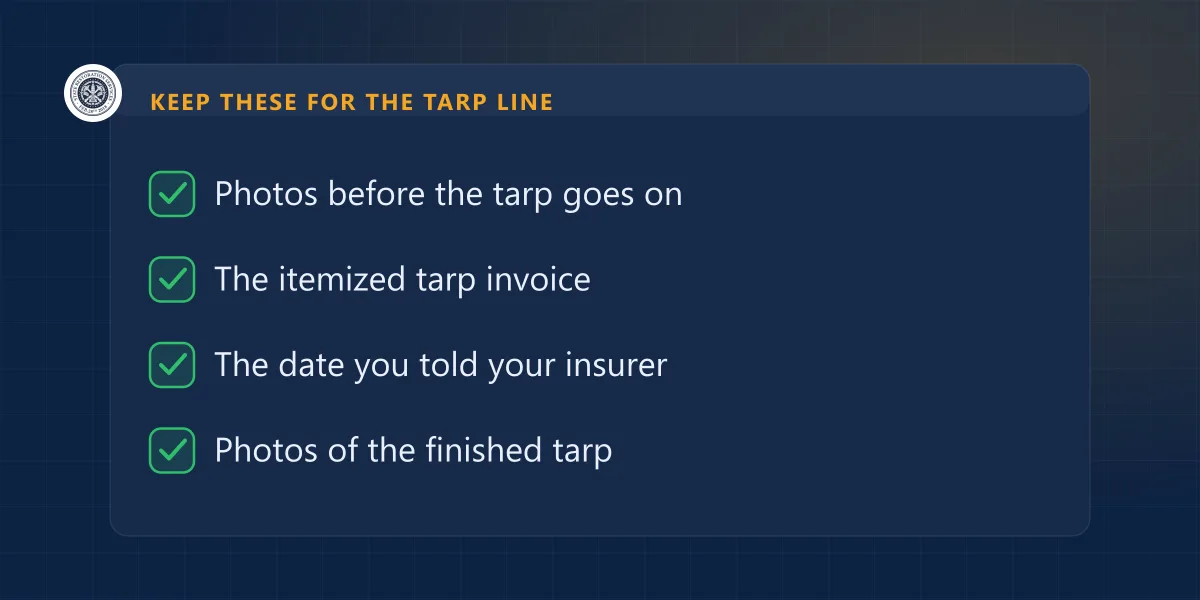
What separates the two houses is the cause. That is why photos of the opening matter so much before the tarp goes on: once it is covered, the adjuster mostly sees blue plastic.
Where the tarp sits against your deductible
The deductible paragraph of the same form says the insurer pays “only that part of the total of all loss payable under Section I that exceeds the deductible amount shown in the Declarations.” The tarp is part of that total. Here is the arithmetic with round example numbers. Your real deductible is on your declarations page, and many Illinois policies carry a separate wind and hail deductible written as a percentage of the dwelling limit, which our guide to roof deductibles in Illinois explains.
- Example deductible: $2,000.
- Example tarp invoice: $500. On its own it is below the deductible, which is why people assume they will pay it themselves.
- Example estimate to repair the hail damage on the roof: $9,000.
- Total loss payable is $9,500. The insurer pays $9,500 less $2,000, which is $7,500, and the tarp is inside that payment.
- If the whole claim, tarp included, comes to less than the deductible, nothing is paid for any of it.
So send the tarp invoice in with the claim rather than paying it and forgetting it. It belongs in the total the deductible comes off.
What a tarp the adjuster will accept looks like
A tarp that blows off in the next storm did not protect anything, and the water that comes in after it is harder to put on the claim. IKO’s homeowner guide How to Tarp a Roof describes how roofers do it, and it is a good list to hold against whoever tarps yours:
- The damage is photographed first, before debris is swept off, unless clearing it is the only way to see how far the damage goes.
- The tarp runs a few feet past the damage on every side, and over the ridge where it can, so rain runs across its top edge instead of under it.
- Loose pieces of shingle and old nails are cleared away before the tarp goes down.
- The tarp ends are rolled around thin boards and the boards are screwed down. Nails through bare plastic tear out in the first strong wind.
- The boards sit slightly off level, so they do not hold water back like a little dam.
- Plumbing vents and chimneys are cut around and taped. They are never covered over.
Ask for photos of the finished tarp too. They show the adjuster a proper job, and they are your proof if the tarp is later blamed for new damage.
Ways a paid tarp turns into your bill
- The opening was there before the storm. If the adjuster finds the leak came from worn shingles or a cracked pipe boot, the tarp follows that cause and stays with you.
- Nobody tarped for weeks. The form excludes Neglect, which covers an owner who, once the loss has happened, does not use “all reasonable means to save and preserve property”. Stains and rot that grew during the wait can be taken off the payment.
- The tarp is left on until it shreds. New leaks after a tarp has failed are easy to argue as an upkeep problem rather than storm damage.
- The permanent repair is billed as an emergency. Re-roofing a whole slope the day after the storm and calling it a tarp job is the kind of invoice that gets cut or held up.
- Your carrier’s form is not the standard one. One Florida insurer’s notice of policy changes renamed the paragraph “Reasonable Emergency Measures”, held it to the greater of $3,000 or 1% of the dwelling limit unless the company approved more in advance, and gave no cover for permanent repairs begun before the earliest of three moments: 72 hours after the loss is reported, the company’s inspection, or its approval. That is a Florida policy, not an Illinois one, but it shows how far a company’s own wording can move. Read the version in your policy before you agree to a large tarp invoice.
How long the tarp can stay up in a north-suburban winter
IKO’s answer is as short a time as possible, and only while the tarp has no rips and water is not getting under it. Here the season decides the rest. A tarp put up after a fall storm can be sitting under wet snow by December, and snow piled on a tarp hides whether it is still holding. Freeze and thaw also work the screws and boards loose over a few weeks.
That is the practical reason to get the permanent repair on the calendar while the claim is still open, not after every piece of paperwork is settled. If the adjuster has not been out yet, give your insurer the date the tarp went on and ask when they can inspect, so the roof is not waiting under plastic into the middle of winter. If you are not sure what to look for on the roof after a storm, our storm damage walk-around covers what you can check from the ground.
If water is coming in after a storm, phone us while the office is open and a tarp on your roof moves to the front of our schedule, so the leak stops while the full repair gets planned. The office takes calls seven days a week: 7:00 AM to 7:00 PM on weekdays and 9:00 AM to 5:00 PM on Saturday and Sunday. Our contact page has the number and a message form.
What Illinois law lets a roofer do on your claim
Illinois law does not let a roofing contractor negotiate an insurance claim for a homeowner. What we do: photograph the damage, tarp the roof, document what we find and write a code-compliant estimate for the roof repair or replacement, which you send to your insurer together with the tarp invoice. The claim itself stays yours. If you would like someone to represent you on it, our partner, the licensed Illinois public adjuster State Adjusting Services, can. Our storm and insurance claim page explains how the two fit together, and filing a storm-damage roof claim in Illinois walks through the claim from the first phone call.
Frequently asked questions
Should I tarp the roof myself to save money?
Only if you can reach the opening from a ladder without walking on a wet or damaged roof. The policy asks for reasonable measures, and nobody expects you to risk a fall. A tarp, boards and screws you buy yourself are paid on the same terms as a roofer’s invoice, so keep the itemized receipt.
Do I need my insurer’s permission before the tarp goes up?
The standard form does not ask for it. It asks you to protect the property and keep a record of what the repairs cost. Some carriers add limits or approval rules in their own forms, so report the loss promptly and read your policy’s version of the clause before agreeing to a large tarp invoice.
Will the insurer pay for the tarp if the claim is denied?
Usually not. The tarp follows the claim. If the opening in the roof was not made by a covered cause, such as hail or wind, the cost of protecting it is not paid either.
Who gets the money for the tarp, me or the roofer?
The insurer pays you, together with anyone else named on the policy, such as your mortgage lender, and you pay the contractor. Keep the itemized invoice and proof that you paid it with the rest of your claim papers.
Related reading: Does homeowners insurance cover a roof leak in Illinois? and what happens when the insurance adjuster inspects your roof.
Storm opened up your roof? Book a free inspection or call (866) 992-2982 during business hours. We serve the north and northwest Chicago suburbs.