
 Volodymyr Lukaniuk
When the insurance adjuster inspects your roof, they look at the house from the ground, then walk each slope and count storm damage inside a chalked test square, check the soft metal (vents, gutters, flashing), sometimes look in the attic or at a stained ceiling, and then leave. The money decision comes later, in a written estimate. Be home for the visit, have your storm date and photos ready, and ask for a copy of that estimate. Your roofer may stand next to the adjuster and point at damage; arguing the claim is a job for you or a licensed public adjuster.
We are a family-owned roofing contractor in Lincolnshire, and in the north and northwest Chicago suburbs we usually see a roof before the adjuster does and again after. Here is the visit in the order it happens, what gets measured, and the few things worth having on the kitchen table.
Who the adjuster works for
The adjuster who comes to your house is paid by your insurance company. The Illinois Department of Insurance describes the job plainly on its disaster claims page: "An adjuster from the company may come to your home and prepare a written damage estimate for the company." They may be on the insurer's staff or an independent adjuster the insurer hired for the storm. After a big hail day in Lake or Cook County, the one you meet may be working through a long list of addresses on the same street.
None of that makes them your opponent. Most are fair and busy. It does mean the person on your roof is writing a report for someone else, so the facts you hand them should be in writing and the damage should be pointed out while they are standing on it, not described afterwards on the phone.
The visit, from the phone call to the estimate
- When the appointment is set
Write down the adjuster's name, company and phone number. The Department of Insurance asks you to do exactly that, in case you need to reach them later. Ask whether they plan to climb the roof or use a drone.
You: tell your roofer the date and time if you want them there. - The days before
Leave the damage where it is. A shingle blown into the yard, a dented downspout, a cracked vent cap are all evidence. Do the temporary repairs that stop water (a tarp, a bucket under the drip) and keep the receipts.
You: photograph the ceiling stains and mark their edges in pencil with the date. - Arrival and the walk around the house
Most adjusters start at ground level: siding, window screens, gutters, downspouts, the air conditioner fins, the deck. Hail that dents soft metal on the side the storm came from tells them the storm was big enough to matter before anyone climbs.
You: walk with them and show the photos you took the day of the storm. - On the roof, slope by slope
They mark a test square on each slope, circle each hit inside it, photograph it, and look at the vents, pipe boots, ridge and flashing. Wind damage is checked differently: creased or missing shingles, counted by slope. On a steep or wet roof some carriers send a drone or a ladder-assist inspector instead.
You: stay on the ground. If your roofer is there, they go up with the adjuster. - Inside, if there was a leak
A stained ceiling, wet insulation or a damp attic deck gets looked at and photographed. If they skip it, ask them to see it. Interior damage that never made it into the inspection notes is the hardest line to add later.
You: have the attic hatch clear and a light ready. - Before they leave
Ask how many slopes they inspected, whether they found storm damage on each, and when the estimate will be sent. You do not have to agree to anything on the driveway, and nothing they say there is the decision.
You: write their answers down with the time. - The estimate arrives
It comes by email or mail with a line-by-line scope, measurements and a payment figure. The Department of Insurance's advice is short: "You should obtain a copy of the estimate report, and do not hesitate to ask questions if you don't understand it."
You: compare it with your roofer's measurements before you spend the check.
What the test square on your roof is counting
A test square is ten feet by ten feet, 100 square feet, chalked on each slope of the roof. Each small cell in the drawing is one square foot, and each circle is one hail hit the adjuster counted as damage.
The home inspectors' association InterNACHI, in its training on how adjusters inspect hail, says the square goes where the damage is worst, not under a tree that sheltered part of the roof, and that "Eight hits is a common number" for replacing that slope. Each insurer sets its own number.
Only hits that break the shingle count: a bruise that gives under your thumb, granules knocked off down to the mat, a crack. A scuff or a blister does not.
This is why a hip roof with eight or ten slopes takes longer than a simple gable, and why the one slope nobody looked at is the one that gets left out of the estimate. On the morning of the visit it is fair to ask, politely, to see the squares. If a slope that faced the storm has no chalk on it, say so while the adjuster is still up there. Our guide to what hail damage on asphalt shingles looks like has photos of a real hit next to ordinary wear.
Questions the adjuster asks, and what to have ready
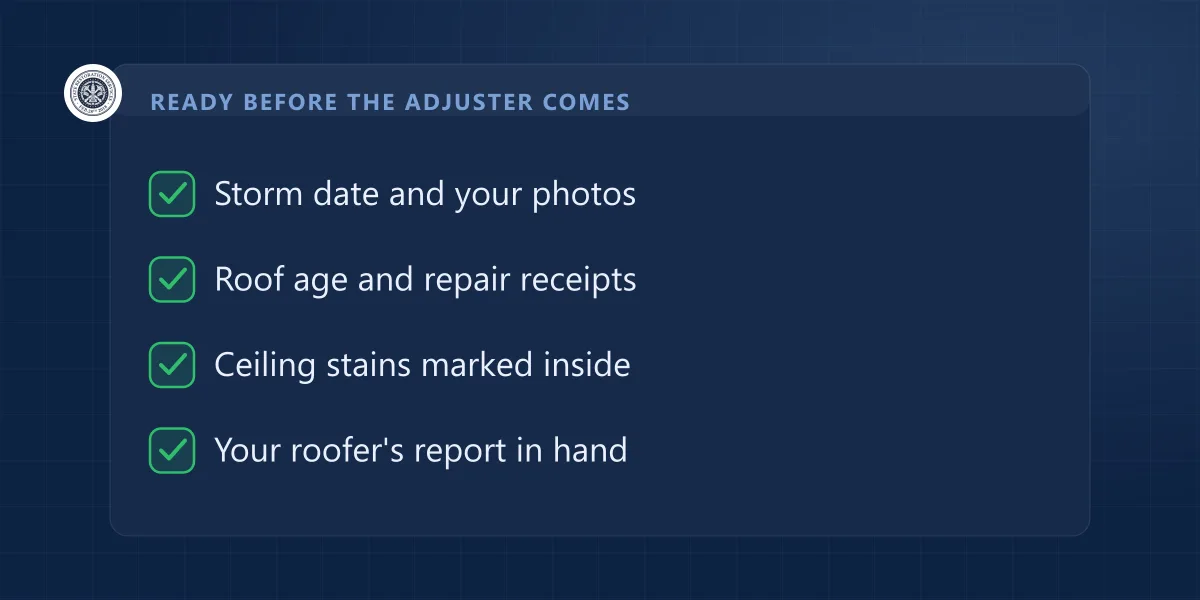
| They will ask | Why it matters to them | Have this on the table |
|---|---|---|
| What date did the storm hit? | The claim is for one event on one date. Damage has to match a storm that actually happened there. | The date, and your phone photos from that day, which carry their own timestamp. |
| How old is the roof? | Age drives depreciation, and wear on an old roof is excluded. | The year it was installed, from the contract, the permit or the house closing papers. |
| Any repairs or earlier claims on it? | An old repair can be mistaken for new damage, or the reverse. | Receipts for past repairs, and the claim number of any earlier roof claim. |
| Did water get inside? | Interior damage is a separate part of the estimate. | Dated photos of each stain and the marked edges on the ceiling. |
| Has a roofer looked at it? | Another set of measurements and photos they may have to answer to. | Your roofer's written report and estimate, if you have one. |
Answer what you know and say so when you do not know. Guessing the roof's age at "about ten years" when it was really sixteen helps nobody, and it is on record from then on.
What your roofer may and may not do that day in Illinois
Illinois draws a hard line between the person who fixes the roof and the person who argues the claim. The Home Repair and Remodeling Act says a contractor "shall not represent, or offer or advertise to represent, on behalf of a homeowner on any insurance claim," shall not file the claim for you, and "shall not climb on a roof or inspect for exterior damage without the insured's express permission." The same subsection then lists what a roofer may still do:
"(1) providing an insured an estimate for repair, replacement, construction, or reconstruction of the insured's property and any such estimate may be submitted to the insured's insurance company; (2) conferring with an insurance company's representative about damage to an insured's property; or (3) discussing repair or replacement options with an insurance company's representative or the insured about options for the repair or replacement of the damage."
815 ILCS 513/18(i), Illinois General Assembly
Your roofer, on the roof with the adjuster
- Points at hits, creases and dented metal the adjuster has not marked.
- Shows the measurements and photos from their own inspection.
- Explains what a proper repair or replacement of that damage includes.
Not your roofer's job
- Arguing the payment, the depreciation or what the policy covers.
- Calling in or filing the claim for you.
- Getting on your roof at all without your say-so.
A door-knocker who promises to "handle your insurance" from start to finish is offering the one thing Illinois says a roofer cannot do. The money side belongs to you, or to a licensed public adjuster you hire. Ours is a separate partner company, the licensed Illinois public adjuster State Adjusting Services, and it works for the homeowner, not the carrier.
After the visit: reading what they wrote
Put the adjuster's estimate next to your roofer's and check four things before anything else:
- The number of squares (one square is 100 square feet of roof). A missing slope shows up here first.
- Whether each slope is listed for repair or replacement, and why.
- The items that go with a new roof, such as drip edge, ice barrier at the eaves, starter and ridge cap, vents and flashing.
- The split between replacement cost and the depreciation held back until the work is done, which our post on recoverable depreciation on a roof claim walks through.
If a line is missing or a quantity is short, it usually gets fixed with documentation, not an argument: measurements, photos and the code or manufacturer requirement, sent as a roof insurance supplement. If you and the carrier still disagree on the amount, most policies have an appraisal clause, explained in our article on the appraisal clause on an Illinois roof claim. And if the answer is a denial, Illinois rules say what the letter has to tell you; see the documents your insurer must send you.
Related reading: filing a storm damage roof claim in Illinois, from the first call to the final payment, and what our free roof inspection covers, the visit we would rather do before the adjuster's.
Common questions about the adjuster's roof inspection
Do I have to be home when the adjuster inspects the roof?
Not always, since many adjusters can inspect the outside without you. Being there is still worth it: you can show the storm-day photos, the ceiling stains and the attic, and you hear what they say about each slope instead of reading it weeks later.
Can my roofer be on the roof with the adjuster?
Yes, with your permission. Illinois law lets a contractor confer with the insurance company's representative about the damage and discuss repair options. It does not let the roofer represent you on the claim or negotiate it.
What if the adjuster does not get on the roof?
Some carriers use drones or a separate ladder-assist inspector on steep, high or wet roofs. Ask how each slope was inspected and ask for the photos. A slope with no photos and no test square is a fair thing to question in writing.
Should I sign anything on the day of the inspection?
You do not need to sign a settlement on the driveway, and you should not sign a contract with any roofer before you have read the insurer's estimate. Read every page someone hands you, and ask for a copy of whatever you do sign.
The adjuster said there is no storm damage. What now?
Ask for the decision and the reasons in writing. If your own roofer found damage, compare the photos slope by slope. A second look, a documented request for reinspection or a licensed public adjuster are the usual next steps.
Waiting on an adjuster's visit? Book a free roof inspection or call (866) 992-2982, Monday to Friday, 8 AM to 5 PM. We serve the north and northwest Chicago suburbs, and storm calls get priority during business hours.