
 Volodymyr Lukaniuk
Quick answer: The claim belongs to whoever owned the home on the day of the storm, not to whoever owns it at closing. If you sell before the roof is repaired, you keep the actual-cash-value check and usually give up the recoverable depreciation. Illinois also requires you to disclose known roof damage before the contract is signed.
Selling a house with an open roof insurance claim is a situation nobody plans for. The hail comes through in June, the adjuster writes the estimate in July, and then life moves faster than the claim does. It is a question we get from homeowners across the north and northwest Chicago suburbs, and the answer has three moving parts: who owns the money, who owns the repair, and what you are required to tell the buyer.
Two honest limits first. Your real-estate attorney and your agent own the contract side of this, and we are neither. And under Illinois law a roofing contractor may not negotiate your insurance claim at all — we document damage and write a code-compliant estimate, while our affiliated licensed public adjuster, State Adjusting Services, is the one who can represent you on the claim. What follows is how the money moves, from the roof half of the job.
Who keeps the insurance money if you sell the house mid-claim?
The person who owned the home on the date of loss. A homeowners policy is written to a named insured, and a claim under it follows that person rather than the deed. Unless you sign something that says otherwise, the checks stay yours — and so does the job of telling the buyer what happened.
This surprises people because so much else about a house transfers at the closing table. The claim does not, for a simple reason: the buyer's new policy starts the day they close, and it will not cover a storm that happened before it existed. If June hail damaged the roof and the sale closes in September, exactly one policy responds to that hail, and it is yours. That is why letting a claim lapse before you sell is the one genuinely bad option — nobody else can pick it up later.
Two other names can appear on the check: your mortgage servicer if you still carry a balance, and a contractor if you have signed a direction-to-pay. Both matter for timing.
What happens to recoverable depreciation if you sell before the roof is fixed?
You almost always lose it. On a replacement-cost policy the carrier pays actual cash value first and holds back the depreciation until the work is finished and invoiced. Sell the house and you can never produce that invoice, so the held-back money is never released. On the settlement below that is $4,100 that quietly stops existing.
Here is the same worked example we use in our guide to roof insurance deductibles in Illinois — a $16,400 replacement-cost estimate against a 1% wind-and-hail deductible on a $350,000 dwelling limit:
| Line on the settlement | Amount |
|---|---|
| Replacement cost value (RCV) of the roof | $16,400 |
| Less recoverable depreciation, held back | −$4,100 |
| Less 1% wind-and-hail deductible | −$3,500 |
| First check (ACV) in your hand | $8,800 |
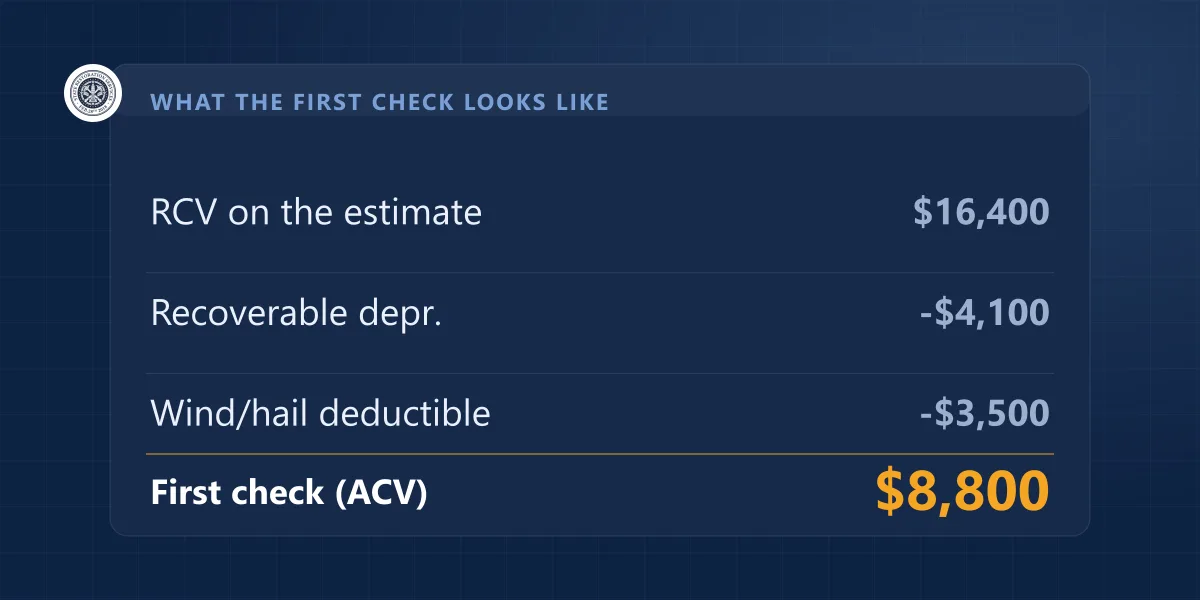
Replace the roof before you close and the carrier releases the $4,100 against the final invoice. You collect $12,900 in total, you pay the roofer $16,400, and your true out-of-pocket is the $3,500 deductible. Sell as-is and you keep $8,800, full stop. The buyer still has a damaged roof, and a buyer holding your adjuster's estimate will ask for a credit that looks a lot like $16,400.
One thing no roofer in Illinois is allowed to do for you here: pay, rebate, or discount that deductible to make the deal easier. If a contractor offers to cover it so the sale goes through, they are offering to break the law on your behalf. The detail sits in the deductible guide, and it applies just as hard during a sale as outside one.
Can you assign a roof claim to the buyer in Illinois?
Generally yes, once the loss has already happened. Illinois follows the majority rule that a policy's anti-assignment clause stops you from handing over the policy, not from handing over money already owed under it. But a workable assignment is a written document your attorney drafts and the carrier acknowledges, not a sentence added to the contract at the last minute.
The Illinois authority people cite is Illinois Tool Works, Inc. v. Commerce & Industry Insurance Co., 2011 IL App (1st) 093084, which held that a post-loss assignment transfers a claim for money rather than the policy itself, so the insurer's consent is not required. The caveat belongs out loud: that was a commercial pollution-coverage dispute between companies, not a homeowner's hail claim. Illinois courts apply the principle, but whether it fits your policy and your closing is a question for your attorney.
The practical part matters more than the case law. Before anyone signs, get the carrier's claim department to put two answers in writing: who they will pay after the sale, and whether they will release the recoverable depreciation to an assignee who completes the work and invoices it. Carriers differ, and a verbal yes from a claim rep is worth nothing to a buyer's attorney. If the carrier will not commit in writing, price the roof into the deal instead.
Which of the three paths actually fits your closing?
Three routes exist: repair before closing, assign the claim to the buyer, or credit the buyer at closing and keep the money. The right one depends on how much calendar you have left and on whether the claim is already settled or still being argued.
| Repair before closing | Assign the claim | Credit at closing | |
|---|---|---|---|
| Who schedules the roofer | You | Buyer, after closing | Buyer, after closing |
| Recoverable depreciation | Released to you | Carrier-dependent, get it in writing | Usually lost |
| Who absorbs the deductible | You | Negotiated | Negotiated |
| Risk of the deal stalling | Lowest | Highest | Low |
| Fits when | Claim is settled and there is time | Buyer is already priced around the roof | You need speed more than the money |
The depreciation row is the only one where the choice costs you real money rather than time, and it is the easiest to miss — it sits near the bottom of the settlement letter.
What does your mortgage company do with the claim check?
If your loan balance is meaningful, the servicer's name is on the check as well, and the funds go into a loss-draft account that pays out in stages against inspections. Selling the house does not make that account disappear on its own. Call the loss-draft department the week you list, not the week you close.
Smaller claims are often endorsed straight back to the homeowner with an ID and a copy of the adjuster's worksheet. Larger ones get monitored: the servicer holds the money, inspects the work partway through and again at completion, and releases the funds in draws. That process assumes the person who owns the house is the one replacing the roof, so it does not resolve itself when the house changes hands mid-claim. Somebody has to call and ask.
Ask three questions and write down the answers: what happens to an open loss draft when the loan is paid off at closing, what documentation releases the remaining balance to you, and how long that takes after the lien is released. A loss draft nobody dealt with is an avoidable way to chase your own money after you have moved out.
Do you have to disclose an open roof claim in Illinois?
Yes, if you know about it. The Illinois Residential Real Property Disclosure Report asks directly whether you are aware of leaks or material defects in the roof, ceilings, or chimney. Since a 2022 amendment, that report has to reach the buyer before the contract is signed, and you have to update it if something changes before closing.
The statute (765 ILCS 77) sets a low bar for what "aware" means: actual knowledge, with no duty to investigate. That sounds like an escape hatch until you remember what is in your folder — an adjuster's report, a scope of loss, a roofer's estimate. All of it is actual knowledge, written down and dated.
Disclosure is cheap and hiding is expensive. Hand the buyer the adjuster's estimate along with the report. Damage you disclosed with a number attached gets negotiated once; damage the buyer's inspector finds two weeks before closing gets renegotiated from scratch, and those never move in the seller's favor. If you want the damage documented properly first, that is what our storm and insurance claim inspections are for.
What if the storm hits after you are already under contract?
Then Illinois's default rule matters. Under the Uniform Vendor and Purchaser Risk Act, if a material part of the property is destroyed before either legal title or possession has passed, the seller cannot enforce the contract and the buyer can recover what they have paid. That is only the default, and it applies unless the contract expressly says otherwise.
The statute is 765 ILCS 65/1, and it also spells out that in an escrow closing title has not transferred until the escrow conditions for passing full legal and equitable title are met. In practice most Illinois residential contract forms write their own damage-before-closing clause on top of that default, which is why your attorney will read your contract before reading the statute.
For roofs specifically: hail bruising is rarely "material destruction" of a house, so it is usually handled by the contract's own casualty clause, a re-opened inspection, or a credit. What the timing settles is whose claim it is, and the answer is nearly always still yours.
| When the storm hit | Whose claim it is | What usually governs |
|---|---|---|
| Before you listed | Yours | Your policy, plus the disclosure report |
| Between contract and closing | Still yours — title has not passed | Your contract's damage clause; 765 ILCS 65/1 if it is silent |
| After closing | The buyer's | The buyer's new policy |
Is it worth replacing the roof before you list?
If the claim is approved and the calendar allows, usually yes. You collect the full replacement cost instead of the depreciated share, you list a house with a new roof and a workmanship record behind it, and no buyer's inspector gets to reprice your deal from the driveway. The math only breaks when you cannot wait.
A full architectural asphalt replacement in the Chicago suburbs runs roughly $9,000 to $18,000 depending on size, pitch, and access. On an approved claim your net cost is the deductible, because the carrier is funding the rest. Then compare that deductible against what a buyer's agent asks for once an inspector writes "roof at end of life" in a report. In our experience that number is never the smaller of the two.
The honest counterweight: if the claim is denied, or the damage turns out to be cosmetic granule loss rather than functional bruising, a pre-listing replacement is a five-figure gift to the buyer. Price the roof into the deal instead. One visit is usually enough to tell you which situation you are in — that is the first step in how we work a storm job, and it is the same inspection whether you are staying or selling.
We work normal business hours, roughly Monday through Saturday, and we will say plainly at that visit whether a residential roof replacement fits inside your closing window or whether a credit is the more realistic route. Either way the claim has to be settled first, and that is the part of the schedule with the least give in it.
Related reading: Filing a storm-damage roof claim in Illinois walks the claim itself from first report to final payment, and shingle color matching on a partial claim covers what happens when only one slope is approved.
Frequently asked questions
Can I keep the insurance check and sell the house as-is?
Yes, provided your mortgage servicer has released the funds and you disclose the damage on the Illinois disclosure report. You keep the actual-cash-value portion and give up the recoverable depreciation, and you should expect the buyer to negotiate against the same damage the check was issued for.
Does the buyer's home insurance cover a storm that happened before they bought the house?
No. A homeowners policy covers losses that occur while it is in force, so the buyer's brand-new policy will not respond to hail that fell months before their closing date. That is why the seller's claim is the only one available for pre-sale storm damage.
Do I have to disclose a roof claim I already repaired?
Damage you reasonably believe has been corrected is not a material defect under the Act, so a properly repaired roof does not need to be reported as a defect. Hand over the invoice and the workmanship warranty anyway. Documented, completed work is a selling point rather than a liability.
Can State Restoration Services negotiate my claim while the house is under contract?
No. Illinois law bars a roofing contractor from negotiating an insurance claim, and that does not change because a sale is pending. We inspect the roof, document the damage, and write a code-compliant estimate. Our affiliated licensed public adjuster, State Adjusting Services, can represent you on the claim itself.
Selling a home with storm damage on the roof? Book a free inspection or call (866) 992-2982 and we will document what is actually up there before your listing photos go live. Family-owned, based in Lincolnshire, serving the north and northwest Chicago suburbs — rated 4.9 stars from 92 Google reviews.