
 Volodymyr Lukaniuk
Hail damage to windows is part of a homeowners insurance claim when the storm actually broke, cracked or dented the window, and it belongs on the same claim as the roof rather than as a claim of its own. A standard policy covers the glass, the frame, the screen and the trim around it as part of the house, and the deductible is taken once from the total of everything the storm did. What decides the money is proof: which side of the house each mark is on, and whether the window still keeps water and air out. Below we go through a window part by part, the way an adjuster looks at it.
Five parts of a window, from the outside in
Each part takes hail differently, and each one is argued differently on a claim. The order below is the order hail reaches them.
1The screen
- What hail does
- Hail tears the mesh or pushes it out of the frame. A screen is thin, so it can show holes from a storm that left the glass behind it whole.
- What proves it
- Holes and stretched spots on the screens that faced the storm, and clean screens on the sheltered sides.
- How the claim reads it
- Paid as part of the dwelling when the hail did it. Cheap to replace, so it matters most as evidence of direction.
2The aluminum wrap
- What hail does
- The bent sheet aluminum that covers the outside of a wood frame and its trim is soft metal, and it keeps every round dent a hailstone leaves.
- What proves it
- Round, scattered dents along the top and sill pieces, matching dents on gutters and vents on the same wall.
- How the claim reads it
- This is where the cosmetic argument happens. A dent that does not let water in may be called cosmetic, and some policies exclude cosmetic damage by endorsement.
3The frame and sash
- What hail does
- Vinyl does not hold a dent the way metal does. When the hit is hard enough it cracks, and the thin outside strip that holds the glass in place is the part most likely to split.
- What proves it
- A crack with clean edges, often at a corner or along the bead, on a window that faced the storm.
- How the claim reads it
- A cracked frame or bead lets water and air in, so it is damage to the window itself, not to its looks.
4The glass
- What hail does
- Large hail with wind behind it can crack or break a pane. A storm window or storm door takes it first if you have one.
- What proves it
- A star or a hole with the broken pieces on the inside sill or floor, photographed before anyone sweeps.
- How the claim reads it
- Covered as breakage of glass that is part of the building, and the policy also pays for damage done by the broken pieces.
5The seal between the panes
- What hail does
- Two panes are sealed together at the edges around a dry air space. If a hit breaks that seal, moist air gets in.
- What proves it
- Fog or condensation that appears between the panes in the weeks after the storm, in a window with other storm marks.
- How the claim reads it
- The hardest part to prove. The insurer will ask whether the seal failed from the storm or from age.
An insurer that writes these claims every season says the same thing about the first and fourth cards: National General's hail guide notes that screens are commonly torn in hailstorms and that windows are sometimes cracked or shattered. That is why the screens are worth photographing even though nobody gets rich replacing them.
Hail mark or older wear: how an adjuster tells them apart
The first question on any window line is whether this storm did it. Hail falls with the wind, so its marks gather on the sides of the house that faced the storm and thin out on the others. Wear and everyday knocks show up wherever the window is used, cleaned or leaned on.
| What you see | Points to this storm | Points to something else |
|---|---|---|
| Where the marks are | Mostly on one or two sides of the house, the same sides where gutters and vents are dented | Evenly on every side, or only on the windows you open most |
| Dents in aluminum | Round, scattered, bright metal inside the dent | Long creases or one dent at ladder height |
| Screen damage | Small holes across the mesh on the storm side | A pushed-out corner from a pet or a slit along one edge |
| Cracked vinyl | A fresh crack with clean, light-colored edges | A yellowed, dirty crack or a frame warped from sun |
| Fog between panes | Started after the storm, in a window with other marks | Was there last winter, or only in the oldest windows |
The same pattern carries across the whole house, which is why the windows help the rest of the claim. Dented aluminum next to a window is the same evidence we look for on hail-dented gutters and downspouts, and the wall around the window is its own line, covered in our post on siding storm damage and the insurance claim.
The glass clause in a standard homeowners policy
Most homeowners policies are built on the same industry form, the ISO HO 00 03. Besides covering the house itself, it has a separate additional coverage just for glass. The sample of the form published by the Insurance Information Institute reads, in part:
"The breakage of glass or safety glazing material which is part of a covered building, storm door or storm window"
"The direct physical loss to covered property caused solely by the pieces, fragments or splinters of broken glass"
ISO HO 00 03 10 00, Section I, Additional Coverage 9, from the III sample policy (PDF)
The second line reaches past the window. If a pane breaks and the shards cut into a vinyl floor or a sofa below the window, the damage done by the pieces is paid too. The same clause sets two limits worth knowing:
- It does not apply if the house sat vacant for more than 60 days in a row right before the loss. A house under construction does not count as vacant.
- It does not raise the limit of your policy. The glass is paid inside the dwelling limit you already have.
Your own policy may be an insurer's version of this form with different numbering or extra endorsements, so read the declarations page and any endorsement with the word "cosmetic" in its title before you assume.
When rain comes in through a broken pane
The window is often the cheapest part of the loss. The room behind it is not. On the side of the policy that covers your belongings, the same form says rain damage inside is covered only when "the direct force of wind or hail damages the building causing an opening in a roof or wall". A pane knocked out by hail is that opening, and the wet rug, furniture and other belongings under it become part of the claim.
The policy also expects you to stop it getting worse. Cover the opening the same day with plywood or heavy plastic, keep the receipt for the materials or the board-up, and photograph the window before and after. The policy pays reasonable costs for protecting the house after a covered loss, the same rule we walk through in our post on whether insurance pays for an emergency roof tarp.
Why the windows go on the roof claim, not a claim of their own
The deductible paragraph in the same form says the insurer pays "only that part of the total of all loss payable under Section I that exceeds the deductible amount". Read that slowly: the deductible comes off the total for the whole storm, once.
That matters because a window claim by itself is usually small. A few screens and a cracked sash rarely add up to a flat deductible, and they never come close to a percentage wind-and-hail deductible. Filed alone, they pay nothing and still go on your claims history. Listed on the same claim as a hail-damaged roof, gutters and siding, every window line adds to the payment, because the deductible has already been taken once. If you are not sure what kind of deductible your policy carries, our guide to your roof insurance deductible in Illinois shows how to find it on the declarations page and works through the arithmetic.
Fog between the panes weeks after the storm
Fog that appears a few weeks after a storm has the least certain answer of any window line. As our replacement windows page puts it, condensation trapped inside the glass means the seal has failed and the window no longer insulates. The question on a claim is why it failed.
A seal can fail because a hailstone hit the window hard, and it can fail because the window is twenty years old and the sealant gave up. Fog shows up slowly in both cases, so the date you first noticed it is not enough. What helps:
- The fogged window also has a cracked pane, a dented sash or a broken bead.
- It sits on the side of the house that took the storm, next to windows with torn screens.
- The same make and age of window on the sheltered side is still clear.
- You have an older photo of the window from the inside, taken before the storm, showing clear glass.
Without at least one of those, expect the insurer to call it age. If the windows are old enough that seals are failing anyway, it is worth weighing a replacement on its own merits, and our comparison of double-pane and triple-pane windows for Chicago winters covers what to replace them with.
The order to do things in after hail hits your windows
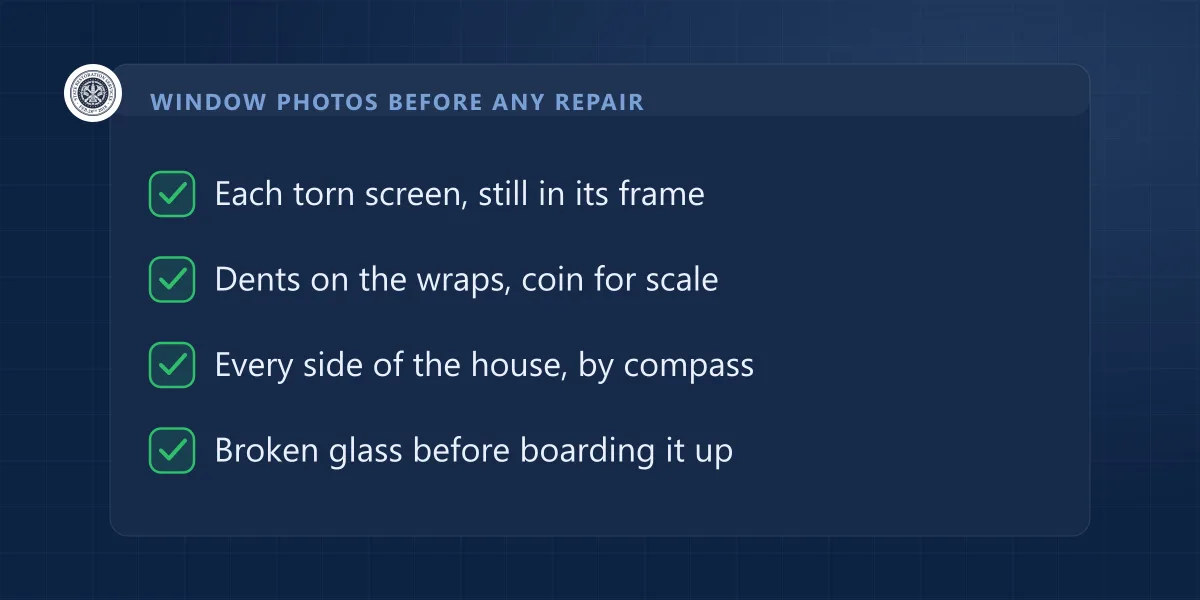
- Walk around the house and note which sides have marks. Write the compass direction of each wall on your phone's notes.
- Photograph every damaged window from far enough away to see the wall it is on, then close up with a coin held next to the dent or crack for scale.
- Photograph broken glass where it fell before anyone cleans it up, then cover the opening and keep the receipt.
- Leave torn screens in their frames until the damage has been seen. A screen in the trash proves nothing.
- Report the loss to your insurer and list the windows with the roof, gutters and siding as one storm, on one date.
- Get a written estimate that names each window, its size and its type, so the line can be checked against the adjuster's.
What we do on a window claim, and what our partner does
Illinois law does not let a roofing or exterior contractor negotiate an insurance claim for a homeowner, and we follow it. What we do is the building side: inspect the windows with the roof, siding and gutters, photograph and measure the damage, write a code-compliant estimate that lists every window, answer the adjuster's technical questions about our scope, and install the replacement windows once the claim is settled. Our storm and insurance page describes that work.
The claim itself belongs to you. If you want someone to represent you on it, our partner, the licensed Illinois public adjuster State Adjusting Services, can do that as a separate company with its own contract.
Questions homeowners ask about hail and windows
Is a torn window screen worth putting on a hail claim?
On its own, almost never, because a few screens cost far less than any deductible. On the same claim as a hail-damaged roof it is worth listing, because the deductible is taken once from the total of everything payable, and torn screens on the side that faced the storm help show which way the hail came from.
My windows fogged up a month after the hailstorm. Is that covered?
Only if you can tie the failed seal to the storm. Fog that shows up in a window that also has a cracked pane, a dented sash or a broken bead on the storm side has a much stronger case than fog in an old window on the sheltered side of the house. Photograph it, note when you first saw it, and report it as part of the same loss.
Should I replace a broken window before the adjuster comes?
Board it up or cover it the same day so rain cannot get in, keep the receipt, and photograph the broken glass before you do. Leave the permanent replacement until the damage has been seen and written up, unless the adjuster tells you in writing that you can go ahead.
Related reading: what happens when the insurance adjuster inspects your roof, and how missed items get added to an approved claim.
Found torn screens or dented window wraps after a storm? Book a free inspection and we will look at the windows together with the roof, or call us at (866) 992-2982.