
 Volodymyr Lukaniuk

The hail storm date of loss is the day the hail actually fell on your house, not the day you noticed the dents. If you found the damage weeks or months later, you rebuild that day from two kinds of record: the free public weather lists that log where hail was reported, and the dated evidence your own house and phone already hold. Check both before you call the insurer, and give one date you can back up.
We see this every fall. A gutter cleaner points at dented downspouts, a home inspector writes "possible hail" in a report, or the first heavy rain finds a bruised shingle, and the homeowner is suddenly asked a question nobody wrote down in June. Here is where we look, and the one trap that catches almost everyone who checks a storm that hit after midnight.
Why the insurer asks for one exact day
A homeowners policy covers what happens while it is in force, and every clock in the claim starts from the date of loss. So the date you write decides more than people expect:
- which policy pays, if you switched insurers or renewed with a new deductible since the storm;
- whether you are still inside the window your policy gives you to report a loss, which is printed in your own policy under the duties after a loss;
- when the time to bring a lawsuit runs out, which in Illinois can pause while the claim is pending, as we worked through with dates in our article on a roof claim denied for wear and tear;
- what the adjuster compares your roof against, because the date you give gets checked against weather records for your address.
A date that moves around is worse than a date that takes a week to find. Pick it once, from evidence.
Four free public records that keep hail days
None of these costs anything, and all of them are run by the government or by volunteers who report to it. They answer different questions, so use them together.
| Record | What you see | How soon it shows up | Its catch |
|---|---|---|---|
| Storm Prediction Center daily reports | A map and list of every hail report the Weather Service received that day, with time, place and size in inches | Within minutes; the page for today refreshes as reports come in | Preliminary, and each page runs from 7:00 AM to 6:59 AM the next morning in Chicago summer time, explained below |
| NWS Chicago event pages | A write-up of big local storm days, sometimes with a drawn map of the largest hail by area and a list of reports | Days to weeks after the storm, and only for notable events | Not every hail day gets a page |
| NCEI Storm Events Database | The official, checked record of storm events by county and date, searchable back to 1950 | Updated monthly, with a delay that can reach 120 days | Last summer's storms may not be in it yet |
| CoCoRaHS hail reports | Reports from trained volunteer observers, with stone size and sometimes a photo | Same day or the next, when an observer files one | Only where a volunteer lives and was home |
The Storm Prediction Center's storm reports page is the fastest way in. Each past day has its own page, and the hail list gives size in inches next to the town and county. The Weather Service's Chicago office posts event write-ups for its bigger days; the March 10, 2026 page is a good example, with hail size maps for DuPage and Cook counties drawn by hand from radar frames and ground reports, and a list of individual reports by size and source. The checked national record lives in the NCEI Storm Events Database, which NOAA describes as updated monthly with a delay of up to 120 days. Volunteers file theirs on the CoCoRaHS hail report list, which you can filter by state and date.
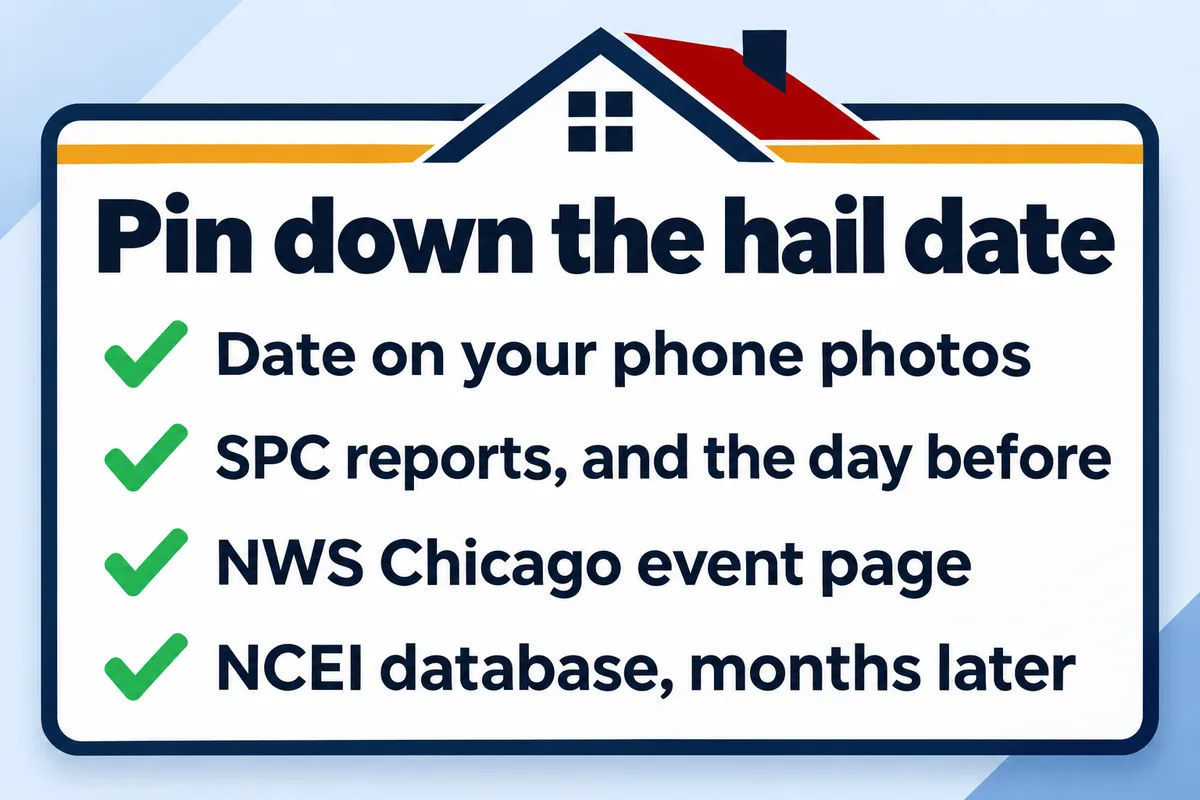
One size note helps you read the lists. The Weather Service calls a storm severe when it brings hail of 1 inch or larger, about the size of a quarter, as the Chicago office spells out. Smaller stones get reported too. Don't skip a day just because the biggest stone on it was 0.75 inch, because the largest stones in a storm often fall where nobody was standing with a ruler.
The midnight trap on the storm reports page
The Storm Prediction Center builds each day's page from 12:00 to 11:59 in Coordinated Universal Time, not Chicago time. In summer Chicago runs five hours behind that clock, so a page dated June 14 holds everything from 7:00 AM on June 14 until 6:59 AM on June 15. Here is a made-up example of a storm that crossed a street after midnight.
- 12:00 UTC, June 14
The page dated June 14 starts collecting reports.
- 05:40 UTC, June 15
Hail on your street. Your phone, your neighbor and the local news all call it June 15.
- 11:59 UTC, June 15
The June 14 page closes. Your storm is listed on it.
- 12:00 UTC, June 15
The June 15 page opens, and your storm is not on it.
Anyone who opens only the June 15 page decides there was no hail and starts doubting the whole claim. For any storm between midnight and 7:00 AM, open the page for the day before as well. The date you give the insurer is still your local calendar date, June 15 in this example.
Your house keeps a dated record too
Public lists tell you hail fell near you on a given night. Your own records tie it to your address, and they're often more exact than any report.
- Phone photos. Scroll back through your camera roll to anything shot outside around the storm: hail in the grass, a flooded patio, branches on the driveway. On an iPhone, swipe up on a photo to see its date and time; in Google Photos, the same swipe shows the details. Screenshots of weather alerts count too.
- Soft metal around the house. Dents on gutters, downspouts, roof vent caps, the fins of the air conditioner and painted window trim are made by the same stones that hit the shingles. They don't date the storm by themselves, but a list of dented parts helps match it to a storm big enough to make them. Our guide to hail damage on gutters and downspouts shows what we photograph.
- A car claim. If a car parked outside that night was claimed for hail, its file already has a date. That is about the strongest single proof there is.
- Neighbors. A neighbor who already filed, or whose roof was replaced after the same storm, knows the date their insurer accepted.
- Texts and emails. Search your messages for the word hail. People text each other about it the same night.
When the records point to two different days
In a busy spring the north and northwest suburbs can see hail two or three times in a few weeks, so it's common to find more than one candidate. Weigh them like this.
The day with proof at your address wins
A dated photo from your yard or a car claim beats a report two towns over. If one candidate has your own evidence and the other only a list entry, give the first.
Bigger stones over smaller ones
When nothing ties either day to your house, the day with larger stones reported nearby is usually the one that marked the roof. Write down both and why you chose one.
Check which policy was in force
If you changed insurers or renewed between the two days, each date sends the claim to a different policy year. Read both declarations pages before you file.
Say what you know, plainly
If you truly can't tell, tell the insurer what you found and on which dates, rather than inventing certainty. A guessed date that has to change later costs more than an honest range up front.
This is also the point where many homeowners bring in help. Illinois law does not let a roofing contractor negotiate an insurance claim, so the person who can represent you on the claim itself is a licensed public adjuster, such as our partner, the licensed Illinois public adjuster State Adjusting Services. Our page on roof insurance claims explains how the two jobs split.
What we write down on a hail inspection
When we inspect a roof for hail, every photo carries its own date and time, and we note the soft metal hits around the house alongside the shingle bruises, test squares and roof measurements. Those dated photos sit next to the house evidence above, so the dents on the downspout and the bruises on the shingles can be lined up against the storm days you found. If the roof does need replacing, our storm restoration crews build it to code with GAF, Owens Corning or IKO systems, and our roof inspection page lists what the visit covers.
One more thing from years of fall inspections: the out-of-town crew that knocks on doors after a storm will happily give you a date. It's usually the date they arrived in town. Use the records.
Frequently asked questions
What is the date of loss on a hail claim?
It is the day the hail fell at your address. The clock does not start on the day you discovered the damage, so a roof found dented in November is usually dated to a storm months earlier.
What if I can't find my storm in any record?
An empty list does not prove nothing fell. Reports only exist where someone saw the hail and passed it on, and hail often falls in narrow strips. Check the day before on the storm reports page, then lean on your own photos, dents on soft metal and neighbors' claims, and describe honestly what you found.
Will the insurance company check the date I give?
Expect it to. Adjusters compare the date of loss with weather records for the address. That is why it pays to look up the same public records yourself before you file, and to give a date you can show.
Can I change the date of loss after I file?
If you find better evidence, tell the insurer in writing what you found and why it points to another day. A date that keeps changing weakens a claim, so take the time to settle it before the first call.
Related reading: what hail damage on an asphalt roof looks like and filing a storm damage roof claim in Illinois.
Found hail damage and not sure when it happened? Call (866) 992-2982 or book a free inspection online. We're open Monday to Friday 7:00 AM to 7:00 PM and Saturday and Sunday 9:00 AM to 5:00 PM, and we work across the north and northwest Chicago suburbs.