
 Volodymyr Lukaniuk

A roof claim denied for wear and tear means the insurer decided that age caused the damage, and that a storm did not. That is a finding about cause, and you can answer it with evidence. A standard homeowners policy excludes the aging of a roof. It does not exclude what hail or wind did to a roof that happened to be old. So read the letter first, check the shingles against the storm date, and reply in writing while you keep an eye on one deadline.
We are a family-owned roofing company in Lincolnshire, and we inspect roofs across the north and northwest Chicago suburbs. This guide goes in the order you will need it: the letter, the shingles, the date, the reply.
Read the letter one line at a time
Illinois sets rules for what this letter must contain, so each line gives you something to check. The wording on the left is a sample we wrote to show the usual shape. Yours will read differently.
What the letter says
What to do with that line
We inspected your roof on the date above after your report of hail damage.
Ask for the inspection report and every photo. Find out whether someone walked each slope, or whether a drone or a ladder-assist inspector did the looking.
The conditions we observed are consistent with wear and tear.
This is the opinion you are answering. Look for which slopes and which marks it means. If it names none, ask in writing.
Your policy states that we do not insure for loss caused by wear and tear, marring, deterioration.
This line is required. Section 919.50(a)(1) of the Illinois claims rules says the explanation must “clearly set forth the policy definition, limitation, exclusion or condition upon which denial was based.” Find those words in your own policy.
We are therefore unable to make payment on this claim.
Look for the Notice of Availability of the Department of Insurance, which has to come with it. The same section gives the insurer 30 days to send this explanation once its investigation and decision are done.
The time to bring suit was paused for a number of days, and a number of days remain.
Section 919.80(d)(8)(C) requires both numbers on a property claim. Copy the end date onto a calendar today. We work through it further down.
Our article on the documents your insurer must send you covers the rest of the paperwork on an Illinois claim.
Does the policy exclude a roof because it is old?
No. The standard form excludes a kind of damage, and age is only the evidence people argue over. In the sample HO-3 form published by the Insurance Information Institute, the exclusion is three words with no definition attached:
“Wear and tear, marring, deterioration.”
So a 20-year-old roof that took a dated hailstorm is a different case from a 20-year-old roof that simply ran out of life. The insurer's letter says yours is the second. Your evidence is about the first.
Keep reading past the exclusion too. Right after it, the form says “any ensuing loss to property described in Coverages A and B not precluded by any other provision in this Policy is covered.” Even when the worn shingle stays your bill, the ceiling stain it caused may not be, and our guide to roof leaks and homeowners insurance goes through that split. Some policies also carry an endorsement that pays for wind or hail on the roof according to its age. That lowers a payment instead of refusing one, and scheduled roof settlement explains how it reads.
Age or storm: what the shingle itself shows
Most of these disputes come down to a few square feet of shingle. Hail and wind leave marks with one shape, and years of sun leave marks with another. We read a roof like this:
| On the roof | Reads as age | Reads as a storm |
|---|---|---|
| Lost granules | Thinning across a whole slope, built up over years | Scattered spots, with a soft bruise under the bare patch |
| Dark spots | Burst blisters: small steep-sided pits, usually a quarter inch or less | Random dents you can feel give when you press them |
| Cracks | A brittle mat, cracking all over the slope | A fracture at the point where a large stone hit |
| Lifted tabs | Sealant let go, tab lifts, no crease in it | A crease across the tab, a torn tab or a missing shingle |
| Metal up there | Faded paint and rust, on every side alike | Small round dents in vents, flashing and gutters |
| Where it sits | About the same on all slopes | Heavier on the side the storm came from |
One sign proves little. Several on the same slope, with a storm on a known date, make a case.
The closest calls have their own articles: shingle blisters against hail hits, what hail looks like on asphalt, and the crease as wind evidence.
An older shingle can be easier to damage
The Insurance Institute for Business and Home Safety tested shingles weathered outdoors and then hit twice with simulated small hail, under an inch. They became up to ten times more susceptible to damage from later large hail than new shingles. So age and a real storm hit can both be true of the same roof. Expect the other reading as well: slow granule loss from many small storms can look a lot like wear, which is why a dated large-hail event matters so much.
Keep one date in front of you while you argue
Most policies limit how long you have to sue, often under a condition called Suit Against Us. Illinois pauses that clock for part of the claim. 215 ILCS 5/143.1 says the period “is tolled from the date proof of loss is filed” until “the date the claim is denied in whole or in part.” Tolled means paused. Take a made-up policy with a two-year limit that runs from the date of loss:
Sample dates, not a real claim. Your own limit is in your policy, and your numbers are in your letter.
The pause in that statute ends at the denial, and it says nothing about a request for a re-inspection. Treat the clock as running while you write back. If the date gets close and the insurer has not moved, that is the time to talk to an attorney.
What to send back, and what each piece answers
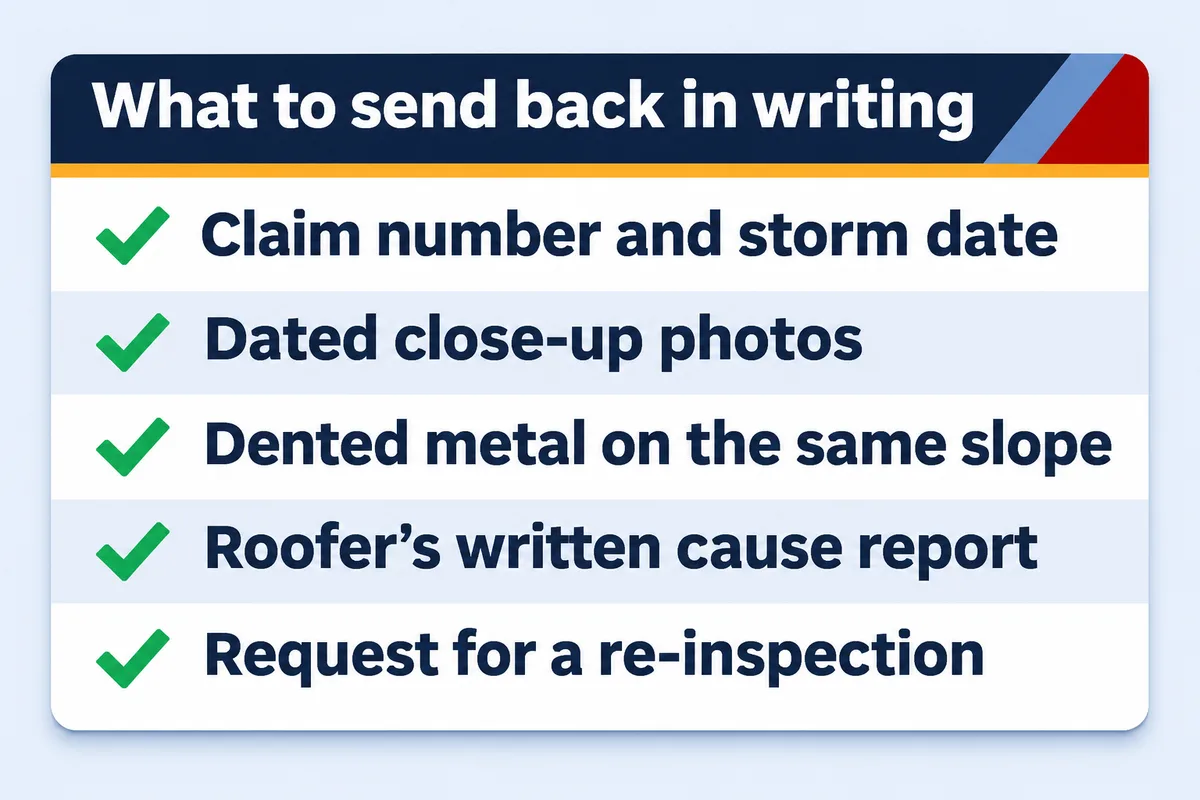
- Open with the claim number, the storm date and the sentence of the letter you dispute, so the reply has to deal with that sentence.
- Show each slope in a wide photo, then a close-up with a coin or ruler for scale, with dates on all of them.
- Add dents in gutters, downspouts and vents. Soft metal does not age into a round dent.
- Include anything older that shows the roof before the storm: a home inspection report, a repair invoice, listing photos.
- Attach a roofer's written report, slope by slope, saying why the marks read as storm damage.
- Ask for a re-inspection with your roofer there. A different adjuster is worth requesting too, though the insurer may say no.
Send it in a way that proves delivery, and keep copies. Meanwhile, keep the water out: the policy expects you to protect the house, and our piece on roof tarps and insurance covers saving those receipts.
Who can say what to your insurer in Illinois
Illinois law separates these jobs, so it helps to know who to call for which one.
A roofer
The Home Repair and Remodeling Act says a contractor “shall not represent” a homeowner on a claim, and allows an estimate and a talk with the insurer's representative about the damage. With your permission we inspect, document the damage, write a code-compliant estimate and answer technical questions about the construction scope.
A public adjuster
Can represent you on the claim itself, for a percentage of the settlement. Our partner, the licensed Illinois public adjuster State Adjusting Services, is a separate company, and our notes on choosing a public adjuster say what to check.
The Department of Insurance
Takes complaints online or by form, or call (312) 814-2420 in Chicago. It reviews how the company handled the claim. It does not act as your lawyer or decide the facts of your case.
An attorney
The person for a lawsuit on the policy, and for the Section 155 question if the insurer has stalled.
You will see appraisal suggested for this. The appraisal clause sets the amount of a loss, and a refusal based on an exclusion is a coverage question, which belongs to a court. So appraisal tends to come later, if the insurer accepts the storm and disputes the price.
When the letter holds up
Sometimes the insurer has it right. Worn evenly on every slope, no storm you can date, clean metal, no creases: there is nothing in that file to argue with, and a stranger who promises otherwise after knocking on your door is selling something. What counts as an old roof will help you judge how long it has left. If it is time, we can price a full roof replacement and talk through financing, and you are planning the job on your own schedule instead of after a leak.
Questions about wear and tear denials
Can an insurance company deny a roof claim just because the roof is old?
Age by itself is not the exclusion in the standard homeowners form. The exclusion is for wear and tear, marring and deterioration, so an insurer has to tie the damage you reported to that cause. An old roof makes that argument easier for them, and your evidence has to answer it. Your own policy may carry an endorsement that lowers what it pays for an older roof, so read those pages too.
Can I reopen a denied roof claim in Illinois?
You can ask. Send new evidence in writing, name the claim number and the line of the letter you dispute, and request a re-inspection. The insurer may change its answer or may stand by it, and the deadline to sue keeps to the dates in your denial letter while you wait.
How long do I have to dispute a wear and tear denial?
The limit that matters most is the time to sue in your own policy, usually under a condition called Suit Against Us. On an Illinois property claim, the denial letter has to say how many days that period was paused and how many are left. Put that date on a calendar the day the letter comes.
Will a roofer's report change the insurer's decision?
No roofer can promise that. A report carries the most weight when it goes slope by slope, shows dated photos, and ties the marks to a storm on a known date. In Illinois a roofer can give the insurer an estimate and talk through the damage with its representative, and cannot represent you on the claim.
Holding one of these letters? Book a free roof inspection or call (866) 992-2982. We work Monday through Friday, 7:00 AM to 7:00 PM, and Saturday and Sunday, 9:00 AM to 5:00 PM, and our insurance claim page shows how we work with homeowners on storm damage.