
 Volodymyr Lukaniuk
File a roof insurance claim when covered storm damage clears your deductible by a wide margin, and pay for the repair yourself when the job lands under the deductible or only a little above it. A worn-out roof with no storm behind it is not a claim at either price. The decision comes down to one subtraction, and you can do it at the kitchen table before anybody calls the insurance company. We price roof repairs across the north and northwest Chicago suburbs, so the sample jobs below use roof numbers and Illinois-style deductibles.
The subtraction that decides whether to file
Start with what the claim could actually put in your pocket, then take away what it could cost you at renewal.
The deductible is the box people get wrong. Many Illinois policies now carry a percentage for wind and hail, so 1% on a house insured for $350,000 means $3,500 and not the $1,000 printed elsewhere on the page. Our guide to your roof insurance deductible in Illinois shows where to find it.
Five sample roof jobs, run through the numbers
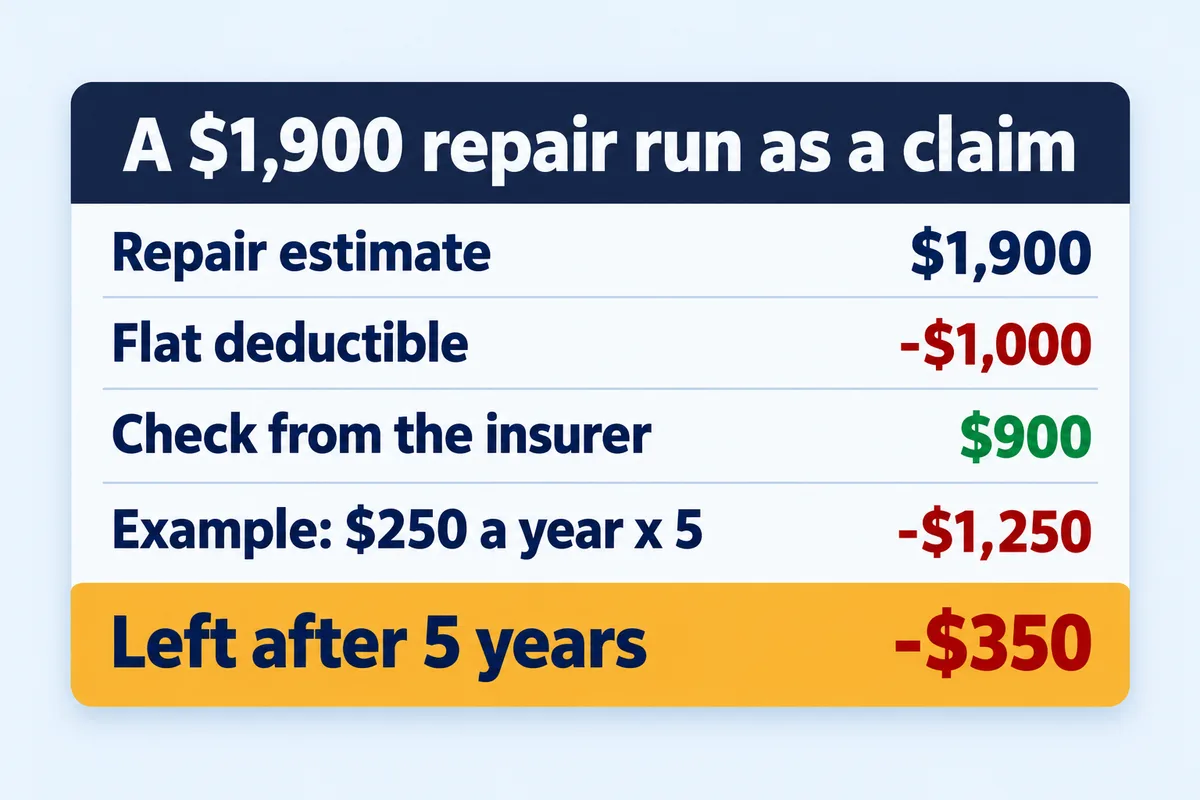
The prices are samples and not quotes. The added premium is $250 a year for five years in every row, a figure picked for the arithmetic, because the real one depends on your company and only your agent can give it to you.
| The job | Deductible | Most the claim pays | After $1,250 more premium | What we would do with these numbers |
|---|---|---|---|---|
| Wind took a few shingles, $600 | $1,000 flat | $0 | Nothing to gain | Pay for it and keep the invoice |
| Storm-torn flashing and shingles, $1,900 | $1,000 flat | $900 | -$350 | Pay, unless your agent says a first claim adds nothing |
| Hail on one slope, $5,500 | 1% of $350,000 = $3,500 | $2,000 | $750 | Close. Get the agent's real figure first |
| Hail across the whole roof, $16,400 | 1% of $350,000 = $3,500 | $12,900 | $11,650 | File |
| The same roof, $16,400 | 5% of $350,000 = $17,500 | $0 | Nothing to gain | The policy pays nothing, so talk to your agent about that deductible |
If your price comes in as one line with no detail, it is hard to run this honestly. Our page on how to read a roofing estimate shows what the lines should say.
Two inputs that change the answer
The check may arrive smaller than the table says. On a replacement cost policy the insurer usually pays actual cash value first and holds back depreciation until the work is done, as we explain in the difference between RCV and ACV. You get that money later, so it is a cash flow problem. On a policy with a scheduled roof settlement, an older roof is paid at a set share of its cost and the rest never comes, so use the scheduled figure in the first box.
Your premium may also rise whether you file or not. State Farm's 8% Illinois homeowners increase, reported by St. Louis Public Radio, reaches existing customers at renewal from December 1. A company-wide raise like that lands either way, so leave it out of the subtraction and count only what the claim itself would add. The same company's Illinois page says its customers now carry a minimum 1% wind and hail deductible, which is the kind of change that moves a small repair below the line without anyone noticing.
What each step leaves on your claims report
Insurers share claim history through a report called CLUE, kept by LexisNexis. It lists things like the date of loss, the type of loss and the amount paid, and it generally goes back up to seven years, according to the Washington insurance commissioner's office. Most of the worry about "just calling to ask" comes from not knowing where the line sits.
- Reading your own policy, or getting a roofer's written price
- Your insurer is not involved, and insurers are the ones who report to this file.
- Asking a general question about coverage or your deductible
- Washington's office says LexisNexis advises insurers not to report these, and the Utah Insurance Department says the same. Advice to insurers is not a guarantee, so read your declarations page first.
- Describing an actual loss to the company or your agent
- Utah warns this "might be considered reporting a claim", and it can show even if nothing is paid.
- Filing a claim that pays nothing
- It may still appear, according to Utah. A job under your deductible can leave a mark and bring no money.
- A paid claim
- It appears with the amount paid, and the next insurer you apply to can see it.
When you do call before deciding, Utah's advice is to be specific about whether you are filing or asking. If you are asking, you can open with:
"I am not reporting a claim. As a general question, what would one paid wind or hail claim do to my renewal, and for how many years?"
If the agent asks whether something happened, tell the truth. The same goes for any insurance application: the report will show what it shows, and the point of this order is to decide with the numbers in hand, not to hide a loss.
The order that keeps both choices open
- Take dated photos from the ground the day you notice the damage.Stay off the roof. If you file later, these are the first thing an adjuster will want, and if you pay yourself they show what was fixed.
- Stop any water coming in.A tarp and a bucket come before any arithmetic. Keep the receipts, because our article on whether insurance pays for an emergency tarp explains how a policy treats them.
- Get a written price from a roofer.Our inspection is free and no-obligation. Ask for the price of the repair and, if the damage is wide, the price of the whole slope, since those are two different rows in the table above.
- Pull out your declarations page.Write down the wind-and-hail deductible in dollars, the dwelling limit, and whether the roof is paid at replacement cost, actual cash value or on a schedule.
- Order your free CLUE report if you have filed before.Washington's office gives the LexisNexis number as 866-312-8076 and says the Fair Credit Reporting Act entitles you to a free copy. Mistakes go to 888-497-0011, and LexisNexis checks with the insurer and answers within 30 days.
- Run the subtraction with your agent's real figure, then decide within days.The standard policy asks for prompt notice after a loss, so a decision to file should not sit until spring. Our guide to filing a storm damage roof claim in Illinois takes it from there.
When the arithmetic is not the whole answer
File even if the numbers look close
- Water got inside. Ceilings, insulation and wet decking can grow past the first price once they are opened up.
- A tree or limb came through the roof. That is what the policy is for, and the bills stack up fast: our article on a tree on the roof follows them one by one.
- Someone was hurt, or the damage reached a neighbor's property. Report those to your insurer whatever the repair costs.
- A hail test shows hits across several slopes. What looked like a small repair may be a whole roof replacement, so price that before you decide.
Never a claim, at any price
- Shingles that aged out, or a pipe collar that cracked with time. Wear and tear is excluded, as our page on whether insurance covers a roof leak explains, so a claim only adds a line to your report. Our note on repair versus replacement covers the fix.
- A slow leak nobody reported for a long time.
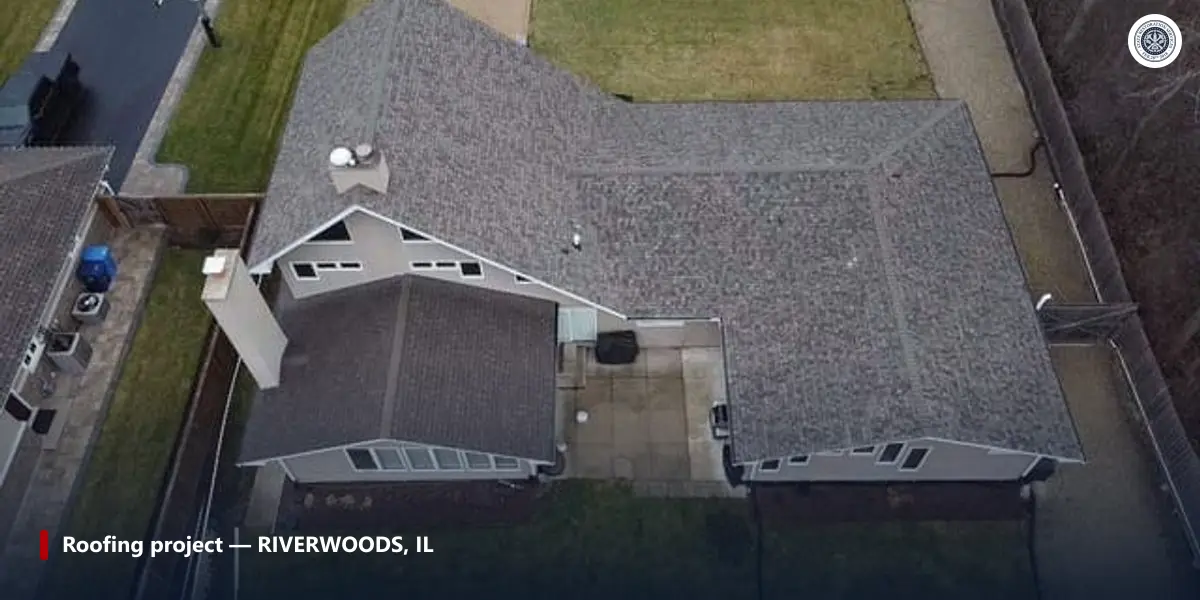
On a house like the one above, the slopes face different directions and take a storm differently. One slope with hits and three without is a very different row in the table from all four, which is why the price comes before the phone call.
If you do pay yourself, keep the invoice and the before and after photos with your house papers. They show that the damage was fixed, which helps if a later storm brings an adjuster to the same roof or a buyer asks about it. If a non-renewal notice ever arrives, our page on insurance non-renewal in Illinois covers the notice periods and your right to a specific reason.
What Illinois law lets a roofer do in this decision
The choice to file is yours, and Illinois keeps it that way. Under the Home Repair and Remodeling rules in 815 ILCS 513, a roofing contractor can give you an estimate and talk through the construction scope, but may not negotiate the claim or call it in for you, as our page on roof insurance supplements sets out. What we do is inspect, photograph, measure and write a code-compliant estimate that you can use in the subtraction above. If you decide to file and want someone on your side with the insurer, our partner, the licensed Illinois public adjuster State Adjusting Services, can represent you on the claim. Our storm and insurance page shows how the two fit together.
Be careful with anyone at the door who says a claim will cost you nothing. That person is not the one opening your renewal bill next year, and our article on storm chasers versus a local roofer has more on the sales pitch.
Questions homeowners ask before they call the insurer
Does asking my agent a question count as a claim?
A general question about coverage or your deductible should not. Both the Washington and Utah insurance departments say the report's owner tells insurers not to report those. Describing an actual loss to the company or the agent can be treated as reporting a claim, even with no payment. Say plainly which of the two you are doing.
Does a denied or zero-payment roof claim stay on my record?
It can. The Utah Insurance Department says a claim that was filed and not paid may still appear on the report. That is why a job under your deductible is worth pricing before you call, since the claim would pay nothing and could still be listed.
How long does a roof claim stay on my record?
The report generally holds up to seven years of home and auto claims. How long your own insurer charges more for a claim is a separate number, and it varies by company. Ask your agent for it, and order your free report to see what is listed now.
Can I pay for the repair now and file a claim later?
Do not count on it. The standard policy asks for prompt notice after a loss, and an adjuster cannot inspect damage that has already been fixed. Make the decision before the permanent repair. Stopping an active leak is different: protect the house, keep the receipt and take photos first.
Will one roof claim get my policy non-renewed in Illinois?
We cannot speak for a carrier, and underwriting rules differ. What Illinois does fix is the process: a non-renewal needs written notice of 30 or 60 days, depending on how long the policy has been in force, with a specific reason behind it. Ask your agent how your company treats a first weather claim.
Related reading: what happens when the adjuster inspects your roof and how to recover depreciation on a claim.
Want the first number for your own subtraction? Call (866) 992-2982 seven days a week (weekdays 7:00 AM to 7:00 PM, weekends 9:00 AM to 5:00 PM), or send us a message and ask for a written price on the repair.