
 Volodymyr Lukaniuk
Quick answer: A dryer vent through the roof is legal in Illinois, and the code never bans it. It is simply the hardest termination to keep clean. The 2021 IRC gives you 35 equivalent feet of duct, and three mitered 90-degree elbows eat 15 of those feet. A dryer roof cap also needs a backdraft damper and no screen.
We get asked about the dryer vent through the roof more often than you would guess, and almost always for one of two reasons: a homeowner is standing in the attic looking at a duct that has come apart, or we are pricing a tear-off and the customer wants to know what happens to that little hood on the back slope. Both are fair questions, and the honest answer runs through a mechanical code section that rarely comes up in a roofing conversation.
So here is what Section M1502 of the 2021 International Residential Code actually says, what we see on Chicago-area roofs when we pull shingles off around one of these, and where the roofing part of the job stops and somebody else's part begins.
Is it legal to vent a clothes dryer through the roof?
Yes. No section of the IRC prohibits a roof termination for a clothes dryer. The code only requires that the duct terminate outside the building, that it follow the dryer manufacturer's installation instructions, and that it keep its distance from other openings. A roof cap satisfies all three when it is installed correctly.
M1502.3 is the controlling paragraph, and it is worth reading word for word because two sentences in it catch most installations:
"Exhaust ducts shall terminate on the outside of the building. Exhaust duct terminations shall be in accordance with the dryer manufacturer's installation instructions. If the manufacturer's instructions do not specify a termination location, the exhaust duct shall terminate not less than 3 feet (914 mm) in any direction from openings into buildings, including openings in ventilated soffits. Exhaust duct terminations shall be equipped with a backdraft damper. Screens shall not be installed at the duct termination."
Read that last sentence again, because it reverses the rule that applies to almost every other roof vent. Note also that the code names ventilated soffits specifically. A dryer cap dropped low on a slope, a few feet above a vented soffit, is pumping warm wet lint straight at an attic intake.
One Illinois wrinkle: there is no single statewide residential code that answers this for you. The Capital Development Board's own FAQ is blunt about it, saying the state baseline "only applies to new residential construction" and that "residential repairs may be regulated by local Authorities Having Jurisdiction (AHJ)." Your village decides. Arlington Heights, Buffalo Grove and Northbrook each run their own building department, and we ask them rather than assume.
How long can the duct be if it exits through the roof?
Thirty-five equivalent feet, unless the dryer manufacturer's instructions say otherwise. M1502.4.6.1 sets it out plainly: "The maximum length of the exhaust duct shall be 35 feet (10 668 mm) from the connection to the transition duct from the dryer to the outlet terminal." Fittings then get deducted from that budget, and the flexible transition duct behind the dryer does not count toward it.
This is where roof runs get into trouble. A wall termination behind the laundry room might be six feet of straight pipe. A roof run has to climb, turn into the attic, cross to a good spot on the slope, and turn up again. Each of those turns is charged against you at a rate set by Table M1502.4.6.1, and the elbow you use changes the bill dramatically.
| Fitting (per Table M1502.4.6.1) | Counts against your 35 feet as |
|---|---|
| 4-inch radius mitered 45-degree elbow | 2 feet 6 inches |
| 4-inch radius mitered 90-degree elbow | 5 feet |
| 6-inch radius smooth 45-degree elbow | 1 foot |
| 6-inch radius smooth 90-degree elbow | 1 foot 9 inches |
| 8-inch radius smooth 90-degree elbow | 1 foot 7 inches |
| 10-inch radius smooth 90-degree elbow | 1 foot 6 inches |
Take an ordinary two-story house with the laundry on the first floor. Twelve feet of rise to get into the attic, ten feet across the attic, two feet up through the deck to the cap: twenty-four actual feet of pipe, which sounds comfortable. Add the three 90-degree turns that route needs. With cheap mitered elbows that is another fifteen feet on paper, and the run fails at 39 equivalent feet.
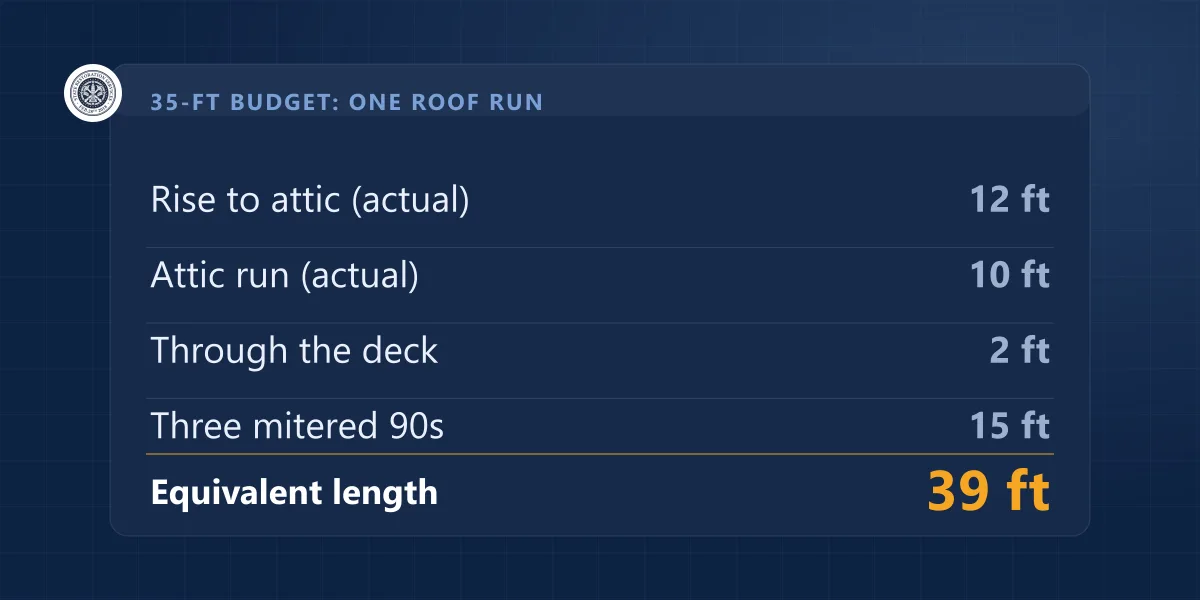
Swap those three mitered elbows for smooth 6-inch radius elbows at 1 foot 9 inches each and the same route lands at about 29 equivalent feet, comfortably inside the limit. Same house, same holes, same labor. The only thing that changed was which fitting somebody bought, which is a good illustration of why we would rather have this conversation before the drywall goes back than after.
If a run does exceed 35 equivalent feet, M1502.4.7 requires the equivalent length to be marked on a permanent label or tag within six feet of the exhaust duct connection. If you have that tag in your laundry room, somebody did the arithmetic. If your duct is clearly long and there is no tag, nobody did.
Why does a roof-terminated dryer duct clog faster?
Two reasons, and they compound each other. Lint that does not make it out of a vertical run falls back down and settles at the first elbow. Then there is the temperature: the last stretch of duct sits in an unconditioned attic, and in an Illinois January that attic is near outdoor temperature. Saturated air off a hot dryer hits cold metal, gives up its moisture, and the lint stops being loose fluff and starts being paste.
That matters more than a slow drying cycle. The U.S. Fire Administration's own finding is that "failure to clean (31%) was the leading factor contributing to the ignition of clothes dryer fires in homes from 2018-2020." Buildup outranks defective appliances and bad wiring as a cause. A roof termination is the configuration most likely to go years without anybody looking at it, because checking it means getting on the roof.
Signs worth taking seriously, from the inside:
- Drying times that have crept up over a season or two, especially on towels and jeans.
- A laundry room that feels humid, or a dryer cabinet that is hot to the touch at the end of a cycle.
- Lint visible around the duct joints in the attic, which means the joints are leaking wet air into your insulation.
- Staining on the shingles below the cap, or a damper that no longer swings freely when the dryer runs.
What makes a dryer roof cap different from every other roof vent?
It is the one roof penetration that must not be screened. Every other cap we install gets mesh, because mesh keeps birds, wasps and squirrels out of your attic. On a dryer termination that same mesh becomes a lint filter mounted at the highest, coldest, least accessible point of the system, which is why the code bans it outright.
The other spec people miss is throat area. M1502.3.1 requires that "the passageway of dryer exhaust duct terminals shall be undiminished in size and shall provide an open area of not less than 12.5 square inches." A four-inch round duct is about 12.6 square inches, so the rule is really saying the cap is not allowed to pinch the airflow the duct just delivered. Plenty of generic hoods do exactly that.
| At the roof | Bath fan cap | Dryer cap |
|---|---|---|
| Screen at the outlet | Normal | Prohibited |
| Backdraft damper | Yes | Yes |
| Minimum open area | Per product | 12.5 sq in |
| Shared with another fan | No | Never |
That bottom row is not our opinion. M1502.2 says dryer exhaust systems "shall be independent of all other systems." We have found a dryer duct and a bath fan tied into one roof cap more than once, usually because a remodel needed a hole and there was already a hole. It backfeeds warm lint into the bathroom ceiling, and it is a code violation on the face of it.
What we do with a dryer cap when we re-roof the house
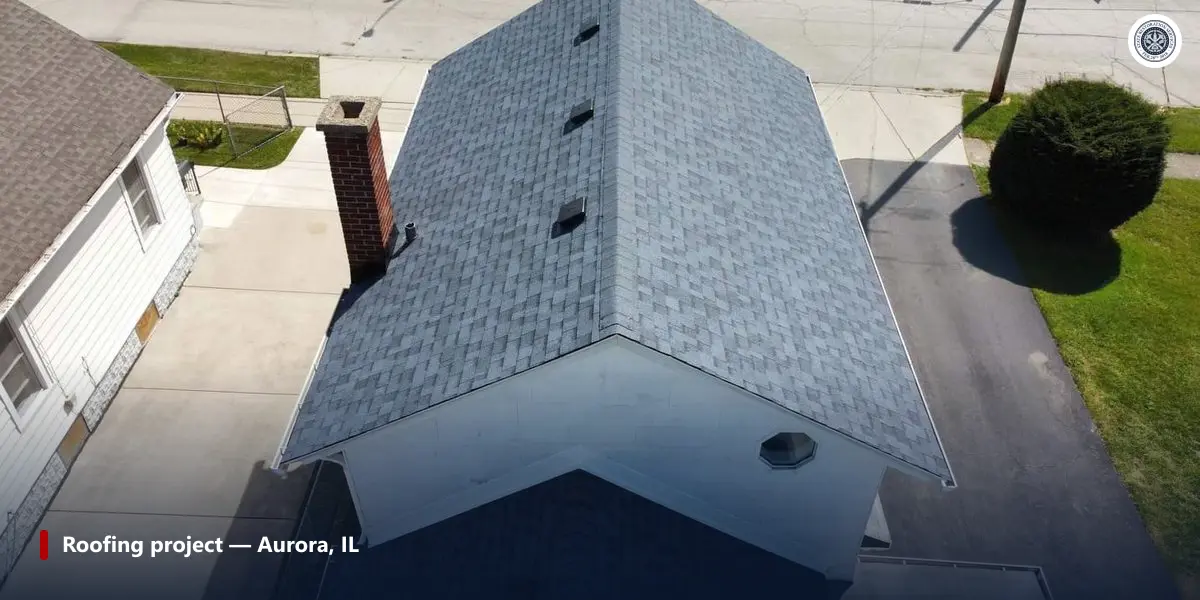
The day of a tear-off is the cheapest day in the life of every penetration on your roof, dryer cap included. The shingles are already off, the deck is exposed, and a cap that has been sitting on ten-year-old sealant can be reset properly for the cost of the part.
On our side of the job, that means the cap gets integrated into the roof the way a pipe boot does, not caulked on top of finished shingles. The base flange goes over the underlayment, the courses above it lap onto the flange, the courses below run under it, and water is handed downhill from one layer to the next without being asked to stop anywhere. Sealant belongs at the fasteners, backing up a lap that already sheds water on its own. If you want the longer version of how that logic applies to the other holes in your roof, our guide to roof pipe boot leaks walks through the same detail.
We will also flag placement while the deck is open. If the existing cap sits within three feet of a soffit vent, a ridge vent or an operable window in a dormer, moving it a few feet up the slope costs almost nothing during a full roof replacement and quite a lot as a separate trip later.
Who does which part, and what it costs
Being straight with you about scope: we are roofers. We handle the penetration, its flashing and the cap. The duct inside the house, the fittings that decide whether you pass the 35-foot test, and cleaning the run are the work of a mechanical contractor or a dryer-vent cleaning company, and we would rather point you at the right trade than pretend the whole system is ours.
In the north and northwest suburbs, replacing a dryer roof cap and flashing it properly as a standalone visit generally runs in the $250 to $600 range, because most of that number is the trip, the ladder and the shingle work around the flange rather than the hood itself. Folded into a storm-damage or insurance job or a full replacement, it is a minor line item on the estimate. We give you a firm number after we have looked at it, and we are not going to quote your roof from a phone call.
One thing we will not do is tell you the vent has to move because it looks wrong from the driveway. Plenty of roof-terminated dryers in Lake and Cook County have run fine for twenty years because somebody used smooth elbows, kept the run short and cleaned it. What we look at is the fitting count, the equivalent length and the condition of the damper.
Related reading: bathroom exhaust fans that vent through the roof covers the very different rule set that applies to bath and kitchen fans, and attic ventilation and roof heat explains why moist air in your attic shortens shingle life.
Frequently asked questions
Can I abandon the roof vent and move the dryer duct out through a wall?
Usually yes, and it is often the better system, because a short straight wall run is easier to clean and spends no time in a cold attic. The roofing side of that change is simple: the old hole gets decked, underlaid and shingled back in during a re-roof. Doing it on an intact roof means cutting into good shingles, so it is worth timing with a replacement if the roof is near the end anyway.
Does a dryer vent need a screen to keep birds out?
No, and it is not allowed to have one. M1502.3 states plainly that "screens shall not be installed at the duct termination." The backdraft damper is what keeps wildlife out: it hangs closed when the dryer is off. If a damper has been propped, painted or lint-jammed open, replace the cap rather than adding mesh.
Brown water drips from my dryer cap onto the shingles. Is the roof leaking?
Most often that is condensate from inside the duct, tinted by lint, rather than water getting past the flashing. The way to tell is from the attic: look at the underside of the deck around the penetration. Clean framing with a stained cap outside points at condensation; wet sheathing and rusty nails around the hole point at the flashing, and that one is ours to fix.
Can the dryer share a roof cap with the bathroom fan?
No. The code requires dryer exhaust systems to be independent of all other systems, so a shared cap is a violation regardless of how convenient the existing hole is. Beyond the code, it pushes lint-laden air toward the bathroom duct and gives moisture a second path into the ceiling.
Thinking about your roof? Book a free inspection or call (866) 992-2982 — we serve the north and northwest Chicago suburbs, Monday through Friday, 8:00 AM to 5:00 PM.