
 Volodymyr Lukaniuk
Quick answer: If you're weighing architectural vs 3-tab shingles for a Chicago-suburb roof, we install architectural (dimensional/laminate) shingles on close to every home now. They run roughly twice as heavy per square, carry wind ratings up to 110–130 mph against 60–70 mph for 3-tab, and hold up 25–30 real years in our freeze-thaw winters versus a realistic 15–20 for 3-tab. 3-tab is cheaper up front and still legal to install — it's just genuinely outmatched by what an Illinois roof deals with.
Almost every estimate we write gets some version of the same question: architectural or 3-tab? Usually it's asked by someone who found a lower number online and wants to know what they'd be giving up. Fair question. So here's the honest comparison of architectural vs 3-tab shingles — not the sales-pitch version — based on how each one actually holds up once a Chicago winter, a summer straight-line wind event, and twenty-five Illinois years get a vote.
What's actually different between architectural and 3-tab shingles?
A 3-tab shingle is one flat layer of fiberglass mat and asphalt, cut into three even tabs, so every shingle on the roof lies flush and looks identical. An architectural shingle is two or more layers laminated together, giving it a thicker, shadowed, dimensional look and roughly 50–100% more material per square.
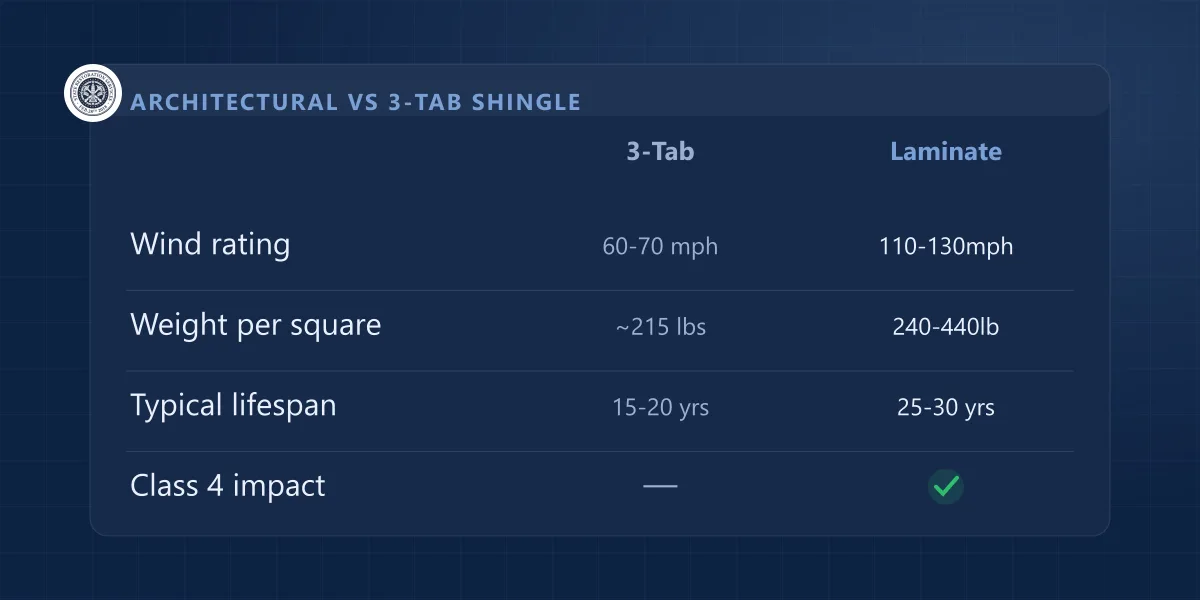
That construction difference isn't cosmetic — it's structural. The extra laminated layer is what gives architectural shingles their higher wind rating, their better impact resistance, and their longer realistic lifespan; it's also what makes them roughly twice as heavy per square (about 240–440 lbs versus roughly 215 lbs for 3-tab, depending on the product line). More material costs more to manufacture, which is the entire reason the price gap exists in the first place — it isn't a markup, it's a different amount of shingle.
Does wind rating actually matter here in Illinois?
Yes. Standard 3-tab shingles are typically rated for 60–70 mph winds when nailed correctly; most architectural lines are rated 110–130 mph. The north and northwest suburbs see straight-line wind events and the occasional derecho most summers, and that's exactly the kind of gust that peels an under-rated shingle back at the tab corners.
Wind rating isn't just a number on a spec sheet — it comes down to how much surface area is bonded down by the sealant strip under each shingle, and how much wind can get a grip on a lighter tab before that bond holds. A 3-tab shingle has less area for that seal to grip. We've pulled plenty of 3-tab roofs where a straight-line gust got under the tabs and stripped a whole section, while a heavier architectural roof a few doors down on the same street didn't lose a single shingle in the same storm.
| Spec | 3-Tab | Architectural |
|---|---|---|
| Weight per square | ~215 lbs | ~240–440 lbs |
| Wind rating (properly nailed) | 60–70 mph | 110–130 mph |
| Class 4 impact-resistant option | Rarely offered | Yes, most major lines |
| Manufacturer warranty | 20–25 year limited | 30-year to limited lifetime |
| Realistic lifespan in Illinois | 15–20 years | 25–30 years |
Can you get hail-resistant shingles in either style?
Mostly no for 3-tab. Class 4 impact-resistant shingles — tested to UL 2218 by dropping a 2-inch steel ball on the mat without cracking it — are made almost exclusively in architectural lines, things like GAF's Timberline AS II, Owens Corning Duration, and IKO Dynasty. A handful of insurance carriers offer a premium discount for a Class 4 roof, and it's worth asking your agent whether yours does.
Hail is the reason a lot of Chicago-suburb roofs get replaced years before they'd otherwise wear out, so that extra laminated layer matters here more than in most parts of the country. If you're already replacing a roof after storm damage, upgrading to a Class 4 architectural shingle is one of the few roofing decisions that can put money back in your pocket every year through a lower premium — just confirm the discount with your carrier first, since it varies by company and by ZIP code, and we can't promise a number that isn't ours to set.
How long do they really last through a Chicago freeze-thaw winter?
3-tab shingles are usually warrantied 20–25 years but realistically show granule loss, curling, and cracking by 15–20 in our climate. Architectural shingles carry 30-year-to-lifetime warranties and typically deliver 25–30 real years, because the thicker laminate resists the expand-and-contract cycle freeze-thaw puts every roof through.
Illinois doesn't hand you one hard winter — it hands you forty or fifty freeze-thaw cycles a season, and every single one of them expands and contracts whatever's nailed to your roof. A thin, single-layer 3-tab shingle has less mat to absorb that movement before it cracks along the cutouts between tabs, which is usually the first place a tired 3-tab roof starts to fail. A laminated architectural shingle flexes across two bonded layers instead of one, which is simply a better match for what our winters do to a roof, year after year.
What's the actual price difference, and is it worth it?
Architectural shingles typically run $450–$1,150 installed per square in our market, against roughly $350–$550 for 3-tab. On an average 20–24 square Chicago-suburb home, that's usually a $2,000–$4,000 difference for the whole roof — not double the price, because tear-off, underlayment, labor, and the permit cost the same no matter which shingle goes on top.
| 3-Tab | Architectural | |
|---|---|---|
| Installed cost per square | $350 – $550 | $450 – $1,150 |
| Typical whole-roof total (20–24 sq) | $7,000 – $13,000 | $9,000 – $18,000+ |
Since tear-off, dump fees, ice-and-water shield, and the permit are fixed costs regardless of which shingle you choose, the material upgrade doesn't double your bill — it adds a few thousand dollars for a shingle that outlasts 3-tab by a decade and shrugs off wind and hail that 3-tab simply can't. Run the math over 25 years and architectural is usually the cheaper roof, not the pricier one; you're just not paying for it twice.
Is there ever a good reason to still install 3-tab?
Sometimes — on a detached garage, shed, or low-visibility structure where wind and hail resistance matter less and budget matters more. We don't recommend it for a primary home roof in our climate, and we'll tell you that straight even if it costs us the sale.
We'll be honest: we install 3-tab rarely, and mostly on outbuildings where a shorter lifespan and lower wind rating aren't a big deal if it fails early. What we won't do is quietly steer you toward it on your house because it's the smaller number on the estimate — that's the kind of shortcut that turns into a wind claim five years later, and we'd rather lose the sale than write you a callback. If budget is the real constraint, ask about financing your roof before you downgrade the material; spreading an architectural roof over time usually beats owning a 3-tab roof outright, and it definitely beats replacing it twice.
Whichever shingle fits your home, we walk the roof in person before we quote it — browse residential roofing for the systems we install. We're based in Lincolnshire and work throughout Lake and Cook County, including Buffalo Grove and Northbrook.
Frequently asked questions
What's the main difference between architectural and 3-tab shingles?
Architectural shingles are laminated from two or more layers of fiberglass mat and asphalt, giving them a thicker, dimensional look, a higher wind rating, and a longer lifespan. 3-tab shingles are a single flat layer — lighter, cheaper, and rated for lower wind speeds.
Are 3-tab shingles still available in Illinois?
Yes, but availability has narrowed as manufacturers have shifted their lineups toward architectural shingles. We can still source and install 3-tab, though we typically only recommend it for outbuildings rather than a primary home roof.
Do architectural shingles really last longer in Chicago winters?
Yes. Architectural shingles typically deliver 25 to 30 real years in our freeze-thaw climate against a realistic 15 to 20 for 3-tab, because the thicker laminated construction resists the expand-and-contract cycle that cracks thinner shingles faster.
Is it worth paying more for architectural shingles?
For a primary home roof, yes. The price gap is usually $2,000 to $4,000 on an average home, not double, and in return you get a decade more lifespan plus far better wind and hail resistance.
Weighing shingle options for your roof? Book a free inspection or call (866) 992-2982 — we serve the north and northwest Chicago suburbs.
Related reading: what a new roof really costs in the Chicago suburbs and what's included in a proper roof replacement.