
 Volodymyr Lukaniuk
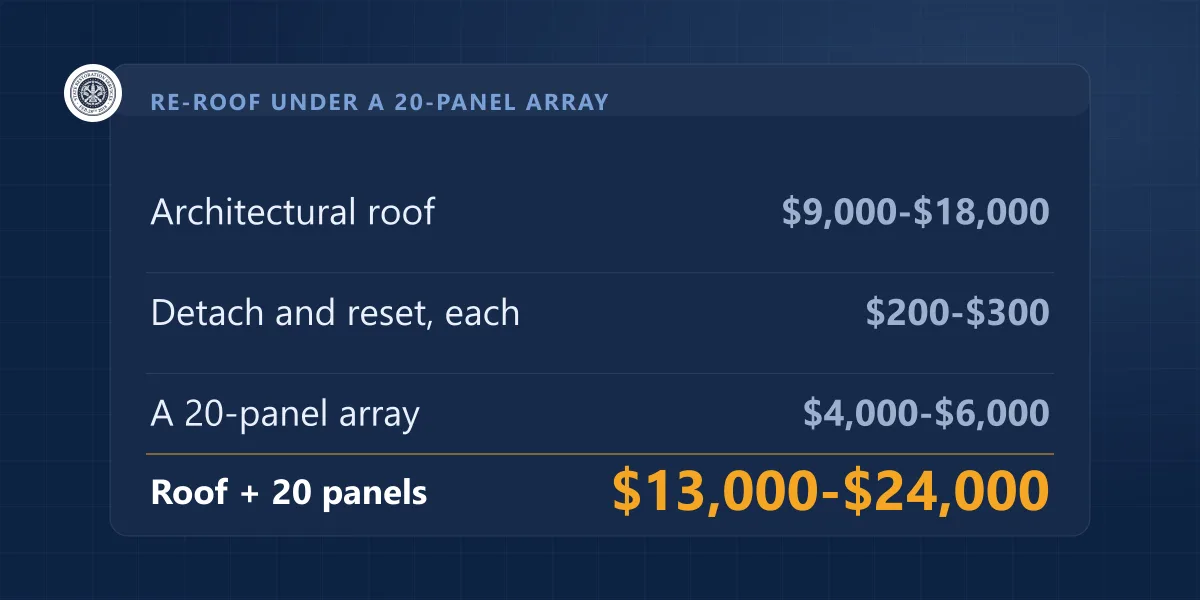
Quick answer: Yes, the panels come off first, and a licensed solar contractor does that work rather than your roofer. Detach and reset is commonly quoted around $200–$300 per panel, so a 20-panel array adds roughly $4,000–$6,000 on top of a $9,000–$18,000 architectural shingle roof. If the system is leased, the company that owns it has to authorize the removal before anyone climbs up.
A roof replacement with solar panels on it is two jobs that have to happen in the right order, by two different trades, and the array is not the roofer’s to touch. We are a family-owned roofing contractor in Lincolnshire and we work across the north and northwest Chicago suburbs. We install roofs, siding, gutters and windows. We do not install, service or move solar equipment, and this guide says so up front, because the sequencing is where these projects go wrong.
Below is the roofer’s half of the decision: what has to come off, who is allowed to take it off, what that adds to the bill, what an array does to your shingle warranty, and the code rule that decides whether the panels go back exactly where they were.
Do the solar panels have to come off to replace the roof?
Yes. A full replacement strips every shingle down to the wood deck, and there is no version of that job that happens underneath a mounted array. The panels, the rails they sit on and the feet bolted through the deck all come off. The roof gets built, then the system goes back up on new penetrations.
The reason this costs real money is underneath the feet. Each mounting foot is lagged into a rafter through a flashed hole, and that flashing is part of the roof you are tearing off. When the shingles go, the flashings go with them. So the reinstall is a fresh set of holes through a fresh roof, sealed and flashed again, which is real work rather than a formality. If a bid promises to shingle around your array, what you are buying is a roof with a permanent blind spot and an argument waiting underneath it about who owns the leak.
A repair is a different question. If a storm tore up an open slope and the array sits somewhere else, we work the open slope and the panels stay put. It is only a tear-off, or work on the slope the array occupies, that forces the removal.
Who removes the panels, and what does detach and reset cost?
A licensed solar contractor does it, and that is not us or any other roofer you call. Detach and reset is commonly quoted around $200–$300 per panel. Run that on a 20-panel array and it adds $4,000–$6,000 to the roof itself, which for architectural asphalt here runs $9,000–$18,000 installed.
Letting anyone outside that trade handle the array is how a panel warranty gets put at risk, so this is not the line to shop hardest on. Two practical notes on booking it. The detach and the reset are separate visits with a roof between them, so the solar contractor has to hold two dates around our schedule, and the roof has to be finished and dry before the array goes back. And the electrical side belongs to that contractor too, including reconnecting and re-commissioning the system. We build the roof; they own everything above it and everything with a wire attached.
Who you even ask depends on who owns the equipment, and that is the first thing to check.
| How the system is held | Who owns the panels | Who authorizes taking them off |
|---|---|---|
| Bought outright | You | You. Hire any licensed solar contractor. |
| Bought with a loan | You (the lender holds the debt, not the panels) | You, though the loan paperwork is worth reading first. |
| Leased | The solar company | The lease holder. Start there before you book a roof date. |
| Power purchase agreement (PPA) | The solar company | The agreement holder, same as a lease. |
The Department of Energy puts the lease and PPA case plainly in its homeowner’s guide to going solar: those arrangements “allow consumers to host solar energy systems that are owned by solar companies.” You host them. That means you cannot hand the array to a contractor of your choosing, and the removal may have to be done by whoever the agreement names, on their calendar and at their price. Find that out before a roof date is booked rather than after, because the solar crew, our crew and the dumpster all have to land in the right order.
Should you replace the roof before the panels go up?
If the roof is past roughly year twelve, do the roof first. Residential solar modules are sold on 25-year warranties, and an architectural asphalt roof in our freeze-thaw climate realistically gives 25–30 years. Those two numbers are meant to line up, and they only line up if both of them start at once.
The 25-year figure comes straight off the data sheets. The Qcells Q.TRON BLK M-G2+, to take one current residential panel, carries a 25-year product warranty and a 25-year performance warranty guaranteeing “at least 90.58% of nominal power up to 25 years.” The Department of Energy states the roof half in one sentence on that same guide: “You should also consider the age of your roof and how long until it will need replacement.” That line is the part of a solar decision a roofer can actually answer. Put a 25-year array on a 13-year-old roof and you have bought a detach and reset somewhere around year twelve of the array’s life, at whatever it costs then.
| Roof age when the array goes up | What that sets you up for | What we would tell you |
|---|---|---|
| New, or under 5 years | Roof and array age out together | Go ahead. This is the clean case. |
| 5–12 years | The roof may need doing before the array does | Get the roof inspected and decide on its condition, not the calendar. |
| Over 12 years | One detach and reset is close to certain | Replace the roof first. It is cheaper now than with panels on it. |
| Any age, with active leaks or soft decking | Deck problems get sealed under an array | Fix the roof first, without exception. |
If the roof falls in that middle band, condition beats age every time, and that is exactly what a free roof inspection is for. We walk it, photograph it and tell you how many years are realistically left, which is the number your solar quote actually needs. We have written separately on how long a roof really lasts in the Chicago freeze-thaw climate, including the signs that separate a roof that is old from a roof that is finished.
And if the answer is “the roof needs doing first” and the timing is awkward, that is a cash-flow problem rather than a roofing one. We publish financing options for exactly that gap.
Does the federal solar tax credit help pay for the roof?
No, on two separate counts. The Residential Clean Energy Credit “is not available for any property placed in service after December 31, 2025,” per the IRS, so a 2026 installation has no 25D credit to claim. And even while the credit ran, it never reached your shingles.
That second half is worth reading in the IRS’s own words, because advice written while the credit was alive routinely told homeowners to bundle a new roof into a solar project and take 30% off both. The IRS page on the credit says: “Traditional building components that primarily serve a roofing or structural function generally don’t qualify. For example, roof trusses and traditional shingles that support solar panels don’t qualify.” The narrow exception is a product that does both jobs at once — “solar roofing tiles and solar shingles do because they generate clean energy.” An ordinary asphalt roof under an ordinary rack was never a qualifying expense.
We are roofers, so take the tax question to whoever prepares your return, and take state and utility program questions to your solar contractor. What we can tell you is that no version of this makes the roof cheaper, and any quote that leans on a federal credit to justify the roof line is leaning on something that is no longer there.
What does an array do to your shingle warranty?
It survives, with one expensive gap. The major shingle manufacturers do not treat a properly installed solar system as a warranty-voiding event, so the coverage stays in force with panels on top of it. What none of them covers is the cost of taking the array off so a defective shingle can be reached. That bill lands on you.
The trade press has put this to the manufacturers directly. Solar Power World’s survey of shingle warranties reports that “GAF warranties will remain in place if a solar system is installed over its roofing products,” with the caveat that if the system has to come off for GAF to inspect defective shingles, “that cost is not covered by its warranty.” Owens Corning takes the same position: it “will not cover the cost of removing a solar system to replace a defective roofing product covered by their standard warranty.” We install GAF, Owens Corning and IKO systems, so this is the shape of what you are holding either way.
| Situation | Covered by the shingle warranty? | Who pays to move the panels |
|---|---|---|
| Manufacturing defect in the shingle itself | Yes, the shingle is covered | You. Removal is excluded. |
| Leak at a solar mounting penetration | No. Not a shingle defect. | Whoever drilled it. Read the solar contract. |
| Shingles damaged during the solar install | No. Install damage is not a defect. | The party that caused it. |
| Storm damage to the roof | Not a warranty matter at all — this is an insurance claim | Ask whether it belongs on the claim. |
So the practical value of a limited lifetime warranty drops once an array sits on top of it: the manufacturer still sends the shingle, and you still pay the crew that has to uncover it. That does not argue against solar. It argues for putting the array on a roof young enough that you never have to test the warranty. Our fuller breakdown of manufacturer versus workmanship coverage covers what else quietly ends a warranty, and third-party penetrations are on that list.
Will the panels go back exactly where they were?
Usually they do, but plan for the possibility that they do not. The reinstall gets inspected against the code your village enforces now, not the edition in force when the array first went up. The International Residential Code sets fire-access pathways and ridge setbacks, and an array laid out generously years ago can come back smaller.
Two provisions do the work. On pathways, IRC section R324.6.1 requires “not fewer than two pathways, on separate roof planes from lowest roof edge to ridge” and “not less than 36 inches wide,” and “not fewer than one pathway shall be provided on the street or driveway side of the roof.” On the ridge, R324.6.2 requires an 18-inch clear setback on both sides of a horizontal ridge for arrays covering up to 33% of the plan-view roof area, and a 36-inch setback once the array covers more than that. A house with a sprinkler system built to NFPA 13D gets more room under R324.6.2.1, where those thresholds move to 66%.
Which edition applies to your house is a genuinely local question, and Illinois made it a checkable one. Public Act 103-0510 amended the Capital Development Board Act effective January 1, 2025: a municipal or county building code has to meet a baseline that includes the International Residential Code “published in the current year or preceding nine calendar years,” and any municipality enforcing a code has to report that code, by title and edition, to the state. The Capital Development Board publishes the results as the Illinois Municipal Code Directory, so you can look up your own village rather than guess. Ask the solar contractor to confirm the layout against that edition before the panels come down, not after.
Permits split the same way the work does. We pull the roofing permit and it is priced into the roof; the electrical and solar permits belong to the solar contractor. Neither of us can pull the other’s.
What happens on a storm claim when there are panels on the roof?
The detach and reset is a real line item, and it is worth raising early because nobody can replace a slope they cannot reach. Illinois law bars a roofing contractor from negotiating an insurance claim, so we document the damage and build a code-compliant estimate; our partner, the licensed public adjuster State Adjusting Services, can represent you on the claim.
One thing we can speak to as roofers is the damage pattern. Panels physically shield the shingles beneath them, so hail lands on the exposed field and on the panels while the covered strip takes far less. That makes for an uneven slope, and it makes photographs of both the covered and uncovered areas worth having before anything is moved. Document it, and leave the coverage argument to the people licensed to have it. If a storm is what started this, our storm and insurance claim team is the right first call, and our walk-through of how to prepare your house for a roof replacement covers the rest of the day, from the driveway to the dish on the gable.
We also want to be honest about the thing we cannot do here. The panels, the wiring, the inverter, the monitoring and the production numbers after the reset are all the solar contractor’s responsibility. If your system comes back online reading differently than it did, that conversation is theirs. We are responsible for the roof underneath it, and we warrant that.
Related reading: what a new roof really costs in the Chicago suburbs and what a real free roof inspection covers.
Frequently asked questions
Can a roofer remove and reinstall my solar panels?
No. Detaching and resetting an array is solar work and it should go to a licensed solar contractor. We are cautious about liability, and there is a harder reason underneath it: panel warranties are written on the condition that qualified people handle the equipment. We coordinate dates with whoever you hire, and we build the roof in between.
How much does it cost to remove and reinstall solar panels for a new roof?
Detach and reset is commonly quoted around $200–$300 per panel. On a 20-panel array that is $4,000–$6,000 on top of the roof, which for architectural asphalt in the Chicago suburbs runs $9,000–$18,000 installed. Get the solar contractor’s number in writing before you sign a roofing contract, because it is a real part of the project total.
Can I replace my roof if my solar panels are leased?
Yes, but not on your own schedule. Under a lease or a power purchase agreement the solar company owns the equipment, so it has to authorize the removal, and the agreement may require its own crew to do the work. Call the lease holder before you book a roof date rather than after.
Should I replace my roof before installing solar panels?
If the roof is past roughly year twelve, yes. A 25-year panel warranty and an architectural asphalt roof that realistically gives 25 to 30 years here are meant to run together, so starting them at the same time avoids paying for a detach and reset mid-life. Between years five and twelve, have the roof inspected and decide on its condition rather than its age.
Planning a roof under an array, or a roof before one? Book a free inspection or call (866) 992-2982 — we install architectural asphalt and metal roofing systems across the north and northwest Chicago suburbs, including Buffalo Grove, and we will tell you straight whether the roof needs doing before the panels do.