
 Volodymyr Lukaniuk
Quick answer: A roof valley is the line where two roof planes meet and dump their water into one channel. There are four ways to finish one: open metal, closed-cut, woven, and the California valley. For Illinois freeze-thaw, open metal sheds ice and debris best, closed-cut is the sensible everyday choice, and woven does not belong on architectural shingles at all.
Every roof valley on your house is doing the work of two roof planes at once. Everything that lands on both slopes gets funnelled into a channel a few inches wide, and then we ask that channel to survive a Chicago January. So when a homeowner in Northbrook or Palatine calls us about a ceiling stain that runs on a diagonal, we have a good idea where we are headed before the ladder comes off the truck.
The odd part is how rarely a valley gets discussed before the work starts. Most bids we are asked to review say nothing about the valleys at all — and how yours get built is a real decision with a real price attached, not something the crew settles on the morning of the tear-off.
What is a roof valley, and why does it leak before the rest of the roof?
A valley is the internal angle where two sloped roof planes meet. It concentrates the runoff from both planes into one narrow path, so it carries far more water, ice and debris per foot than any other part of the roof. That concentration, not bad shingles, is why valleys show up first in leak calls.
Three things pile up in a valley and nowhere else. Water volume is the obvious one. Debris is the second: pine needles, maple seeds and shingle granules all wash downhill and stop where the slope changes, which is exactly where you do not want a dam. Ice is the third and the worst — a valley holds snow longer than an open field of shingles because two planes shade it, and meltwater running down it refreezes near the eave where the roof is coldest.
None of that is a defect; it is what a valley is for. The job of the valley detail is to move that concentrated load off the roof without letting any of it get underneath, and the four methods below do it with different amounts of margin.
What are the four roof valley types?
There are four: open (exposed metal down the centre), closed-cut (one plane's shingles run through, the other is cut back), woven (both planes interlaced course by course), and California (a shingle laid vertically up one side, then cut over). Each is built differently and fails differently.
| Method | How it is built | What to watch |
|---|---|---|
| Open | Metal flashing runs down the centre and stays visible; shingles are cut back on both sides in a widening V. | The metal must be fastened only at its outer edges. A nail driven through the channel will leak; it is only a question of when. |
| Closed-cut | One plane's shingles run past the centreline; the other plane is laid over and cut in a straight line about two inches off centre. | The straightness of the cut, the nail-free zone, and whether the lining underneath is actually there. You cannot see it once it is done. |
| Woven | Shingles from both planes alternate across the valley, each course carrying onto the opposite slope. | Laminated shingles are too thick to lie flat woven — they crack and bridge. Manufacturers rule this out, as below. |
| California | A shingle is run vertically up one side of the valley, then the field shingles from the other plane are cut over it. | Fast, which is why it turns up uninvited. Permitted only on certain shingles at certain slopes. |
Open valleys earn their keep on long runs, shallow pitches and tree-covered lots. Closed-cut is the default on most Chicago-area reroofs. Woven belongs to the era of three-tab shingles and is genuinely rare on new work now.
Which roof valley holds up best in an Illinois winter?
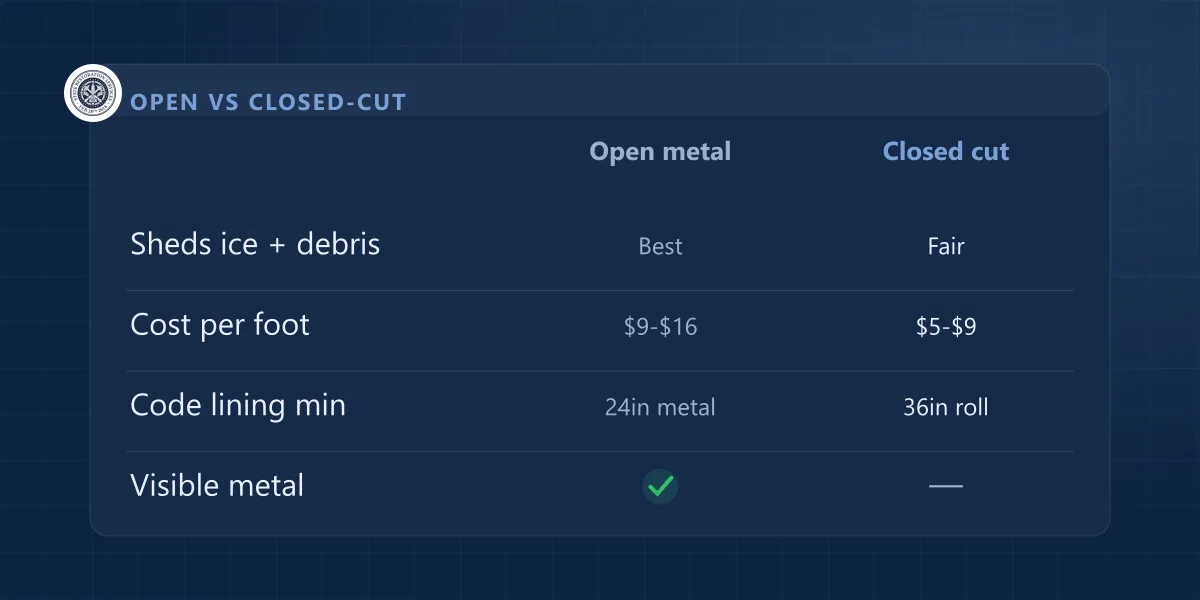
Open metal, by a clear margin. A smooth metal channel sheds sliding snow, ice and needles that a shingled valley catches on its granules. Closed-cut is a solid second and is what most north-suburb roofs get. Woven is last, and on architectural shingles it should not be on the list at all.
The reason is friction. A closed-cut valley is a granule surface, and granules grab. In a normal rain that means nothing. In late January, when a thaw sends meltwater down the valley over a roof that is still below freezing at the eave, that rough surface holds a film of water long enough for it to freeze — and now you have a small ice dam sitting in the one place on the roof where the most water has to pass. We wrote about the eave version of that problem in our guide to why ice dams form on Illinois roofs; the valley version is the same physics in a narrower space.
That does not make open metal the right call on every house, and we do not sell it that way. On short, steep valleys with no trees over them, a properly built closed-cut valley will outlive the shingles above it. Where we push for open metal is the specific case: a long valley, a shallow pitch, a big roof plane draining onto a small one, or mature oaks that fill the valley with mulch for six months a year.
What does the code actually require in a valley?
The International Residential Code, section R905.2.8.2, sets minimum valley linings by method: an open valley lined with metal must be at least 24 inches wide, and a closed valley needs at least one ply of 36-inch smooth roll roofing. Self-adhering polymer-modified bitumen underlayment — what everyone calls ice-and-water shield — is permitted instead of either lining.
That last sentence is the useful one. Ice-and-water shield in a valley is not a premium add-on somebody thought up to pad an estimate; it is a lining the code names by standard. We run it into every valley before the shingles go on, on every roof, which is the same thing we say about it in our guide to the flashing details that cause most roof leaks.
| Requirement | Open valley | Closed-cut or woven |
|---|---|---|
| Minimum lining (IRC R905.2.8.2) | Corrosion-resistant metal, 24 in wide minimum | One ply of 36 in smooth roll roofing minimum |
| Accepted alternative | Self-adhering polymer-modified bitumen underlayment (ASTM D1970) | |
| Fasteners near the centre | None through the metal channel; secure at the outer edges only | Nothing within about 6 inches of the centreline |
| Shingle run past centreline | Cut back on both sides, widening toward the eave | Through-plane shingles run at least 12 inches past centre |
One Illinois wrinkle: until recently a village could adopt whatever code edition it liked, or none at all. Public Act 103-0510 moved the state to a statewide building code baseline effective 1 January 2025, but municipalities still amend, and Lake and Cook County villages do not always land in the same place. Your village permit desk will tell you which edition they enforce — a better source than any roofer's memory, ours included.
The manufacturer rule most bids get wrong
Shingle warranties are written on top of the code, not instead of it, and on valleys the manufacturers are stricter than the code is. GAF's technical bulletin on valley flashing options requires laminated shingles — the Timberline series and every other architectural shingle — to be installed with an open or closed-cut valley, because laminated shingles crack and break when they are bent into a weave.
Read that against what is on almost every Chicago-suburb roof: architectural shingles. So a bid specifying "woven valleys" on an architectural-shingle roof is not a stylistic preference — it is an installation the manufacturer has ruled out, and it is the first thing an inspector looks at if the roof ever has a manufacturing claim.
The California valley has its own rule. GAF's bulletin on closed-cut California valleys permits them on Timberline shingles at slopes of 4:12 or steeper unless local code says otherwise, and does not recommend them on GAF's other shingles. We are not against the method — on the right shingle at the right pitch it is sanctioned. We are against finding out about it afterwards. Ask.
What should the valley line on your estimate say?
It should name the method, the lining, and the metal. Four short specifics turn a vague line into something you can hold a contractor to, and any roofer worth hiring can produce them without breaking stride. If nobody can tell you which valley you are buying, you are not comparing bids yet — you are comparing numbers.
- The method, by name. "Open valley", "closed-cut valley", "California valley". Not "valleys as needed".
- The lining and its width. Ice-and-water shield or roll roofing, and how wide. This is the layer you will never see again after day one.
- The metal, if the valley is open. Material, gauge and colour — painted 26-gauge galvanized steel and 24-gauge are both common, and the colour should be chosen against your shingle rather than whatever is on the truck.
- Linear feet of valley. A typical suburban house has somewhere between 30 and 80 feet of it. If two bids differ by a lot of money, the valley footage is one of the first places to look.
This is the same exercise we walk through in our guide to reading a roofing estimate line by line, and it is exactly the kind of question a door-knocker who arrived in town after the last hailstorm tends to answer with enthusiasm rather than a number.
What does a roof valley cost in the Chicago suburbs?
As part of a full roof, a closed-cut valley runs roughly $5 to $9 per linear foot and an open metal valley roughly $9 to $16, with the metal, the pitch and the access driving where you land in the range. Rebuilding one valley on an otherwise sound roof is a different job and prices differently.
| Work | Typical north-suburb range | What moves it |
|---|---|---|
| Closed-cut valley, during a full reroof | $5–$9 per linear foot | Pitch, valley length, shingle line |
| Open metal valley, during a full reroof | $9–$16 per linear foot | Metal gauge and finish, pitch, number of valley terminations |
| Ice-and-water shield lining in the valley | Included in our reroofs; roughly $2–$4 per linear foot as a standalone line | Width used, whether the deck needs prep first |
| Rebuilding one failed valley on an existing roof | $400–$1,200 | Length, access, whether the deck under it is rotted, shingle availability for the tie-in |
Two honest notes on that last row. A valley repair on a roof that is already near the end of its service life is usually money spent twice, and we will say so on site rather than take the repair. And nobody can price rotted decking under a valley before the shingles come off, because nobody can see it — a firm all-in number for that sight unseen is a guess, and guesses go up, never down. If the whole roof is in question, our page on residential roof replacement covers what a full job includes, and there is financing if the timing is bad.
Can valley damage be an insurance claim?
Sometimes. Exposed valley metal is soft metal, so it dents like a gutter does — and dents in valley metal are one of the things an adjuster can actually see and date. Wind can lift shingles along a valley edge too. Age, granule loss and a bad original cut are not storm damage, and no adjuster will call them that.
Where it gets useful is when the valley metal is part of a wider hail inspection. Soft metals across the property — valley flashing, gutters, downspouts, vents, the aluminum on a window wrap — corroborate each other. If a storm hit hard enough to bruise the valley metal, that is evidence about what it did to the shingles, which is the same logic we described in our guide to hail damage on gutters and downspouts.
One thing we cannot do, and want to be plain about: Illinois law does not permit a roofing contractor to negotiate an insurance claim on your behalf. We inspect, we document what we find with photographs and measurements, and we build a code-compliant estimate. If the claim itself needs someone in your corner, our affiliated licensed public adjuster, State Adjusting Services, can represent you on it. Our storm and insurance page lays out how that split works.
Related reading: Roof Flashing 101: The Cheap Part That Causes Most Leaks and What's Actually Included in a Full Roof Replacement.
Frequently asked questions
Are open valleys better than closed valleys?
Open metal valleys shed ice, snow and debris better and generally last longer, which matters most on long valleys, shallow pitches and tree-covered lots. Closed-cut valleys look cleaner and cost less, and on a steep roof with short valleys they will comfortably outlast the shingles. Pick based on valley length, pitch and how much tree debris lands up there.
Can you weave architectural shingles in a valley?
No. Laminated shingles are too thick and stiff to lie flat through a weave, and GAF requires laminated shingles such as the Timberline series to use an open or closed-cut valley instead. If a bid on an architectural-shingle roof specifies woven valleys, ask the contractor to point you to the manufacturer instruction that allows it.
Do roof valleys need ice-and-water shield in Illinois?
The code lets self-adhering polymer-modified bitumen underlayment serve as the valley lining, and in a freeze-thaw climate that is the version worth having, because a valley holds snow and refreezing meltwater longer than the open field of the roof does. We put it in every valley regardless of what the local amendment requires.
How long should a roof valley last?
A correctly built valley should last as long as the shingles above it, so 20 to 25 years or more on an architectural roof. Valleys that fail early usually fail for a reason you can name: a nail driven through the channel, a lining that was never installed, a woven valley on a shingle that should not have been woven, or debris nobody cleared for a decade.
Not sure which valley you have, or why one of them is staining a ceiling? Book a free inspection or call (866) 992-2982 — we are a family-owned Illinois roofing contractor based in Lincolnshire, serving the north and northwest Chicago suburbs across Lake and Cook County, Monday through Saturday.