
 Volodymyr Lukaniuk
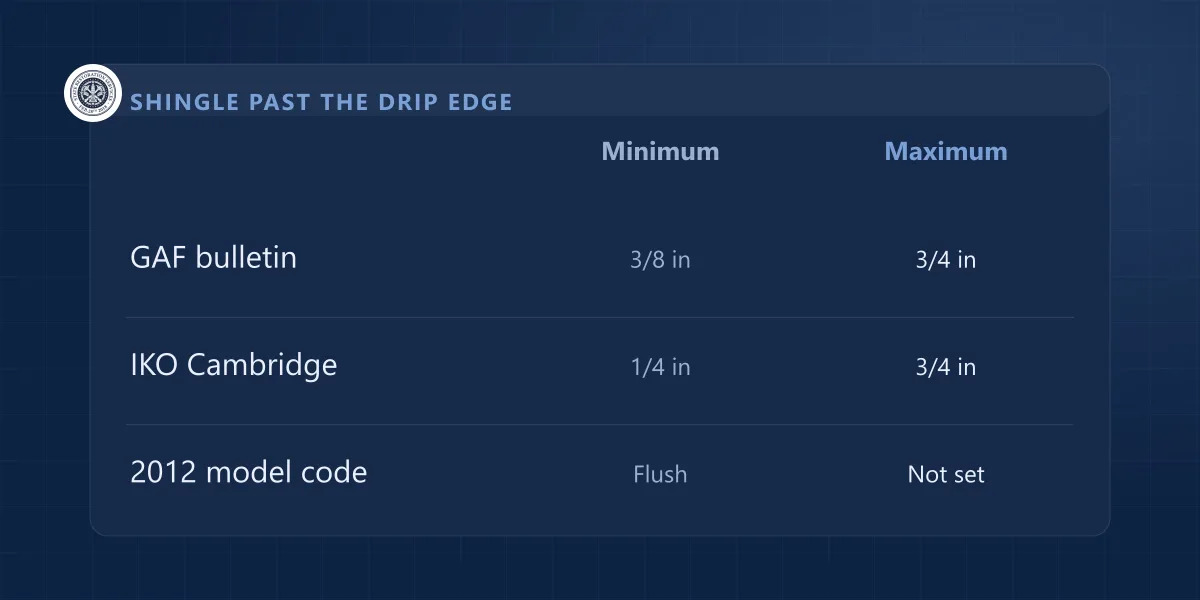
Shingle overhang should be between a quarter inch and three quarters of an inch past the drip edge, at the eaves and at the rakes. GAF prints 3/8 to 3/4 inch. IKO prints 1/4 to 3/4 inch. Past 3/4 inch the shingle edge hangs in the air with nothing under it, and that is where it cracks.
So the whole argument fits inside half an inch. We install both of those brands in the north and northwest Chicago suburbs, and the roof edge is a place where we often find guesswork left by crews who never read the wrapper. Below are the printed numbers, the one case where flush is allowed, and a way to check your own roof without a ladder.
What do GAF, IKO and the building code print about shingle overhang?
The two manufacturers agree on the top of the range and differ by an eighth of an inch at the bottom. The model building code sets no overhang at all: it permits shingles flush with the metal unless the shingle maker says otherwise. Both makers do say otherwise, so their instructions decide.
| Document | Least overhang | Most overhang | Flush with the metal? | Nailing of the drip edge |
|---|---|---|---|---|
| GAF bulletin TAB-R-141 | 3/8 in (9 mm) | 3/4 in (19 mm) | Only when the drip edge itself sticks out from the fascia (D type) | Every 8 to 10 in, or as local code requires |
| IKO Cambridge application instructions | 1/4 in | 3/4 in | Not offered in this document | About 12 in apart |
| 2012 International Residential Code, R905.2.8.5 | None | None | Permitted, unless the shingle maker specifies differently | 12 in on center at most |
Sources read on October 13, 2026: GAF Technical Advisory Bulletin TAB-R-141, Drip Edges and Shingles; IKO Cambridge application instructions; the International Code Council's page on the 2012 drip edge rule.
The code sentence is short enough to quote:
Unless specified differently by the shingle manufacturer, shingles are permitted to be flush with the drip edge.
IKO's instruction for the starter row is just as short: "It should overhang the eaves and rake edge by 1/4" to 3/4"." The first full course then goes on flush with that starter, so the starter sets the line for everything above it. We wrote about that hidden row in starter strip shingles at the eaves and rakes.
We also install Owens Corning. Its figure is printed in the installation instructions on the bundle wrapper, like every other brand's, and the wrapper on your roof's shingle is the number that counts for your roof.
The half inch that matters, drawn to scale
The bar below is one inch long. Zero is the outer lip of the drip edge. Read it left to right as the shingle sticking out farther and farther.
- Flush to 1/4 inch. The code allows flush. GAF allows it only over a D-type edge. IKO's Cambridge sheet starts at 1/4.
- 1/4 to 3/8 inch. Inside IKO's range, under GAF's minimum.
- 3/8 to 3/4 inch. Inside both ranges. A crew that aims for half an inch lands here on either brand.
- Past 3/4 inch. Outside both. GAF says the shingle is no longer supported.
Three measurements that share the word overhang
Half the confusion at the kitchen table comes from one word doing three jobs. A roofer, a code book and a real estate listing can each say "overhang" and mean a different distance.
- Shingle overhang
- How far the shingle edge reaches past the outer lip of the drip edge. This is the 1/4 to 3/4 inch on this page.
- Drip edge drop
- How far the metal hangs below the roof sheathing. The 2012 code asks for at least 0.25 inch, with the top flange running at least 2 inches up the deck and neighbouring pieces lapped at least 2 inches. People read that quarter inch and think it is the shingle number. It describes the metal.
- Roof overhang
- The part of the roof framing that sticks out past the house wall, usually by a foot or more. Its underside is the soffit. If that is what you came for, our pages on the underside of a roof overhang and the edge of the roof name the parts.
What goes wrong when shingles hang over too far?
An asphalt shingle is stiff only while something is under it. GAF's bulletin puts the limit and the reason in three sentences:
Shingles should not extend more than 3/4" (19 mm) past the drip edge. If shingles overhang the edge of the roof by more than 3/4" (19 mm), then they are not supported and may crack and break off. In addition, the wind resistance at the roof edge may be compromised.
You can often spot the result from the driveway. The bottom row droops toward the gutter, and in time corners of it are missing. A long lip also hides a crooked cut from anyone standing on the lawn, which is one reason a crew in a hurry to reach the next hail town leaves one.
And when they stop short of the edge?
Then the water can miss the gutter on the house side. With a plain L-shaped edge and a shingle cut flush or short, runoff can cling to the metal, run down the face of the fascia and get behind the gutter. GAF's bulletin says that where there is a gutter, the shingles should overhang its inside edge so the water goes into the gutter and not down the face of the building. Dark streaks on the fascia board behind a gutter that is not clogged can point to the roof edge above it, though the gutter usually gets the blame. The same bulletin adds that "L" metal is not a suitable drip edge in the first place.
How to check your own roof edge without a ladder
You do not need to go up. A dry day, a pair of binoculars or a phone camera on zoom, and ten minutes will tell you most of it.
- Stand back from the house, in line with the eave, and sight along the bottom row of shingles. The line should be straight and the lip even from end to end. A wavy edge means the cut wandered.
- Look for a thin strip of metal under that bottom row, between shingle and gutter. That is the drip edge. If you see bare wood or only the gutter, there may be none.
- Compare the shingle lip with something of known size. A standard K-style gutter is 5 or 6 inches across the top, so a lip that covers a quarter of the gutter opening is far past 3/4 inch.
- Check the rakes, the sloped edges at the gable ends. They have no gutter, so the lip is easy to see against the sky. Look for corners that have snapped off.
- Open an upstairs window that looks down on a lower roof, such as a porch or garage. From there you can see the edge from above and hold a tape near it without stepping out.
- After a steady rain, look at the fascia behind the gutter. Is it wet, or streaked?
- Take photos of anything odd, with the date.
If two or three of those look wrong, it is worth having the edge looked at up close. That is part of what we do on a free roof inspection.
Can the overhang be corrected on a roof that is already on?
A long overhang can be trimmed back to a straight line while the shingles are sound, and it is a small job. A short one can't be stretched. There the fix is in the metal: a drip edge or gutter apron slid under the first row so the water lands in the gutter. Our article on gutter flashing explains that piece. If the bottom row has already cracked along the edge, those shingles come out and new ones go in on a proper starter.
On a full roof replacement the edge is rebuilt anyway. The edge metal, the starter and the first course go on in that order, and the overhang is set once, with a tape, before the second row is nailed. Ask your roofer what number the crew sets and which document it comes from. A good one answers without looking it up.
Does the shingle warranty cover a bad roof edge?
No. GAF's bulletin says its shingle warranty "only covers manufacturing defects in the shingles and does not cover the drip edge or damage due to their installation." A shingle that broke because it hung too far was installed that way, so the claim goes to whoever installed it, under the workmanship warranty. Our guide to manufacturer and workmanship roof warranties shows which paper answers for what. One more GAF line worth knowing: metal drip edge at the eaves is required when a Silver Pledge or Golden Pledge warranty is sought.
Roof edge questions homeowners ask us
Should shingles overhang the drip edge or sit flush with it?
Overhang it, by 1/4 to 3/4 inch on IKO and 3/8 to 3/4 inch on GAF. The 2012 model code permits flush unless the manufacturer specifies differently, and GAF allows flush only when the drip edge is a D type that extends out from the fascia.
Is one inch of shingle overhang too much?
Yes, by both documents we read. GAF and IKO each stop at 3/4 inch. GAF's bulletin says shingles past that point are not supported and may crack and break off, and that wind resistance at the roof edge may be compromised.
Is the overhang the same at the rake as at the eave?
The printed range is the same. GAF gives 3/8 to 3/4 inch at both the eave edge and the rake edge, and IKO gives 1/4 to 3/4 inch for both. The difference is under the shingle: underlayment goes over the drip edge at the eaves and under it at the rakes.
Is a drip edge required on a shingle roof in Illinois?
The model code has required one at eaves and gables of shingle roofs since its 2012 edition, but each village adopts its own code, so ask your building department which edition applies. GAF requires metal drip edge wherever local code does, and strongly recommends it on every roof.
Related reading: why flashing causes most roof leaks and what a full roof replacement includes.
Not sure your roof edge was cut right? Book a free inspection or call (866) 992-2982, Monday to Friday, 8:00 AM to 5:00 PM. We work across the north and northwest Chicago suburbs.