
 Volodymyr Lukaniuk
Quick answer: Soffit is the panel under your roof overhang; fascia is the board behind it that caps the rafter ends and holds your gutters. Most Chicago-area homes have aluminum-wrapped wood or solid aluminum, and both usually fail from hidden moisture or animal entry long before the roof itself wears out. A full fascia wrap and soffit replacement on an average home runs roughly $1,800–$4,500; a simple scrape-and-repaint touch-up is $150–$400. Storm damage can be a claim — rot from years of neglect or a family of squirrels is not.
Stand under your roof edge and look up. The flat panel running horizontal, sometimes with little slotted holes in it, is the soffit. The board it's nailed against — the one your gutters are actually screwed into — is the fascia. Together they close off the underside of your roof overhang, and on a lot of the homes we work on around Buffalo Grove, Wheeling and Northbrook, that's the most neglected 30 linear feet on the whole house. Nobody looks up there until a gutter starts sagging or something with a tail finds a gap.
What do soffit and fascia actually do?
Soffit closes the underside of your roof overhang and, on most homes, carries the intake vents that feed fresh air into the attic. Fascia is the vertical board at the roof edge that caps the rafter tails and gives your gutters something solid to hang from. Lose either one and you lose ventilation, gutter support, or both.
They don't get much credit because they're not the roof and they're not the gutters — they're the trim in between. But we've pulled ridge vents off attics that were still baking at 150°F in July because the soffit vents underneath were painted shut or blocked with blown-in insulation, so the ridge had nothing to pull air from. We wrote a whole guide on how attic ventilation actually works if you want the deeper explanation, but the short version is: exhaust vents at the ridge only work if intake vents at the soffit are open and unobstructed. A pretty ridge vent installed over a blocked soffit is decoration, not ventilation.
What's actually on your house, and what holds up best?
Most homes built or re-sided in the last 30 years around here have one of a handful of combinations. None of them are wrong — they just fail differently in an Illinois freeze-thaw climate.
| Material | Where it's used | Realistic lifespan | Chicago-weather notes |
|---|---|---|---|
| Solid aluminum soffit | Soffit | 25–35 yrs | Won't rot; can dent from hail or a ladder mishap |
| Vinyl soffit | Soffit | 20–25 yrs | Cheaper, but can warp or crack brittle in a hard cold snap |
| Aluminum-wrapped wood fascia | Fascia | 20–30 yrs on the wrap | Looks fine long after the wood underneath has started to go — the wrap hides rot, it doesn't stop it |
| Raw, painted wood fascia | Fascia | 10–15 yrs without upkeep | Needs repainting every 3–5 years or moisture gets in fast |
| Fiber cement fascia | Fascia | 30+ yrs | Holds paint well, doesn't rot, costs more to install |
Why does fascia rot before anyone notices?
Fascia rots from the back, where you can't see it, because that's where the water actually reaches it — not the front, where the paint is. A gutter that's overflowing behind the fascia, or an ice dam backing meltwater up under the shingles and down behind the drip edge, soaks the hidden face of that board for months before anything blisters on the side you can see from the driveway.
We see two repeat causes. First, gutters that were never pitched right or that have been full of leaves for a season or two — water finds the path of least resistance, which is straight down the back of the fascia instead of into the downspout (our gutter pitch and downspout guide covers the fix). Second, ice dams: we've written about why ice dams actually form in an Illinois attic, and the same backed-up meltwater that leaks into a ceiling also runs behind the fascia board at the eave, all winter, every winter, until it finally gives.
What are the actual warning signs?
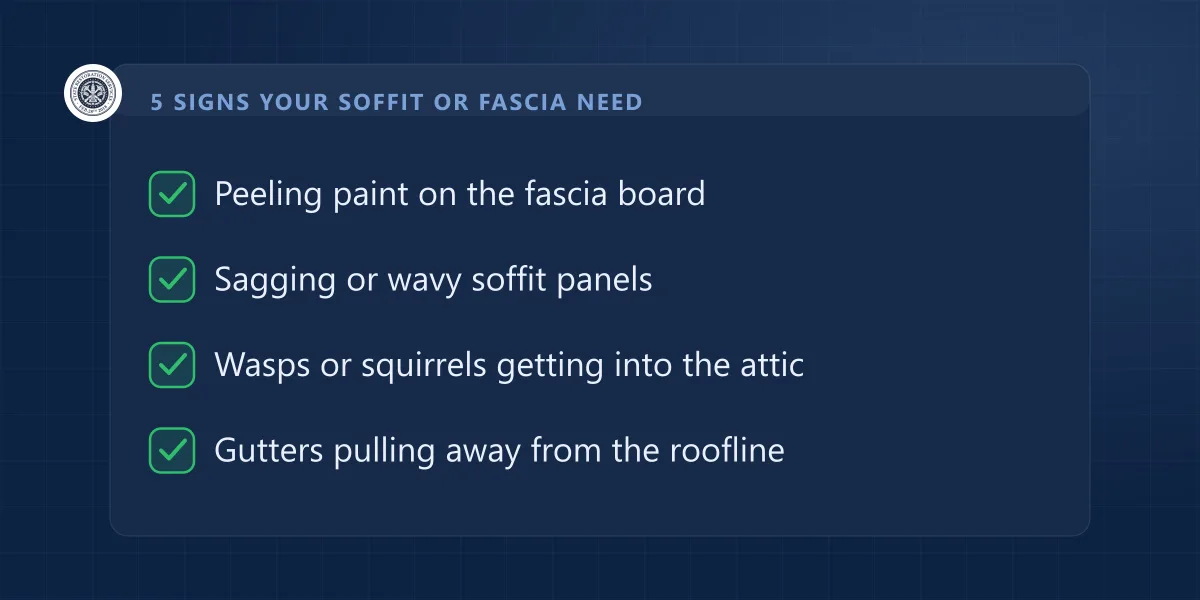
Peeling paint, sagging soffit panels, wildlife getting into the attic, gutters pulling away from the roofline, and dark rot streaks at the bottom edge of the fascia are the five signs we look for first. Any one of them on its own is worth a look; two or more together usually means the problem has been building for a while.
The wildlife one deserves its own paragraph, because it's the call we get most often once the leaves are down. A squirrel doesn't need much — a soft, half-inch gap where a soffit panel has come loose is an open door, and once one gets in, the chewing to widen that gap does more damage in a month than the original rot did in five years. If you're hearing scratching in the attic before dusk, that's not a roofing problem yet, but it's about to become a soffit-and-fascia one.
Repair, patch, or full replace?
The call comes down to how much of the run is actually compromised, not how bad the worst spot looks. A single soft section doesn't justify tearing off 40 feet of good material.
| What you're looking at | What we'd actually do |
|---|---|
| Peeling paint, wood underneath is still solid | Scrape, prime, repaint — or wrap it in aluminum so you never paint it again |
| One or two soft or rotted sections | Cut out and splice in new fascia board, re-wrap that run |
| Soffit panels sagging or gapped in several spots | Replace the full run, not just the gap — matching 15-year-old aluminum color is a losing game |
| Rot at multiple corners, gutters starting to pull loose | Full fascia and soffit replacement, usually paired with a gutter reset |
What does it cost in the Chicago suburbs?
Prices vary with how much linear footage is involved, how many corners and dormers you have, and whether soffit, fascia, or both need work. These are realistic ranges for the north and northwest suburbs, not a quote.
| Scope | Typical range |
|---|---|
| Paint or caulk touch-up | $150–$400 |
| Fascia board splice or repair (per section) | $250–$600 |
| Aluminum soffit replacement, full run | $1,200–$2,800 |
| Full fascia wrap + soffit replacement | $1,800–$4,500 |
| Paired with new seamless gutters | add $1,000–$2,500 |
That last line is worth planning for on purpose. If your fascia is being replaced anyway, that's the cheapest moment to also put up new gutters — our gutter installation crew and fascia work go up in the same trip, which saves you a second setup charge. If the roof itself is getting old at the same time, it's worth having our residential roofing team look at all three together rather than fixing the trim twice.
Does insurance cover soffit and fascia damage?
Wind or hail that visibly bent, cracked, or tore off soffit and fascia is usually a legitimate part of a storm claim. Rot from years of clogged gutters, or an opening a squirrel chewed wider, is maintenance and normal wear — insurers treat that as the homeowner's upkeep, not a covered loss.
The honest way to tell the difference: storm damage tends to be sudden and match a known wind or hail event — a whole section creased or missing after one storm. Wear-and-tear damage builds slowly and usually starts from the back of the board, where you never see it until it's already rotted through. If a storm is involved, document it the same day and get it into your claim with the roof and gutter damage, not filed separately later. Illinois law doesn't allow a roofing contractor to negotiate your insurance claim for you — we document what we find and build a code-compliant estimate, and our affiliated licensed public adjuster, State Adjusting Services, can represent you on the claim itself if you want that. Our insurance claim page walks through how that works.
Frequently asked questions
Can I just paint over rotted fascia instead of replacing it?
No — paint seals the surface but does nothing for wood that's already soft underneath. A rotted section needs to be cut out and spliced with new material; painting over it only hides the problem until the board can no longer hold a gutter screw, at which point the whole run pulls loose.
Do soffit vents actually make a difference in Illinois winters?
Yes. Open, unobstructed soffit vents are the intake half of a balanced attic ventilation system, and a cold, evenly ventilated attic is one of the main things that keeps snow from melting unevenly on the roof and refreezing into an ice dam at the eave.
Why do squirrels keep getting into my soffit?
Soffit panels are thin and often just friction-fit or lightly nailed, so a small gap from age or a loose seam is an easy target. Once a squirrel gets a foothold it will chew the opening larger, which is why a soft or loose soffit panel should get fixed before, not after, you hear activity in the attic.
Should soffit and fascia be replaced at the same time as a new roof?
If they're already showing rot, sagging, or gaps, yes — it's far cheaper to do it in the same job than to bring a crew back out later, and a roofer working on the fascia can tie the new drip edge and ice-and-water shield in correctly the first time. If they're solid, there's no need to replace healthy trim just because the shingles are being redone.
Noticed rot, sagging, or gaps along your roofline? Book a free inspection or call (866) 992-2982 — we serve the north and northwest Chicago suburbs, including Buffalo Grove and the surrounding area.