
 Volodymyr Lukaniuk
Quick answer: A gutter needs a slight, continuous slope toward its downspout — roughly 1/4 inch of drop for every 10 feet of run, a little more on long runs. Most homes need one downspout for every 35-40 feet of gutter, and every downspout should carry water at least 4-6 feet away from the foundation. Get either one wrong and water backs up, overflows, or dumps it right where you don't want it: against your basement wall.
Gutter pitch and downspout placement don't get much attention until something goes wrong — a soggy flower bed, a cracking foundation wall, water in the crawl space after every hard rain. We've been installing and repairing gutters on homes across the north and northwest Chicago suburbs since 2018, and it's almost always one of two things: the gutter run is flat (or pitched backward) so water just sits there, or there aren't enough downspouts in the right spots to move the water the gutter does collect.
How much slope should a gutter actually have?
A gutter should drop about 1/4 inch for every 10 feet of run, sloping continuously toward the downspout, with no low spots or reverse pitch anywhere along the way. On a 40-foot run that's roughly a 1-inch total drop from the high end to the downspout — enough that water keeps moving without being so steep it looks crooked from the ground.
Here's the part that trips up a lot of DIY installs: pitch has to be consistent, not just correct on average. A gutter that's dead level for 15 feet, then drops sharply for the last 10, still holds standing water in that flat section. Every hanger has to step down a hair from the last one. We set ours with a string line and a laser level, not by eye — "it looks about right" is how you end up with a puddle that never quite drains and breeds mosquitoes by July.
On a longer run — 40 feet or more — we usually pitch from the center out to downspouts on both ends instead of running the whole length to one corner. It cuts the distance water has to travel, which means a smaller, less obvious slope does the job and the gutter still looks level from the driveway.
How many downspouts does your house actually need?
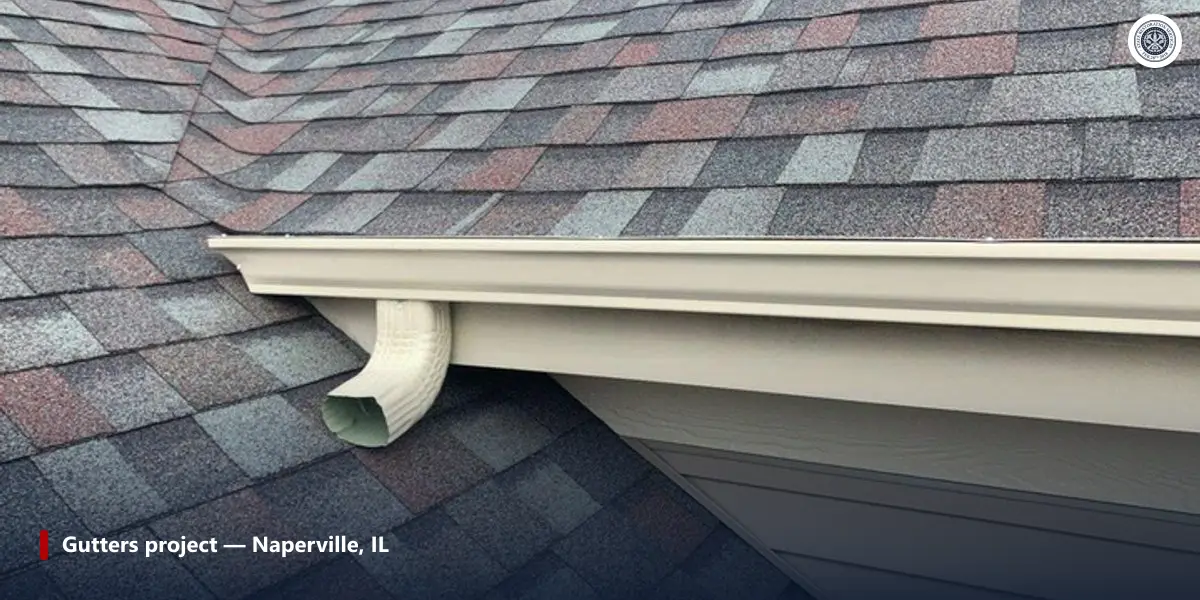
Most homes need roughly one downspout for every 35-40 feet of gutter, sized to the roof area that drains into it — a 2x3 downspout comfortably handles up to around 600 square feet of roof, a 3x4 handles closer to 1,200. Beyond that, or on a steep or complex roof that sheds water fast, you're better off with two downspouts than one oversized one.
Roof pitch matters here too. A steep roof in a hard Chicago downpour moves a lot more water into the gutter per minute than a low-slope roof of the same square footage, so a steep roof with only one downspout on a long run is a common reason gutters overflow even when the pitch itself is fine — the gutter just can't drain water out the bottom fast enough.
| Roof area draining to one downspout | Downspout size | Typical setup |
|---|---|---|
| Up to ~600 sq ft | 2x3 inch | 1 downspout |
| ~600-1,200 sq ft | 3x4 inch | 1 downspout |
| Over ~1,200 sq ft, or steep/complex roof | 3x4 inch | 2 or more downspouts |
Corners and valleys are where we add downspouts even when the math says you could get away without one — a valley dumps two roof planes' worth of water into a single gutter section, and that section needs its own way out.
Where should downspout water actually go?
Downspout water needs to land at least 4-6 feet from the foundation, on ground that slopes away from the house, not toward it. A splash block or a flexible extension is the minimum; a buried drain line to daylight, a dry well, or a pop-up emitter out in the yard is the better fix on a lot near-level or clay-heavy Chicago-area lots.
- Splash blocks — cheap and better than nothing, but they only work if the grade actually slopes away from the house. On flat ground they just relocate the puddle a few feet.
- Flexible or rigid extensions — carry water further than a splash block, and they're the easiest upgrade if you're seeing water at the foundation right now.
- Buried drain lines — run underground to a spot in the yard, a dry well, or the street, so you don't have a hose lying across the lawn. Needs a clean-out and a real outlet, not a line that dead-ends underground.
- Grading — the ground within 10 feet of the foundation should drop at least a few inches, sloping away. No amount of downspout extension fixes water that's still pooling in a low spot right against the wall.
What actually happens when pitch or downspouts are wrong?
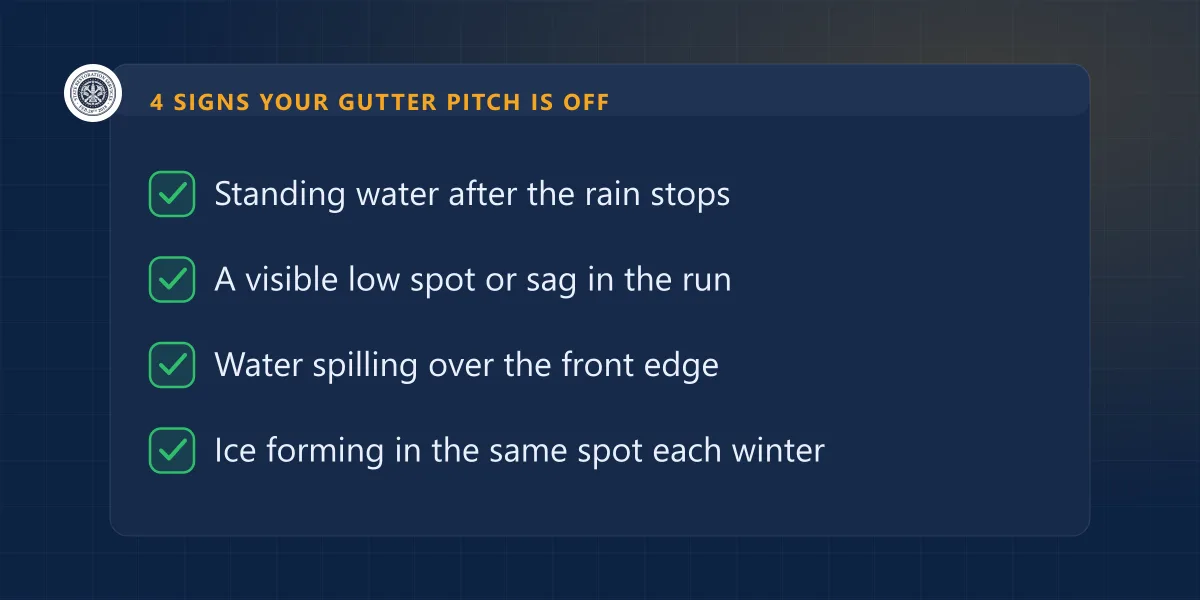
Bad pitch or too few downspouts shows up as standing water in the gutter, water spilling over the front edge during hard rain, staining or erosion trenches below the downspout outlet, and — over a Chicago winter — the same spot re-freezing into ice every time it's above freezing during the day. None of it is cosmetic for long; it's water finding the fastest path into your basement or crawl space.
We covered how a flat, poorly-ventilated eave section builds up ice in our ice dam guide — a gutter with backward pitch does the same thing at ground level: water sits, freezes overnight, and doesn't fully clear before the next cold snap, so the ice just keeps building. A downspout dumping right at the foundation does the same slow damage in warm weather, just as erosion and hydrostatic pressure against the wall instead of ice.
| What you see | Likely cause |
|---|---|
| Water sitting in the gutter days after rain | Flat or reverse-pitched section |
| Water sheeting over the front lip in heavy rain | Not enough downspouts for the roof area, or an undersized downspout |
| A trench or mulch washout under one spot | Downspout draining too close to the house with no extension |
| Same corner iced over every cold snap | Standing water at a low spot refreezing |
Frequently asked questions
Can I fix gutter pitch myself?
You can check it yourself with a level and a bucket of water — pour water at the high end and watch whether it reaches the downspout without pooling. Fixing it usually means re-hanging sections with new hanger spacing, which is doable on a single-story ranch but gets riskier fast on a two-story roofline, where we'd rather send a crew than have you on a ladder.
How far should downspouts extend from the house?
At least 4-6 feet is the minimum we'd install, and further if the ground near your foundation is flat or slopes toward the house at all. On a lot with real drainage problems, a buried line running further out to daylight or a dry well is worth the extra cost.
Do splash blocks work as well as extensions?
Only if the grade already slopes away from the foundation. A splash block on flat ground just moves the puddle a couple feet and the water still soaks back toward the wall — an extension or buried line is the more reliable fix on most of the lots we work on.
Does gutter pitch really affect ice dams?
Yes — water that sits in a flat or backward-pitched gutter freezes first and doesn't clear before the next cold snap, building up the same way an ice dam does at the eave. Fixing the pitch is one of the cheaper, more permanent parts of preventing them, alongside the attic sealing and ventilation work we cover in our ice dam article.
Not sure if your gutters are pitched right? We install and repair seamless gutter systems across Lake and Cook County, and we'll check pitch, downspout sizing, and drainage as part of any free inspection — including for homeowners in Buffalo Grove and the surrounding suburbs. If you're also due for a roof replacement, we'll look at both at once and walk you through how we handle the whole job. Related reading: are gutter guards worth it? and 5-inch vs 6-inch gutters. Call (866) 992-2982 or get in touch — we work normal business hours and get back to you fast.