
 Volodymyr Lukaniuk
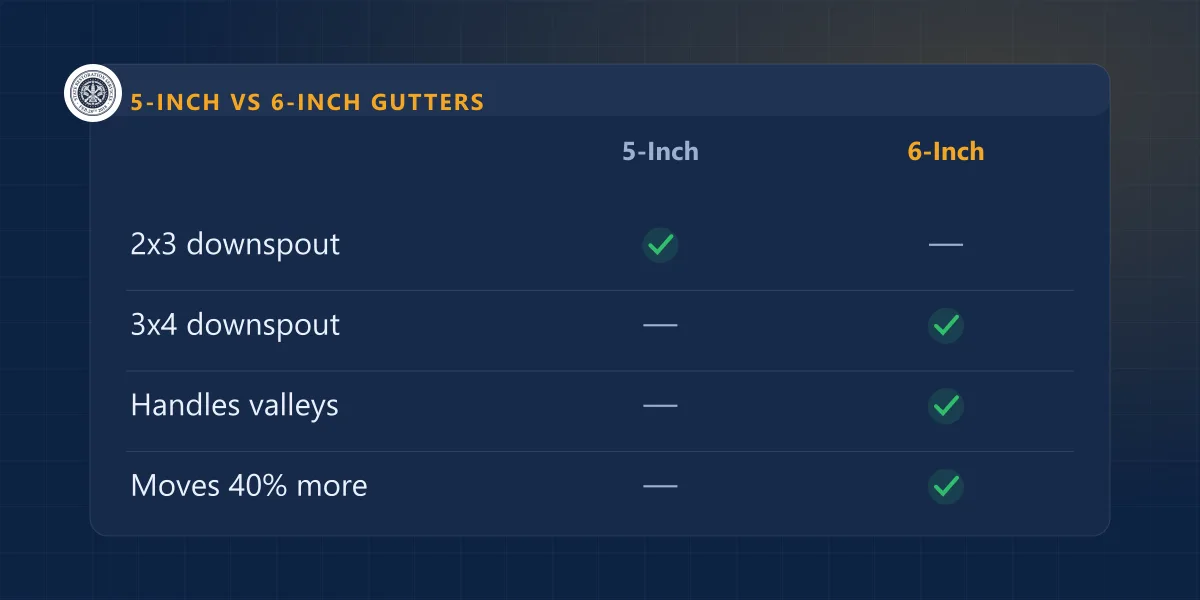
Quick answer: Most typical suburban homes — simple gable roofs, average pitch, a few shade trees — do fine with 5-inch K-style gutters. Step up to 6-inch if your roof is steep, cut up with multiple valleys, buried under mature oaks and maples, or you've already watched water sheet over the front edge in an ordinary rain. Paired with a 3×4-inch downspout, 6-inch moves roughly 40% more water than 5-inch on a 2×3.
When we're out measuring a gutter job in Buffalo Grove, Wheeling, or Vernon Hills, one of the first real questions is 5-inch vs 6-inch gutters — because it isn't just a size on a spec sheet, it's the difference between a system that quietly does its job for twenty years and one that overflows every time a real Illinois storm rolls through. Both are K-style aluminum, both come in the same handful of colors, and both look nearly identical from the driveway. The difference is entirely in how much water they can move before they lose the fight.
What's actually different between 5-inch and 6-inch K-style gutters?
The profile shape is the same — K-style means the front face looks like crown molding, not a smooth trough. What changes is the size of the channel and the downspout it feeds: 5-inch gutters pair with 2×3-inch downspouts, 6-inch gutters pair with 3×4-inch downspouts, and the bigger channel simply holds and moves more water before it tops the front edge.
From the ground, most people can't tell them apart. A 6-inch gutter is roughly an inch taller and the downspouts are a bit more visible, but the hangers, brackets, and general look are the same. This is purely a drainage decision, not an aesthetic one — which is exactly why so many homes end up with whatever size the last contractor happened to have on the truck, whether or not it actually matches the roof.
How much more water does 6-inch actually move — and why that matters here in Illinois
A 6-inch gutter moves roughly 40% more water than a 5-inch gutter running the same length, because of both the larger trough and the bigger downspout it feeds. That difference shows up exactly when you need it most: a fast-moving summer thunderstorm dropping an inch of rain in twenty minutes, which is a normal Tuesday for Cook and Lake County between May and August.
Total roof square footage matters, but it's not the only thing that decides gutter size. A steep pitch sheds water faster per minute than a shallow one, even on the same footprint. Multiple roof valleys funnel two or three planes of runoff into a single stretch of gutter, concentrating flow well beyond what that section would see on a simple gable roof. That's why a roof that isn't especially large can still overwhelm 5-inch gutters if it's cut up with valleys, dormers, or a steep main slope.
| Gutter size | Downspout | Water moved vs. 5-inch | Best for |
|---|---|---|---|
| 5-inch K-style | 2×3 in | Baseline | Most ranch, split-level, and simple gable roofs |
| 6-inch K-style | 3×4 in | ~40% more | Steep, cut-up, or large roofs; heavy tree cover |
When 5-inch is genuinely the right call for your house
We're not in the business of upselling a bigger system than a house needs. A single-story home with a straightforward gable roof, decent pitch, a handful of downspouts already spreading the load, and no history of overflow is doing exactly what it should on 5-inch gutters. Most of the ranches and split-levels we work on through Arlington Heights and Morton Grove fall right into this category — 5-inch, properly pitched and properly hung, handles Illinois rain without drama.
The mistake isn't choosing 5-inch. It's choosing it by default on a roof that was never a good fit for it — a steep two-story with three valleys funneling into one 30-foot run, for instance — and then wondering why it overflows every August.
Five signs your gutters are already too small
- Water sheeting over the front edge during an ordinary rain, not just a downpour.
- A washed-out line in the mulch or grass directly under a stretch of gutter.
- Staining or soft, spongy spots on the fascia board behind the gutter.
- Downspouts running full and gurgling loudly during a normal storm.
- Ice building up at that same stretch of eave every winter, even right after a fall cleaning.
Any one of these on its own could be a clog or a pitch problem — worth ruling out before you spend money upsizing. All five, or the same spot acting up storm after storm even when it's clean, is a capacity problem, and that's a 6-inch conversation.
What it costs installed in the Chicago suburbs
Expect roughly $7–$12 per linear foot installed for 5-inch seamless aluminum gutters, and $9–$15 per linear foot for 6-inch, including the larger downspouts. For a typical two-story home with 180–200 linear feet of gutter, that puts a full 5-inch system around $1,300–$2,400 and a full 6-inch system around $1,600–$3,000. Steep pitches, multiple stories, and hard-to-access rooflines push toward the top of either range because of the extra labor and equipment, not the material itself.
| Compare | 5-inch | 6-inch |
|---|---|---|
| Installed cost per ft | $7–$12 | $9–$15 |
| Typical whole-house cost* | $1,300–$2,400 | $1,600–$3,000 |
| Downspout size | 2×3 in | 3×4 in |
*Based on a 180–200 linear foot run on a typical two-story suburban home; every roof is measured individually before we quote.
Mixing 5-inch and 6-inch on the same house — yes, and here's when it makes sense
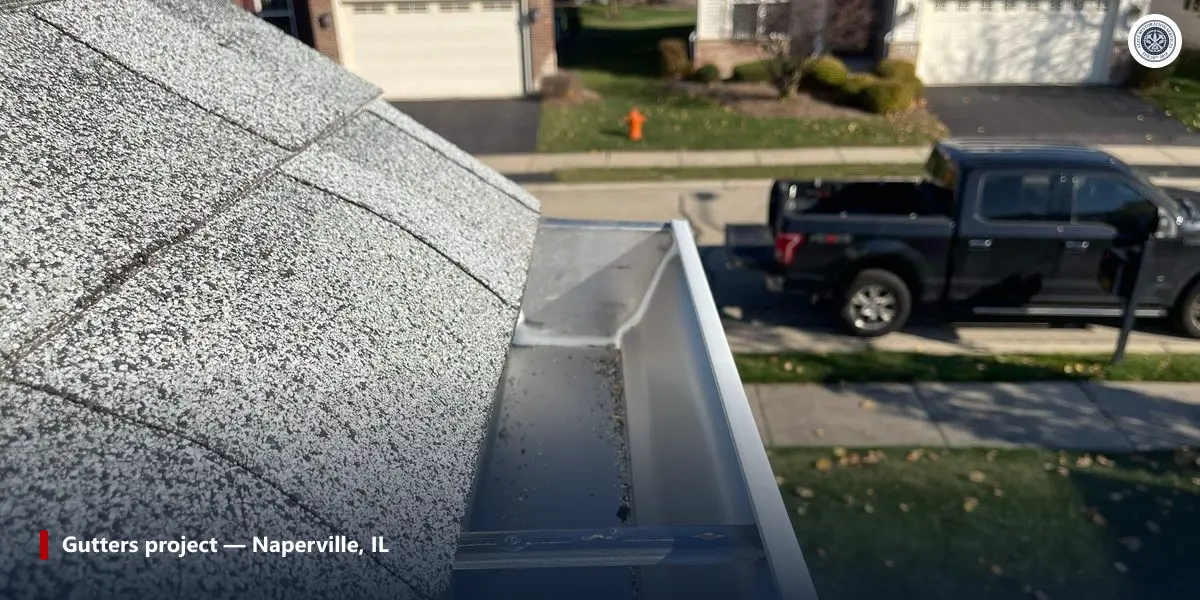
We do this more often than people expect. If most of a roof drains fine on 5-inch but one section — usually where two roof planes meet in a valley, or the steepest slope on the house — keeps overflowing, we'll upsize just that run to 6-inch and leave the rest at 5-inch. It fixes the actual problem area without the cost of upsizing a whole house that mostly didn't need it. It's not a compromise; it's how you're supposed to size a gutter system in the first place, section by section instead of one blanket number for the whole roofline.
This is exactly the kind of thing that's hard to judge from the ground or from a photo, which is why we walk the roof and measure drainage area before recommending a size as part of our seamless gutter installation estimates — and while we're up there, we'll flag any fascia or siding damage the undersized run has already caused so it gets fixed at the same time, not on a second visit.
Related reading: if trees are the bigger issue on your roof, see our honest breakdown of whether gutter guards are worth it. If ice buildup at the eave is what brought you here, that's usually an attic problem first — read our guide to why ice dams actually form in Illinois.
Frequently asked questions
My 5-inch gutters are overflowing — does that mean I need 6-inch, or could it just be a clog?
Rule out the cheap fix first. A clogged gutter or a blocked downspout will overflow no matter what size it is, so clean it out, confirm the pitch is right, and watch it during the next real rain. If it's clean, properly pitched, and still sheeting over the edge in an ordinary storm, that's a capacity problem — 6-inch with a 3×4 downspout is the fix.
Can I mix 5-inch and 6-inch gutters on the same house?
Yes, and we do it regularly. If one section of roof — usually a valley or the steepest slope — is overwhelming a 5-inch run, we'll upsize just that section to 6-inch and leave simpler runs at 5-inch, targeting the actual problem instead of paying to upsize the whole house.
Will 6-inch gutters look too bulky on my house?
Most homeowners can't tell the difference from the ground. A 6-inch K-style gutter is roughly an inch taller than 5-inch, and at typical viewing distance it reads the same. The 3×4 downspouts are a bit more noticeable than 2×3, but still far smaller than most people expect once they're actually installed.
Do bigger gutters help with ice dams?
Not directly. Ice dams form from attic heat loss melting snow that refreezes at the cold eave, not from gutter size. A 6-inch gutter moves meltwater faster once it's flowing, which helps a little, but it won't fix an ice dam on its own — that takes attic air sealing and insulation.
Not sure which size your roof actually needs? Book a free gutter estimate or call (866) 992-2982 — we measure your roof's actual drainage area before recommending a size, not just default to whatever's on the truck. Questions first? Reach out here.