
 Volodymyr Lukaniuk
Quick answer: A gutter sags or pulls away when the hardware behind it loses its grip on the fascia board: too few hangers, spikes that walked out over the seasons, or wood gone soft from water running behind the trough. Amerimax's own install sheet calls for a hanger every 24 inches, and every 18 inches where ice and snow load are normal.
Every spring we get calls that open the same way. The gutters are pulling away from the house, there is a gap you can see from the driveway, and water is running down the fascia instead of into the trough. The trough itself is usually straight and perfectly serviceable. What gave up is the hardware behind it, and the board that hardware was fastened to.
This is one of the few things on a house where you can work out most of the answer from the ground, with no ladder and no tools. You just have to know what you are looking at. So here is what holds a gutter onto a house, how many of those fasteners there are supposed to be in a climate like ours, and how to tell a re-hang from a replacement.
What is actually holding your gutters onto the house?
Four pieces of hardware do that job, and they are not interchangeable. A hidden hanger clips inside the trough and takes a screw through the back wall into the fascia. A fascia bracket nails to the board and the gutter snaps into it. A spike passes through a ferrule and into the fascia. A roof strap runs up under the shingles instead.
Amerimax's installation sheet for metal gutter systems lists all four in its parts chart, and the wording on each one is worth reading. The hidden hanger with screw says to "power drive ¼ in. hex head screw into fascia board." The spike and ferrule says to "insert ferrule into gutter and fasten screw or spike through gutter, ferrule and fascia board." The fascia bracket nails "along guide string every 24 in." Three of the four end in the same place: the fascia.
The fourth one, the hidden hanger with a roof strap, carries a restriction people miss. Amerimax says to "only use when no fascia board exists." That restriction is aimed at roof edges built without a fascia board in the first place. On a house that has one, a strap will not rescue wood that has gone soft; it moves the same load onto fasteners driven through the roof deck, under your shingles. We spell that out because we get asked about it a lot, usually by someone hoping to avoid a carpentry bill.
The ferrule in a spike installation is a small brass or aluminum tube that sits inside the trough and stops the spike from crushing the gutter as it is driven. It does that job well. It cannot stop a smooth shank from backing out of wood that swells every July and shrinks every January, with a trough full of water hanging off it the whole time. That is why a spiked gutter tends to develop a visible sag between two spike heads that are slowly standing proud of the fascia.

How far apart should gutter hangers be in the Chicago suburbs?
Eighteen inches, in our climate. Amerimax's sheet is specific about it: "use one hanger every 24 in. or every 18 in. for heavy ice & snowload areas." Lake and Cook County are squarely heavy ice and snow load territory, so 18 inches is the figure to hold a bid to rather than the more common 24.
Manufacturers do not all open with the same number, which is the part worth knowing before you compare two quotes. ALSCO Metals, which makes aluminum rainware, answers the spacing question in its headline by saying hangers "should be no more than three feet apart." Further down the same article, its own installation tips say to use 24 inches normally and, "for rainy or snowy climates," no more than 18. Both statements are on one page. The second one is the one that applies here.
| Source | Standard spacing | Ice and snow |
|---|---|---|
| Amerimax metal gutter install sheet | 24 in. | 18 in. |
| ALSCO Metals guide, headline answer | Up to 36 in. | Not stated |
| ALSCO Metals guide, installation tips | 24 in. | 18 in. |
Run the arithmetic on a single 40-foot elevation and the spread stops being academic. Forty feet is 480 inches. At 36-inch spacing that is about 14 hangers. At 24 inches it is 21. At 18 inches it is 27. The same gutter, the same house, and roughly twice as many points of attachment between the loosest reading and the one written for ice and snow load. When a gutter run sags in the middle, the count is usually the first thing we check.
Spacing is also not the whole instruction. The same sheet has you set the run on a string line dropped "approximately ¼ in. for every 10 ft. of gutter" toward the downspout, and seal the corners, since a seamless gutter still has joints at every miter, outlet and end cap. We covered the slope side of that in our guide to gutter pitch and downspout placement.
Does any building code say how a gutter has to be hung?
No. There is no code rule anywhere for how a gutter is fastened to a house. The 2021 International Residential Code mentions gutters on a home exactly once in its roof chapter, and that single mention is about where the water ends up rather than what holds the trough. Section R801.3, reproduced in full here, reads in its entirety:
"In areas where expansive soils or collapsible soils are known to exist, all dwellings shall have a controlled method of water disposal from roofs that will collect and discharge roof drainage to the ground surface not less than 5 feet (1524 mm) from foundation walls or to an approved drainage system."
That is a conditional rule about discharge distance. It says nothing about hangers, spacing, fasteners or fascia. Search the whole of Chapter 9, the roof assemblies chapter, and the word "gutter" appears once more, in the sidewall flashing paragraph, and only as the destination kickout flashing is supposed to aim water into.
Illinois does not fill the gap either. The Capital Development Board's codes FAQ states plainly that "the State has not adopted a building code for repairs to existing single family residences," and directs you and your insurer to "check with your unit of local government to verify if it has adopted any building code or ordinance regarding these." Some north suburban villages have their own requirements; many say nothing about gutters at all.
That leaves the manufacturer's printed instructions as the written standard your installation can actually be measured against. It is a humbler document than a building code, and it is sitting in the box the hangers came in. It is also the document a warranty claim gets read against, so it is the one we work to.
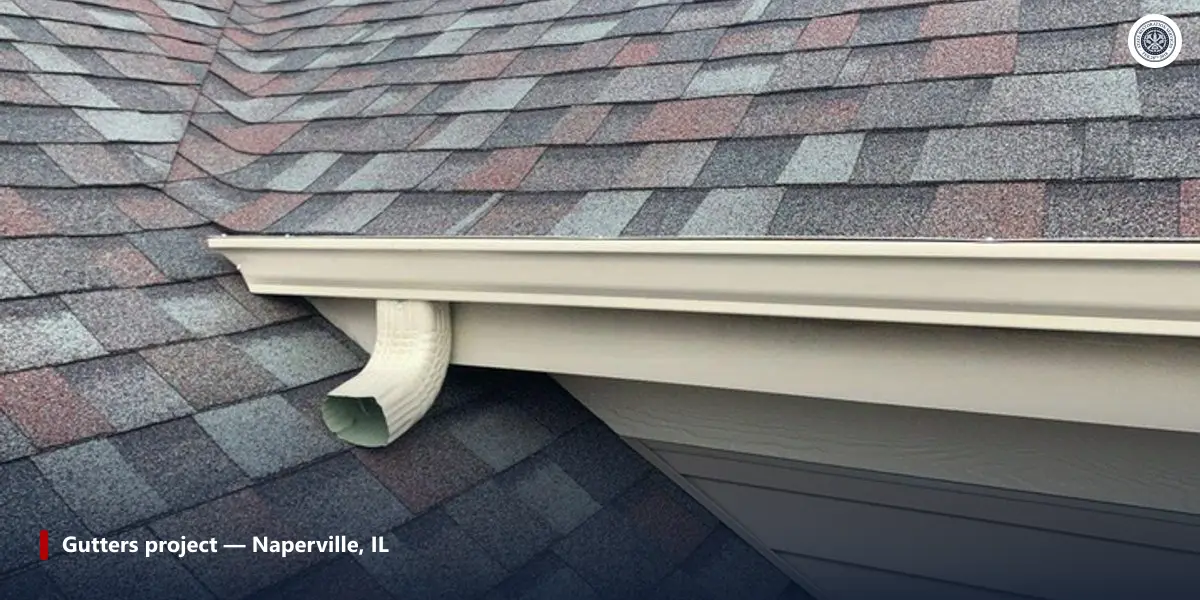
Why does the fascia board decide whether your gutters stay up?
Because every hanger screw ends in it. The load path is short and unforgiving: water and debris sit in the trough, the trough hangs on the hangers, the hangers hang on screws, and those screws have about three quarters of an inch of fascia board to bite into before they reach the rafter tail behind it. Soften that board and nothing above it matters.
Water gets behind a gutter for ordinary reasons. A missing or short drip edge lets runoff curl back onto the board. A gutter pitched the wrong way holds standing water against its own back wall. A blocked trough overflows at the seam rather than the front lip. Give any of those a few seasons and the fascia goes soft and spongy right where the fasteners are, which is the point at which a screw spins in place instead of tightening.
This is why Amerimax's very first step is not about gutters at all. It says: "remove old gutters and inspect fascia board. REPLACE IF NEEDED." Hanging new seamless gutters on a soft fascia produces a run that looks correct on the day and starts dropping within a couple of winters, and it is a common reason we tell someone their gutter quote needs a carpentry line in it. We wrote about how to read that board in soffit and fascia: what they actually do, and fascia repair or wrapping is part of our siding and exterior trim work.
Does ice pull a gutter off, or just finish what was already loose?
Usually the second. Ice does add real weight, which is exactly why the install sheet tightens hanger spacing to 18 inches in snow country. But a run that comes down in February has normally been carrying too few fasteners, or fasteners in soft wood, since long before the first freeze. The ice is what finally exceeds what was left.
That distinction matters if you plan to file. A gutter torn off by a single storm is a sudden loss. A gutter that was already sagging, spikes backed out, fascia soft, is deferred maintenance, and the wear-and-tear exclusion in a standard homeowners policy is written to exclude exactly that. Photograph the damage before anyone clears anything. Our guide to frozen gutters and downspouts goes through the winter side in detail.
One honest note on the claims side, because it comes up: Illinois law does not allow a roofing contractor to negotiate your insurance claim. We document what we find and write a code-compliant estimate. If the claim itself needs representing, that is work for a licensed public adjuster, and our affiliated firm State Adjusting Services can take it on. Our storm and insurance page explains how the two roles stay separate.
Can sagging gutters be re-hung, or do they need replacing?
It depends almost entirely on the shape of the aluminum and the state of the wood, not on how alarming the sag looks. A straight trough on a sound fascia can be re-hung on proper hidden hangers at the right spacing and last another decade. A trough that has kinked where it pulled, or a fascia that is soft along its length, is a different job.
| What we find | Usual call |
|---|---|
| Trough straight, a few spike heads backed out | Re-hang on hidden hangers at 18 in. |
| Trough straight, fascia soft in patches | Repair the fascia first, then re-hang |
| Trough creased or kinked where it let go | Replace that run; a creased trough holds water |
| Whole run holding water, pitch wrong end to end | Re-hang the run to a string line |
| Fascia soft the full length behind the gutter | Fascia replacement, then new seamless gutter |
Cost follows that split more than it follows the length of the run. Re-hanging existing gutters is the cheapest outcome on the list. New seamless aluminum is priced by the foot, and we set out the current Chicago-area ranges in how much gutters cost per foot. Carpentry is the line that actually moves the total, which is why we price the fascia separately and show it to you rather than burying it. Either way, the work itself is seamless gutter installation and repair, and if the trough is simply packed solid, that is gutter cleaning and not a hanger problem at all.
What can you check from the ground before you call anyone?
More than you would think, and all of it from the driveway. None of this will tell you the exact repair. It will tell you whether the conversation is about hardware, about wood, or about both, which is enough to notice when a quote covers only one of them and says nothing about the other.
- Sight down the line of the gutter against the roof edge. The roof edge is straight, so it makes a reference line. A dip in the middle of a run, or a gutter that is further from the roof at one point than another, shows up instantly.
- Count spike heads. If you can see round fastener heads on the face of the gutter, you have spikes, not hidden hangers. Any that are standing out from the face are on their way out.
- Look at the fascia below the gutter after rain. A vertical stripe of dirt, peeling paint or dark staining means water is getting behind the trough rather than into it.
- Check the gap at the back of the gutter. A trough leaning away from the house at the top, so daylight shows between it and the fascia, is a fastener problem you can see from the lawn.
- Watch where ice forms in winter. Ice consistently building at one section, rather than evenly along the eave, points at standing water in that section.
Please leave the ladder alone for this. Every one of those checks works from the ground, and a wet or frozen eave is a bad place to be proving otherwise. A free inspection costs you nothing and we will tell you if the answer is "tighten four hangers."
Frequently asked questions
How far apart should gutter hangers be in Illinois?
Every 18 inches. Amerimax's installation sheet calls for a hanger every 24 inches in general, and every 18 inches in heavy ice and snow load areas, which describes Lake and Cook County. ALSCO Metals gives the same 18-inch figure for snowy climates in its installation tips, although its headline answer says up to three feet.
Are gutter spikes bad?
They are not defective, but they are a smooth shank driven into wood that swells and shrinks all year while a loaded gutter hangs off it, so they work loose over time. Hidden hangers use a threaded screw, hold better, and are not visible from the ground. On a re-hang we fit hidden hangers.
Can you put new gutters on old fascia?
Only if the board is still sound. Amerimax's first installation step is to remove the old gutters and inspect the fascia, and replace it if needed, because hanger screws get their grip from that board. New gutters on soft fascia look right on the day and begin sagging within a season or two.
Does homeowners insurance cover gutters pulling away from the house?
It depends on the cause. Gutters torn off by a specific storm are generally a sudden loss. Gutters that sagged over years because of backed-out spikes or rotted fascia are treated as maintenance, which policies exclude. Photograph the damage before clearing anything, and note that Illinois law bars a roofer from negotiating the claim.
Gutters starting to lean away from the house? Book a free inspection or call (866) 992-2982 — we serve the north and northwest Chicago suburbs from Lincolnshire, and our office is open Monday to Friday, 8:00 AM to 5:00 PM. You can also send us a photo through the contact page and we will tell you what we are looking at.