
 Volodymyr Lukaniuk
Quick answer: Frozen gutters and downspouts almost always start inside the house. Warm air leaking into the attic melts snow on the roof, the water runs down to the cold overhang, and it refreezes in the trough and the pipe. Chipping the ice out is a chore. Keeping it from coming back is an attic and drainage fix.
Every January the calls sound the same. Somebody in Buffalo Grove or Mundelein is standing in the driveway looking up at a downspout with a fat bulge of ice in it, wondering whether the whole gutter is about to come off the fascia. Frozen gutters and downspouts are one of the few winter problems where the part you can see — the ice — is the least useful part of the diagnosis.
We are a family-owned roofing and gutter company based in Lincolnshire, working the north and northwest suburbs since 2018, and this is the post we end up repeating on the phone every winter. Here is the whole thing: why it freezes, why the downspout goes first, what is actually safe to do in February, what stops it coming back, and where insurance does and does not help.
Why do gutters and downspouts freeze in the first place?
Because part of your roof is above freezing and part of it is not. Snow on the warm upper roof melts, the water runs down, and when it reaches the overhang — which has cold air under it, not a heated attic — it refreezes. The gutter is the coldest thing on the whole house, so that is where liquid water stops moving.
The University of Minnesota Extension lays out the three conditions plainly: snow on the roof, an upper roof surface above 32°F, and a lower surface below it. That upper-roof warmth is not the sun. In an Illinois January it is your furnace, coming up through gaps around bath fans, recessed lights, the attic hatch and the top plates of your walls.
Which is why a gutter that drains perfectly in April can be a block of ice in January while the neighbour's identical gutter is clear. It is not the gutter. It is how much heat is getting past the ceiling.
Why does the downspout freeze before the gutter does?
Because the downspout is the narrowest part of the system and the coldest end of it. A standard 2×3-inch downspout has six square inches of cross-section, and the outlet feeding it is a hole roughly that size cut in the bottom of a much wider trough. Ice has far less distance to bridge there than anywhere else in the run.
Then there is the bottom of the pipe. The last elbow sits within a foot of the ground, it is nearly horizontal, and it is where the last of the water is still sitting when the flow stops at sunset. It is also where snow gets shovelled and plowed against the house. That elbow freezes first, and once it is plugged the column of water above it freezes upward.
If your downspout ties into a buried drain line, it is worse. In the Chicago area, footings go 42 inches below grade because that is the frost depth we design for. The corrugated pipe carrying your downspout out to the lawn is typically buried 12 to 18 inches down — comfortably inside the frost zone. It is frozen solid from December onward, and the downspout above it has nowhere to discharge.
North and east elevations round it out. They get the least winter sun, so they thaw last and refreeze first, which is why the same two corners of the house act up every single year.
| What you can see | What is actually happening | What it costs you if you leave it |
|---|---|---|
| Icicles hanging off the front lip | Roof meltwater reaching a below-freezing gutter | Nothing yet — but it is the first sign the attic is warm |
| Solid ice in the trough, water running down the wall | Trough plugged; water backing over the rear edge onto the fascia | Rotted fascia, stained soffit, wet exterior wall |
| A bulge or a split seam in the downspout | Water froze inside the pipe and expanded | New downspout run, usually the elbows with it |
| Nothing draining on a 40°F afternoon | Blockage at the outlet, the bottom elbow, or a frozen buried line | Ice loading the whole run instead of draining |
| Gutter sagging or pulled away from the fascia | Ice weight in the trough plus the ice sheet bonded above it | Gutter replacement and fascia repair |
On that last row, one number is worth having. A 5-inch K-style trough holds roughly a third of a gallon of water per running foot, so packed solid it carries somewhere around 2.8 pounds of ice per foot — call it 110 pounds across a 40-foot run, before you count the ice mounded above the lip. That is our own arithmetic from the trough volume, not a manufacturer figure, and it is worth knowing mostly because it explains what people get wrong: the gutter full of ice is rarely what tears it off the house. What tears it off is the sheet of ice bonded to the shingles above it, expanding and creeping down.
What can you safely do when the downspout is already frozen?
Less than you would like, and all of it from the ground. In freezing weather a ladder against an iced gutter, on frozen ground, under a roof that is shedding ice, is the single most dangerous thing a homeowner does all year. An iced gutter is a ground-level job until it thaws.
What genuinely helps, in order:
- Pull the bottom elbow or extension off. It is usually two screws or a crimped joint. That gives the ice column somewhere to go on the next warm afternoon, and it tells you immediately whether the blockage is in the pipe or in the buried line below it.
- Shovel out the discharge zone. A downspout discharging into a snowbank is a downspout discharging into nothing.
- Warm water, from the ground, into the low end. Warm, not boiling — boiling water refreezes into a sheet at your feet and does the aluminium no favours.
- Roof-rake the bottom three or four feet after a heavy snow, standing on the ground. Removing the snow at the eave removes the fuel. In the middle of winter this is the highest-value thing a homeowner can do, and it is the only one that treats the cause rather than the symptom.
And the ones that cost people money every year:
| Do this | Never do this |
|---|---|
| Work from the ground, with the elbow off | Set a ladder against an ice-loaded gutter |
| Warm water into the low end of the pipe | Chip at the ice with a hammer or screwdriver |
| Roof-rake the eave after a heavy snow | Throw rock salt or calcium chloride in the trough |
| Photograph the damage before you clear it | Climb up to “just have a look” in a thaw |
The chipping one is worth explaining. Standard seamless aluminium gutter is 0.027 inches thick — about two business cards. A screwdriver goes through it, and a split seam that you cannot see under the ice becomes a leak in April. And the salt: chlorides pit aluminium and chew through the fasteners holding the system to your fascia, and the runoff lands on whatever is planted under the downspout. The damage de-icing salt does to soil and plantings is well documented. The salt-in-a-stocking trick you will find online costs you the gutter and the shrub.
If water is already coming through a ceiling, that is not a gutter call any more. Get someone out to look at the roof.
What actually stops frozen gutters from coming back?
Fixing the heat loss, in that order: air sealing, insulation, ventilation. Everything else on the list below buys you a better winter but does not change the physics. If you only ever do one thing, make the attic floor airtight — a gutter cannot freeze on meltwater that never melted.
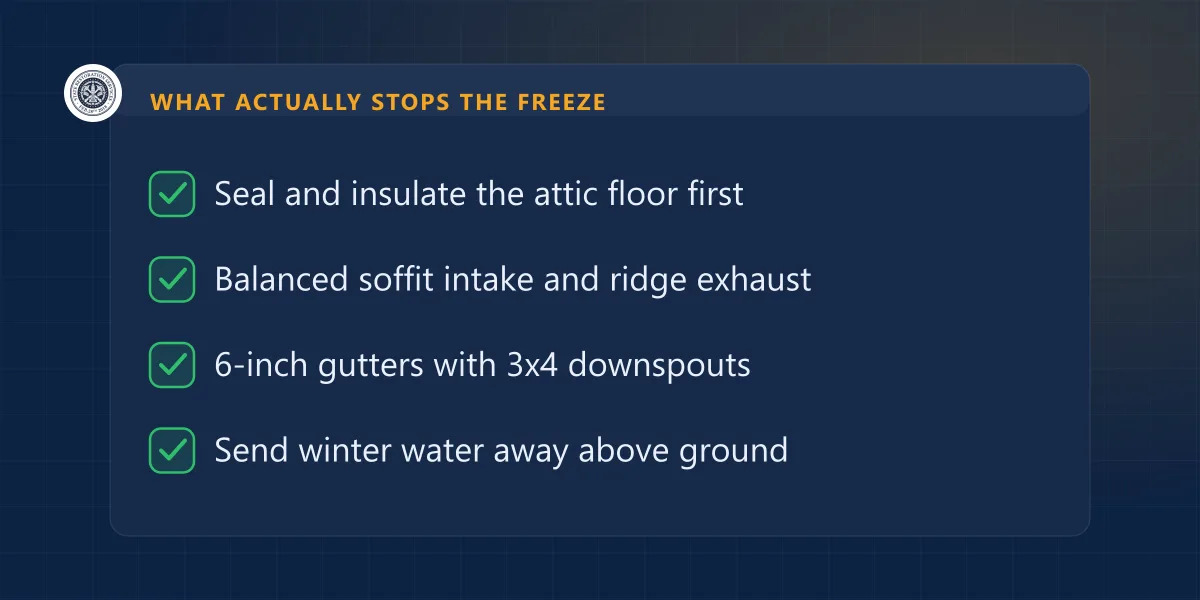
Straight answer on scope, because it matters when you are deciding who to call: we do not sell insulation or air sealing. That is an insulation contractor's work and we will tell you so. What we do handle is the ventilation half — soffit intake and ridge exhaust balanced properly, which is part of any roof replacement we do — and the entire water-carrying side of it.
| Fix | Does it stop it coming back? | Rough cost |
|---|---|---|
| Roof-raking the bottom 3–4 feet | For that storm only | Free, plus $30–$60 for a rake |
| Heat cable in the gutter and downspout | Manages it; does not cure it | $300–$700 installed, plus power all winter |
| Late-fall clean-out so the trough starts empty | Helps; will not stop meltwater icing | Quoted per home before we start |
| 6-inch gutters with 3×4 downspouts | Big help — ice has twice the pipe to bridge | $9–$15 per foot installed |
| Above-ground winter discharge | Yes, for the bottom-of-the-run freeze | Low — often an elbow and an extension |
| Attic air sealing, insulation, balanced ventilation | Yes — this is the actual cure | Varies; insulation contractor plus roofer |
On sizing: a 3×4 downspout has twelve square inches of cross-section against the 2×3's six. Exactly double. That is why a partial ice ring closes a 2×3 and merely narrows a 3×4, and it is a large part of why 6-inch gutters on 3×4 downspouts move about 40% more water than the standard pairing. If you are already replacing a run that splits every winter, upsizing it costs a few dollars a foot more than replacing like for like. We form both on site — seamless gutter installation is half of what we do between roofs.
On the buried line: if yours ties underground and it backs up every February, ask for a clean-out at the base of the downspout and a way to bypass the buried run in winter. A pipe that sits two feet above the frost line will freeze; that is not a defect, it is where it was buried. Getting the water above ground and moving it eight feet out beats fighting it.
And going into winter with a clean trough genuinely matters, because wet leaves pack into ice like rebar. Late fall, after the last leaf drop, is the window — our gutter cleaning crews clear the downspouts, not just the trough, which is where the blockages actually sit.
One thing about heat cable that nobody mentions
If you go the heat cable route, it has to run the whole path the water takes: a zigzag at the eave, along the trough, through the outlet, and all the way down the downspout to daylight. Cable that stops at the outlet just relocates the plug three feet lower.
The part almost nobody brings up is electrical. NEC Article 426.28 requires ground-fault protection of equipment on fixed outdoor de-icing and snow-melting gear. That is equipment-level protection in the 6–50 milliamp range, not the 5-milliamp GFCI receptacle most people assume already covers it — they are different devices doing different jobs. Worth asking your electrician which one is actually on that circuit before the cable goes up.
Does insurance pay for gutters that ice tore off?
Sometimes, and it depends almost entirely on what the photos show. A gutter that ice pulled off the fascia in one storm is a sudden loss. A gutter that was already sagging, rusted at the hangers and pulling away before the cold hit is deferred maintenance, and no policy in Illinois covers maintenance.
So photograph it before you clear anything. Get the ice in the frame, get the whole elevation, and get the date on the file. Once the ice is gone and the gutter is in a pile by the garage, the argument is a lot harder to make.
One more thing worth knowing, because door-knockers in January tend not to volunteer it: under Illinois law a roofing contractor may not negotiate your insurance claim. We document the damage and write a code-compliant estimate, and that is where our role ends. If you want somebody representing you on the claim itself, our affiliated licensed public adjuster, State Adjusting Services, can do that. If you would rather handle it yourself, our storm and insurance claim page walks through how the process runs.
Related reading: if the ice is building at the roof edge rather than in the pipe, start with why ice dams form on Illinois roofs. If your gutters overflow in ordinary rain too, the problem may be upstream of winter entirely — see gutter pitch and downspout placement.
Frequently asked questions
How do I thaw a frozen downspout without wrecking it?
From the ground, not from a ladder. Take the bottom elbow or extension off so the ice column has somewhere to go, shovel the snow away from the discharge point, and pour warm water — not boiling — into the low end. Never chip at it with a hammer or a screwdriver.
Will heat cable stop my gutters from freezing?
It manages the ice, it does not cure it. Heat cable keeps a melt channel open so water has a path out, but it does nothing about the attic heat that is melting the snow in the first place. It also runs on electricity every time it snows, and it has to continue through the outlet and all the way down the downspout to daylight, or it just moves the blockage lower.
Do gutter guards stop ice from forming?
No. Guards keep leaves out so the trough goes into winter clean, which helps, but meltwater still freezes on and under them. A solid sheet of ice sitting on top of a guard is also harder to clear than ice in an open trough, so guards are a debris decision rather than an ice decision.
Should I take the downspouts off for the winter?
No. A gutter with no downspout dumps concentrated meltwater right at the foundation, which is the problem you were trying to avoid. If the freeze is happening at the bottom, disconnect only the elbow or the extension and get the water moving away from the wall above ground.
Gutters icing up every winter? Book a free inspection or call (866) 992-2982 — we are a family-owned crew in Lincolnshire, rated 4.9 stars from 92 Google reviews, and we work the north and northwest Chicago suburbs during normal business hours.