
 Volodymyr Lukaniuk
A fresh hole in the soffit or fascia in November is most often a squirrel or a raccoon choosing a place to spend the winter. Now and then it is a woodpecker's roosting hole, or a gap that bats have been using since summer. Before anyone nails a patch over it, find out whether the animal is still inside. If it is, a licensed wildlife control operator takes it out, because Illinois requires a state permit for that work. Then the eave is repaired in a metal that animal cannot chew or pry through, and the soft wood or loose panel that let it in is fixed with it.
We rebuild eaves; we do not trap animals. Most of the chewed fascia we see in the north and northwest suburbs started as a soft spot behind a gutter or a soffit panel that had slipped out of its channel, and the animal only finished the job. Our guide to what soffit and fascia do calls this the call we get most often once the leaves are down. Here is the longer version: how to read the hole, who is allowed to deal with the animal, why bats follow a different calendar, and what the repair costs at our published prices.
Read the hole before you touch it
The state's own wildlife site keeps it simple: smaller holes in the eave usually mean a squirrel, larger ones a raccoon, and woodpeckers drill holes of their own (Wildlife Illinois, holes in the eaves). You do not need a ladder for this part. Stand in the driveway with binoculars, or zoom in with a phone, and look at where the opening is, what its edge looks like and when things happen there.
Squirrel
- Where
- Corners of the eave, the roof return where the lower roof edge meets a wall, and the top edge of the fascia right behind a gutter.
- The edge
- Rounded and gnawed. New chewing shows light, raw wood against the paint.
- When
- Squirrels are out in daylight, so you may see one go in and out between breakfast and lunch.
Raccoon
- Where
- A soffit corner it can reach from the gutter, a tree limb or a lower roof, or a gable vent.
- The edge
- A bigger opening. A soffit panel can be pried out of its channel rather than chewed, and a flimsy cover can be pulled off.
- When
- Night. In winter a raccoon can stay put for long stretches, so a quiet week does not prove much.
Woodpecker
- Where
- Fascia, trim and the corners of the house, mostly wood or stained surfaces near trees.
- The edge
- Clusters of small shallow dents are drumming. Rows of holes mean it was hunting insects. One round hole that goes through to the insulation is a roost.
- When
- Roost holes are usually drilled in late summer or fall, for a warm place to spend the winter (Wildlife Illinois on woodpecker holes).
Bats
- Where
- They do not make a hole. Any gap wider than a quarter inch where the soffit, fascia or trim has opened up is enough.
- The edge
- Dark rub marks from oil and dirt where they squeeze through, and droppings on the wall or the ground below.
- When
- At dusk, leaving to feed in warm weather. As it turns cold, Illinois bats migrate or hibernate.
Is anything still using it? The three-day newspaper test
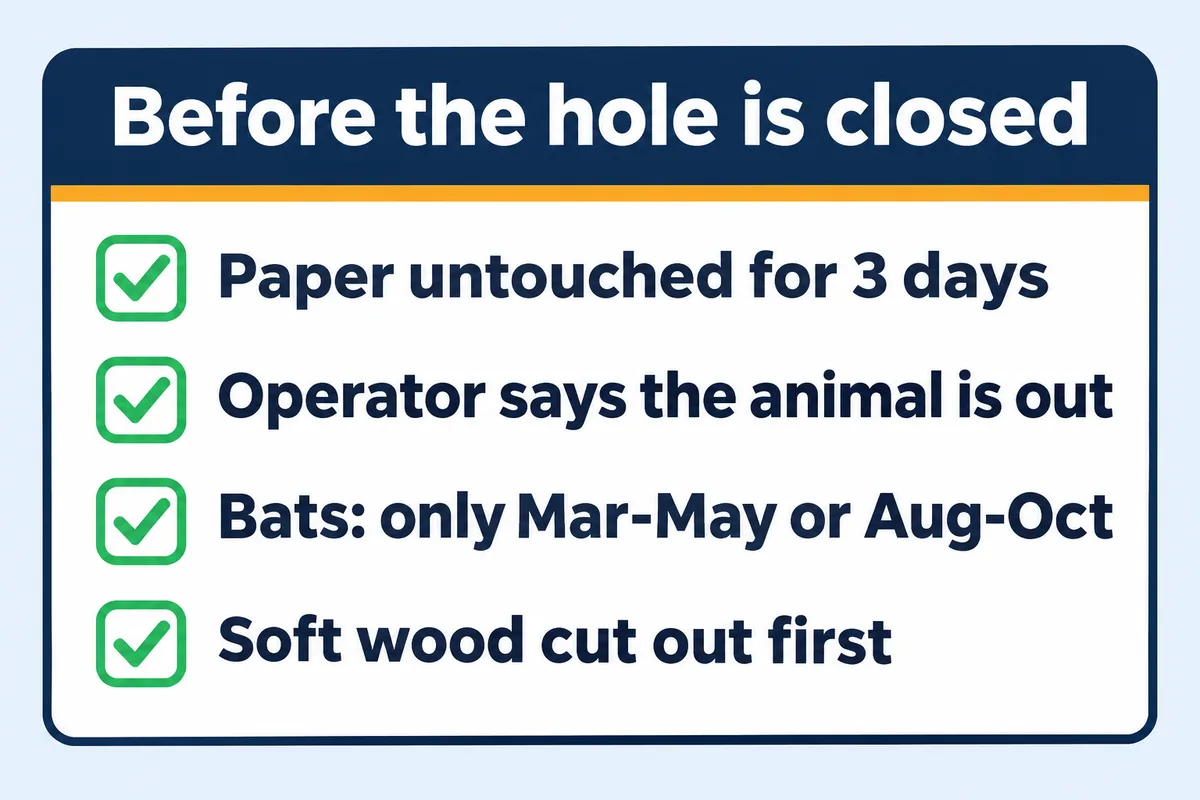
Wildlife Illinois gives homeowners a cheap test before any repair (repairing wildlife damage). It is worth doing before anyone closes an eave:
- Stuff the hole loosely with a few sheets of newspaper. Loosely matters: an animal inside has to be able to push it out, not be sealed in.
- If the opening is low enough to reach safely, on a garage or porch roof edge for example, sprinkle flour on the surface in front of it so footprints show.
- Leave it for two or three days. Paper still in place and clean flour mean it is reasonable to go ahead with the repair.
- Paper pushed out or pulled away, or tracks in the flour, mean something is still using the hole. It has to come out before anyone repairs anything.
- Never patch over paper that moved. The state's page is plain about why: a shut-in animal does more damage trying to get out or back to its young, and one that dies in the wall or attic leaves a smell nobody forgets.
In November we read a quiet newspaper with a little more suspicion. Cornell's pest-exclusion guidance points out that raccoons, among others, can be inactive for long periods in winter, so an entry can look abandoned and be busy again on the first warm spell (Cornell IPM, pest exclusion). If you hear thumping at night or smell droppings, believe that over the paper. The other date to know runs the other way: Wildlife Illinois asks for repairs to be made before the breeding season, March through late July, when closing a hole can trap young inside.
Who is allowed to take the animal out in Illinois
Not your roofer. Illinois puts anyone paid to remove these animals from someone else's property under a state permit, and the same rule covers paid bat eviction:
"Any individual desiring to take game mammals, furbearing mammals, other mammals, game birds, or bats, or to provide services for the exclusion and/or eviction of bats, that are causing damage to property or risks to human health or safety on the land of another, for a fee, must first obtain a valid Class A Nuisance Wildlife Control Permit from the Department."
Illinois Administrative Code, title 17, section 525.20(a)
So the order on your house is set. A licensed nuisance wildlife control operator removes the animal and tells you it is out, and then the eave is rebuilt. If you would rather trap it yourself, Wildlife Illinois says you will likely need a nuisance animal permit from the IDNR district wildlife biologist for your county before you set a trap (Wildlife Illinois on trapping it yourself). Either way, the roofer's part comes after that: wood, metal and fasteners.
Bats in the eave: in November they wait until spring
Bats are the one case where the calendar decides, not the hole. The Illinois Department of Public Health allows a bat to be put out of the rooms you live in at any time of year. From an attic or another space you do not use, permanent eviction is allowed only from March 15 to May 15 and from August 5 to October 30, on evenings when it is above 50 F at dusk, so that pups that cannot fly yet are not shut in (IDPH, bat exclusion).
- Jan
- Feb
- Marfrom 15th
- Apr
- Mayto 15th
- Jun
- Jul
- Augfrom 5th
- Sep
- Octto 30th
- Novnow
- Dec
Dark months: attic eviction allowed, evenings above 50 F. Red outline: today. Every other month the gap stays as it is.
That means a bat gap found this week is not sealed this week. The department's advice for a colony in a part of the house nobody lives in is to close every gap wider than a quarter inch between that space and the living area and let the colony be. In the next window, the eviction (one-way devices that let bats out and not back in) is done by the permit holder or by you. Once the bats are out, the opening is closed in metal or quarter-inch mesh, which is roofing and trim work.
What goes back on the eave, and what it costs
The material has to beat the animal that came through. Cornell's guidance draws the line clearly: aluminum flashing is fine for birds and bats, but raccoons and rodents can chew or claw through it. Galvanized sheet metal fastened with screws holds up against them, and hardware cloth comes in quarter-inch and half-inch mesh. Soffit vents are best protected with metal louvers fixed firmly to the soffit. So a squirrel hole gets new wood and a galvanized patch, not a bead of caulk and a dab of paint.
| What we find | What goes back | Our range |
|---|---|---|
| A chewed hole in a fascia board that is still solid around it | The chewed piece cut out and a new section spliced in, with a galvanized patch behind the trim metal where the squirrel worked | $250 to $600 per section |
| Soffit panels chewed or pried loose along a run | A new aluminum soffit run set into its channels, with the vented panels kept where the attic needs air | $1,200 to $2,800 |
| Fascia soft for the whole length behind a gutter | The gutter taken down, the board replaced and wrapped, and the gutter rehung on solid wood | $1,800 to $4,500 for a full fascia wrap and soffit |
| Shallow woodpecker dents in sound trim | Filled, sealed and repainted | $150 to $400 |
These are the ranges from our soffit and fascia price table for the north and northwest suburbs, not a quote. Taking an existing gutter down runs $1 to $2 per foot on our gutter repair page, and the same page prices soft fascia as its own line, so you can see what the animal cost apart from what the gutter cost. The board itself is replaced as part of our siding and exterior trim work.
Why the eave let them in
Wildlife Illinois calls the eave a prime way into a building, particularly where it has had water damage, and that matches what we pull off houses. A squirrel rarely starts on sound, painted wood. It starts where the wood is already soft.
The usual soft spot is the top of the fascia right behind a gutter. When the shingles stop short of the edge, or there is no metal edge to throw water into the trough, rain runs down the back of the gutter and soaks that board for years. Our article on how far shingles should extend past the drip edge shows how to check that from the ground. Fix the edge with the fascia, or the next soft spot will be a foot down the same board.
The second is a soffit panel that has slipped out of its channel, often at an outside corner or the roof return, where the pieces meet at angles and a gap opens a little more each winter. The third is a gable vent with a plastic louver or a torn screen behind it. If the roof itself is due, the eave work goes on the same job as the new drip edge and gutters, which is the cheapest time to do it; our residential roofing crews set the edge metal first and the gutter goes back on solid wood.
Frequently asked questions
Does homeowners insurance pay for squirrel damage to the soffit or fascia?
Usually not. A storm that tears the eave open can be a claim, but chewing by a family of squirrels, or rot from years of water getting behind a gutter, generally is not. The exclusions in your own policy decide it, so read that page or ask your carrier in writing before you count on a check.
Can I just push steel wool or spray foam into the hole?
Not as the repair. Cornell pest-exclusion guidance lists foam, caulk and copper gauze for cracks and small gaps, and it warns that raccoons and rodents can pull out weak exclusion or open a new hole. A hole a squirrel or raccoon has already used gets cut back to sound wood and covered with galvanized sheet metal fastened with screws or with hardware cloth, and only after the newspaper test says nothing is inside.
Will the animal come back after the hole is fixed?
It may try. Wildlife Illinois says an animal using your house as a den is very persistent about getting back in, even if it has to chew or tear a new opening, so make the repair quickly once the animal is gone and look over the rest of the eave, the roof return and the vents the same day.
Related reading: gutters sagging or pulling away from the fascia and gable vents next to a ridge vent.
Found a chewed spot on the eave and the animal is gone? Call us at (866) 992-2982, Monday to Friday 7:00 AM to 7:00 PM and Saturday and Sunday 9:00 AM to 5:00 PM, or book a free inspection. We work across the north and northwest Chicago suburbs.