
 Volodymyr Lukaniuk
Gutter heat cable is worth paying for on one stubborn stretch of eave and a poor deal as a whole-house answer to ice. It keeps a wet channel open so meltwater can get off the roof and out of the downspout, and it does nothing about why the snow is melting up there. At today's ComEd prices a short run costs roughly $8 to $25 a winter if somebody uses the switch. A big run left on from December through February comes to about $650.
Those two numbers are far apart because cable is sold by the foot and billed by the hour. So count the feet first, then the hours.
Count the cable before you price anything
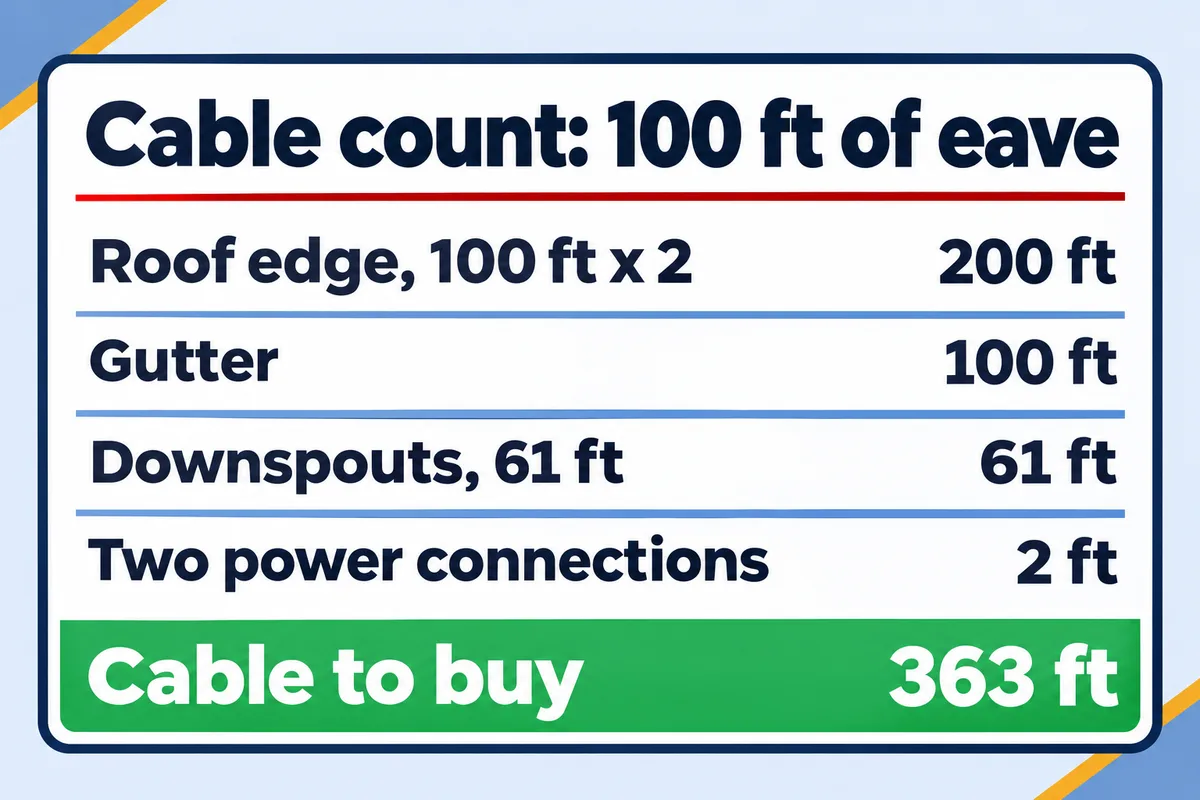
A house needs far more cable than its gutter length. The WarmlyYours installation manual counts it this way: the zigzag along the roof edge, plus one foot per foot of gutter, plus the downspouts, plus a foot for each power connection. On a standard eave with a 1-foot overhang, the zigzag takes 2 feet of cable per foot of roof edge. The right column below is the manual's own sample. The left column is ours, for a single 30-foot eave with one 10-foot downspout at its end.
| What the cable covers | One 30 ft eave | Manual's 100 ft sample |
|---|---|---|
| Zigzag on the roof edge | 60 ft | 200 ft |
| Inside the gutter | 30 ft | 100 ft |
| Down the downspouts | 10 ft | 61 ft |
| Power connections | 1 ft | 2 ft |
| Total | 101 ft | 363 ft |
Two things push the count higher. A downspout in the middle of a run has to be looped down and back, so its length counts twice. A valley takes cable two-thirds of the way up and back down. Plug-in kits come in fixed lengths and can't be shortened, so you buy the size that fits your run instead of trimming to it.
What the cable itself costs
One maker's list gives you a yardstick. WarmlyYours sells a 30-foot, 5-watt-per-foot plug-in kit for $69, and 250 feet of its self-regulating 240-volt cable for $1,350, which works out to $5.40 a foot. At that rate the manual's 363 feet is about $1,960 in cable alone, before power kits, clips and labor. That self-regulating cable is hardwired, so an electrician is on the bill as well.
One short eave is a much smaller job. Our guide to frozen gutters and downspouts puts cable at $300 to $700 installed, which fits a short run like that. A whole house costs more because of the footage above.
What does heat cable add to a ComEd bill?
Multiply the feet by the watts per foot, turn that into kilowatts, then multiply by the hours on and the price of a kilowatt-hour. Both WarmlyYours products above are rated at 5 watts a foot.
For the price, we added up the charges that rise with each kilowatt-hour on a single-family home without electric heat. Delivery is more than a third of it, and it's easy to leave out.
- Plug In Illinois price to compare, October 1, 2026 to May 31, 2027
- 10.103¢
- Citizens Utility Board's 2026 list, distribution facilities charge
- 6.228¢
- Same list, electricity distribution charge
- 0.126¢
- Rounded, before taxes and other adjustments
- 16.5¢
| Hours the cable is on | One 30 ft eave (505 watts) | Manual's sample (1,815 watts) |
|---|---|---|
| 100 hours | $8 | $30 |
| 300 hours | $25 | $90 |
| December 1 to February 28, never off (2,160 hours) | $180 | $647 |
The hours are sample figures for the arithmetic, not a forecast of a Chicago winter. The WarmlyYours rating of 5 watts is taken at 50°F, and self-regulating output moves with the temperature, so treat these as ballpark numbers. Your supplier's price may differ, and your own bill lists it.
When should it be on?
The Wrap-On cable instructions give a narrow window: power on only while snow and ice are melting and the air is between 15°F and 35°F, and off once the melting stops. They also say to disconnect the circuit for the summer so nobody turns it on by accident.
The sheet warns the cable may not hold a path open, and it calls partial melting undesirable.
The only time this maker says to run it. Snow on the roof, water moving, ice building at the eave.
Off. A dry roof at 30°F gives the cable no water to clear.
A plug and a person are the cheapest control there is, if that person is home and paying attention. Controls cost real money: WarmlyYours lists an outdoor thermostat at $485 and a more advanced control at $969. On the big sample house, the gap between 300 hours and never turning it off is $557 a winter, so a control can pay for itself quickly there. On one 30-foot eave the same gap is $155, and a reminder on your phone may be all you need.
Where we'd run it, and what we'd repair first
We look at cable the way we look at a tarp: it's useful on a known spot when the proper repair can't happen, or has already happened and the spot still ices up. Our article on what causes ice dams and what stops them covers the attic side of that. On an actual house, we sort it like this.
Cable can earn its power
- A short eave that ices up again after the attic has been air sealed and insulated.
- A story-and-a-half house, where the sloped ceilings leave little room for insulation at the eave.
- A low porch roof tied into a valley, where melt from a big slope lands on a small gutter.
- One downspout that freezes every winter and can't be rerouted.
Fix this before buying any
- A gutter full of leaves. The makers say to clear debris first, and our note on when to clean gutters in the fall has the timing.
- A gutter that sags or pulls off the fascia. Water and ice sit in the low spot, so repair the hangers first.
- Ice along every eave of the house. That points to heat loss in the attic, and at $647 a winter you'd be paying yearly for a problem insulation can reduce.
- A gutter that's too small or badly pitched. Our gutter installation page lists the sizes we hang.
The wiring is the part that can hurt somebody
This is a live heating element lying in water on a roof. Every manual we read treats it that way, and the MOR Heat Trace design guide explains why a standard breaker isn't enough:
"Arcing may not be stopped by conventional circuit breakers."
MOR Electric Heating, roof and gutter guidelines
That guide cites the National Electrical Code's requirement for ground-fault protection on electric de-icing, and both it and WarmlyYours call for a 30-milliamp trip level on the cable circuit. The Wrap-On kit wants a permanent, weatherproof, grounded outlet with GFCI protection under the eave, and the cord should approach it from below so water can't run down into the plug. An orange extension cord through a window doesn't meet any of that.
Circuit size matters too. The WarmlyYours table for a 0°F start allows at most 140 feet of its 120-volt cable, or 285 feet of its 240-volt cable, on a 15-amp circuit. The 363-foot sample goes past both, so ask an electrician to size it before you buy. It's also worth a call to your village's building department to ask whether the job needs a permit.
Already have cable up? Check it before the first snow
- Clear the gutters and downspouts. The WarmlyYours manual wants leaves, pine needles and anything else that can burn out of there first.
- Walk the run from the ground with binoculars and look for a cut jacket, or a loop knocked loose by a ladder or a falling branch.
- Make sure no stretch touches or crosses itself, especially inside the downspout. The Wrap-On sheet uses spacers every 6 to 8 inches there.
- Press the test button on the GFCI or ground-fault breaker. WarmlyYours calls for that check every year.
- Switch the summer disconnect back on. If the ground-fault device trips, leave it off and call the electrician.
- Replace any clip that has let go. Tape pads only stick to roofing above 40°F, so do this on a mild afternoon while you still have one.
Frequently asked questions
Does gutter heat cable stop ice dams?
It opens drain paths through the ice, and it doesn't stop the ice from forming. The snow still melts from attic heat, and it still refreezes at the cold eave. If the leak comes back with the cable running, the cause is further up the roof.
Can I leave gutter heat cable on all winter?
You can, at a price. Left on from December through February, a 101-foot run costs about $180 and a 363-foot run about $647 at 16.5 cents a kilowatt-hour. The Wrap-On instructions say to run it only while snow and ice are melting between 15°F and 35°F.
Can I install heat cable in December or January?
The WarmlyYours manual lists 0°F as the minimum for installing its cable, but its double-sided tape pads only go on above 40°F. The gutter and the shingles also have to be free of debris, and a snowy roof is a bad place for anybody to work. Early November is a much easier time for this job.
Does heat cable work in plastic or vinyl gutters?
Some kits say so. The Wrap-On kit is sold for metal or plastic gutters. WarmlyYours tells installers to check the temperature rating of the roof, gutters and downspouts and pick a heater that stays under it. Read the sheet for the cable you're buying.
Related reading: whether gutter guards are worth it here and how soffit and fascia work at the eave.
Same eave icing up every year? Call (866) 992-2982, seven days a week (weekdays 7:00 AM to 7:00 PM, weekends 9:00 AM to 5:00 PM), or book a free inspection online. We work on gutters and roofs across the north and northwest Chicago suburbs.