
 Volodymyr Lukaniuk
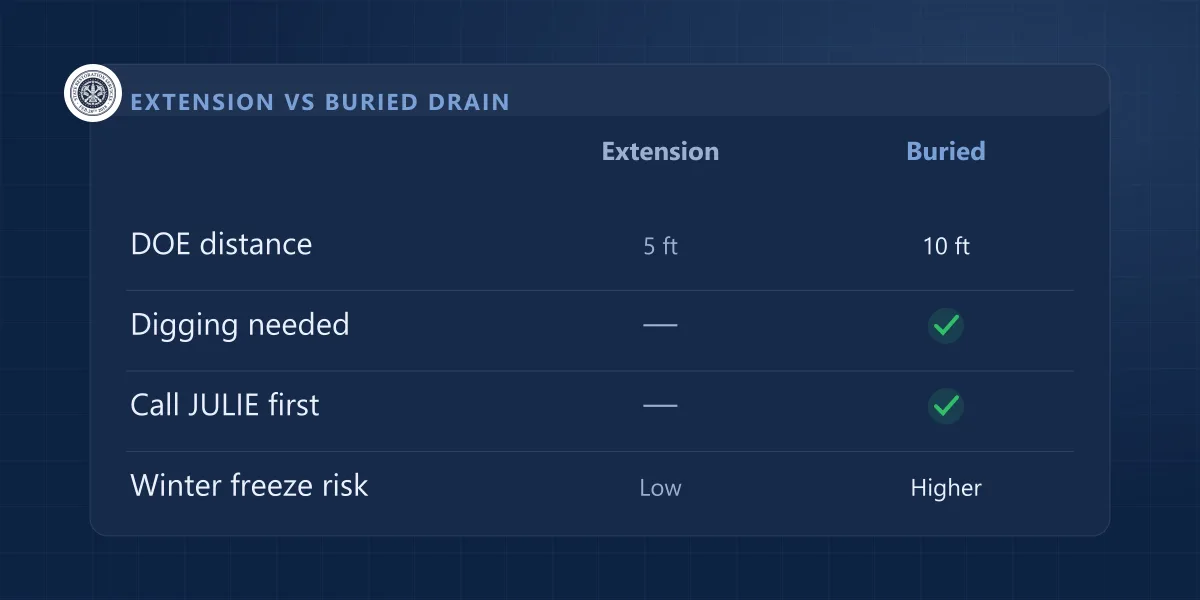
Where should downspouts drain? Far enough that the water can't run back to the foundation, on your own lot, and not across a walkway that turns into a skating rink in January. The usual number is 5 feet for an extension lying on the grass and 10 feet for a buried pipe.
That is the short version, and for most houses in the north and northwest Chicago suburbs it is enough. The longer version has two surprises in it. One is how much water we are talking about. The other is that your village may have written its own rule, and it does not always match what the internet tells you.
How much water comes out of one downspout?
One inch of rain puts 0.623 gallons on every square foot the roof covers. A house with a 2,000 square foot roof footprint sheds about 1,246 gallons in a one-inch storm. Split between four downspouts, each corner of the house receives roughly 312 gallons.
The arithmetic is short: one square foot, one inch deep, is 1/12 of a cubic foot, and a cubic foot holds 7.48 gallons. Roof pitch does not change the result, because rain falls on the footprint, not on the slope. Measure the ground your roof covers, overhangs included.
| Roof footprint | Runoff in a 1-inch rain | Per downspout, 4 spouts | Per downspout, 6 spouts |
|---|---|---|---|
| 1,500 sq ft | 935 gal | 234 gal | 156 gal |
| 2,000 sq ft | 1,246 gal | 312 gal | 208 gal |
| 2,500 sq ft | 1,558 gal | 389 gal | 260 gal |
| 3,000 sq ft | 1,869 gal | 467 gal | 312 gal |
The split assumes each downspout takes an equal share. Real houses are lopsided: a long back gutter with one outlet can carry twice what the front corner does.
So a downspout that ends in a bare elbow is pouring a few hundred gallons into one square yard of soil beside your basement wall, every storm. Nobody would do that with a garden hose. People do it with a roof for twenty years and then wonder about the damp corner downstairs.
How far from the foundation should a downspout discharge?
Three published numbers cover nearly every case. The City of Chicago asks for at least 3 feet. The U.S. Department of Energy's building guide asks for 5 feet when the water comes out on the surface and 10 feet when it travels in a buried pipe. In each case the ground at the outlet has to slope away from the house.
The Chicago figure comes from the city's downspout disconnection guide, which also tells owners to think about winter icing before choosing where the water goes. The 5 and 10 foot figures come from the Department of Energy's Building America guide to gutters and downspouts. The same guide wants the buried pipe to be solid, not perforated, and warns against tying it into the perforated drain tile around the footing.
Distance alone does not finish the job. Five feet of extension that ends in a low spot sends the water straight back. Before you buy anything, stand outside in a steady rain and watch which way the puddle travels.
Extension, splash block, rain barrel or buried line: which suits which yard?
Pick by the yard, not by the price tag. A yard that falls away from the house needs only a rigid extension. A flat yard with a walkway in the way is where a buried line earns its trench. A splash block on its own is shorter than every number above.
| How the downspout ends | Suits this yard | Watch for |
|---|---|---|
| Splash block only | Ground that already drops sharply away from the wall | Too short on flat lots. It protects the soil from washing out and little else. |
| Rigid aluminum extension, 4 to 6 feet | Most suburban lots with a gentle slope to the lawn | It gets kicked, mowed over and left folded up. A hinged one that nobody folds back down is a bare elbow again. |
| Rain barrel | A gardener who will empty it between storms | The table above shows a few hundred gallons per downspout in one storm, far more than a barrel holds, so the overflow needs its own extension. Drain it and take it off line before the first freeze. |
| Buried solid pipe to a pop-up outlet | Flat lots, a patio or walk next to the spout, a downspout landing in a narrow side yard | It has to fall the whole way and it has to end somewhere you are allowed to send water. |
What does your village say about downspout discharge?
There is no single Illinois rule. Each village writes its own, usually in the building or sewer chapter of its code, and the limits can be tighter than the national advice. Most of them agree on two points: roof water stays out of the sanitary sewer, and it does not get aimed at the neighbour.
Mount Prospect, next door to Arlington Heights, is a good example because its code puts numbers on it. Section 21.223 of the Mount Prospect Village Code reads:
The water must be directed either toward the street abutting the property or parallel to or away from the nearest lot line.
The point of discharge of any downspout or sump pump shall not be more than five feet (5') from a foundation.
The point of discharge of any downspout or sump pump shall not be less than five feet (5') from any lot line.
Read the middle line twice. In that village the outlet may be no farther than 5 feet from the house, so a 10 foot buried run that every drainage article recommends would need the village engineer's sign-off. The same section bans downspouts from the sanitary or combined sewer and says it applies to existing houses as well as new ones.
Take a narrow lot where the wall is 8 feet from the lot line.
A spout aimed straight at the neighbour has to stop 5 feet short of the line, which leaves 3 feet of extension. Three feet meets the village rule and is under the federal 5.
The fix is to turn the elbow so the extension runs along the wall line toward the front or back yard, parallel to the lot line. Now it can be the full 5 feet and still sit 8 feet from the neighbour.
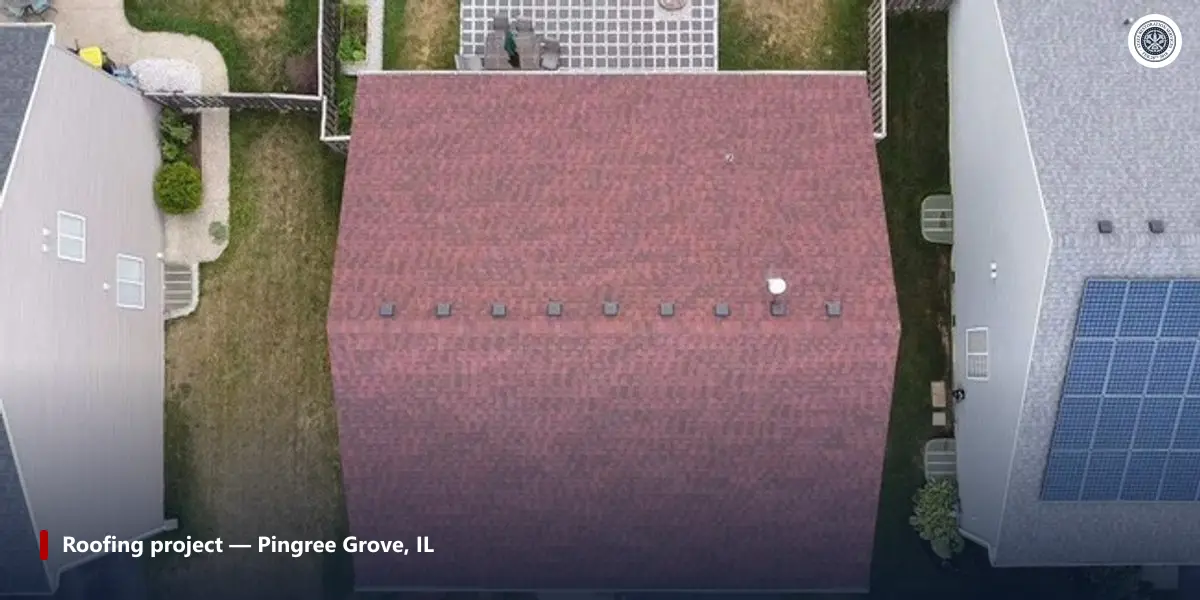
The photo shows why this matters: side yards between suburban houses are often a strip of grass a mower wide. We have not read every code in Lake and Cook County, and codes change, so we don't quote other villages from memory. Call your village's building or engineering desk and ask these five things:
- Is there a minimum distance from the lot line for a downspout or sump outlet?
- Is there a maximum distance from the foundation?
- May the water be directed toward the street, and may it cross the public sidewalk?
- Do I need a permit to bury the line or to connect it to a storm sewer?
- Is my street on a combined sewer, and does that change anything for my downspouts?
When does a buried downspout line make sense?
Bury the line when the surface route is blocked or the lot is too flat for an extension to work: a patio beside the spout, a walkway that would ice over, a side yard too tight to turn in. Skip it when the lawn already carries water away, because a pipe adds joints, an outlet and a trench to look after.
A buried line fails for one of a few plain reasons. It was laid flat or with a dip, so water sits in it and freezes. Perforated pipe was used, so it leaks the water out beside the house. It ends in the soil with no real outlet. Or shingle grit and leaves went down the spout and nobody could get them back out. The federal guide asks for a fall of at least half an inch per foot on a buried drain. That is 5 inches over a 10 foot run, and a flat lot may not have 5 inches to give.
Trenching is normally a drainage or landscape contractor's work. Whoever digs, Illinois law requires a locate request first. JULIE takes requests at 811 or online and the service is free. A gas line does not care that the trench was only 8 inches deep.
What we check on the gutter before anyone digs
Plenty of "drainage problems" start 10 feet up. Before paying for a trench, we look at the part we install.
- Count the downspouts. One outlet on a 50 foot gutter sends the whole run to one corner. Adding a second spout halves what that corner has to handle. Our article on gutter pitch and downspout placement explains where they belong.
- Check the size. We hang 5-inch gutters with 2x3 downspouts on most homes and 6-inch gutters with 3x4 downspouts under large or steep roofs. If water sheets over the front edge in a hard rain, read 5-inch vs 6-inch gutters before blaming the yard.
- Look inside the bottom elbow. A fist of maple seeds there makes the water leave through the seams above it and run down the siding.
- Follow the extension. Is it attached, is it pointed downhill, and does it clear the mulch bed that was built up against the house last spring?
- Think about January. Any outlet that crosses a walk or driveway makes ice. We covered the winter side in frozen gutters and downspouts.
If the gutters themselves are undersized, sagging or dented from hail, fix those first. Our seamless gutter installation crews size and place the downspouts and extensions as part of the job, and you can send us a photo of the problem corner if you are not sure which trade to call.
Downspout questions we hear on estimates
How far should a downspout extension reach from the house?
Aim for 5 feet on the surface, the figure in the U.S. Department of Energy building guide, and never less than the 3 feet the City of Chicago asks for. The ground at the end must slope away from the wall. Check your village code first, because some villages set their own limits.
Can I connect a downspout to the sewer or to the drain tile around my foundation?
Not to the sanitary sewer. Mount Prospect, for one, bans it outright for old and new houses. The federal building guide also says not to tie a gutter drain into the perforated foundation drain. A connection to a storm sewer is a question for your village engineering desk before any work starts.
Do buried downspout lines freeze in Illinois winters?
They freeze when water stays in them. A line with a steady fall and an open outlet empties after each rain and has nothing left to freeze. A line laid flat, with a dip, or with a buried outlet holds water, and the ice then backs up into the downspout and the gutter.
Do I have to call JULIE before burying a downspout pipe?
Yes. JULIE, the Illinois one-call system, says the law applies whenever you dig to plant, build or fix anything outdoors, and it lists no exception for a small trench. Call 811 or file the request online. It is free, and the buried lines on your lot get marked before you start.
Not sure where your roof water is going? Book a free inspection or call (866) 992-2982. We work across the north and northwest Chicago suburbs.