
 Volodymyr Lukaniuk
Aluminum gutter thickness is written as a decimal of an inch: .027 means 27 thousandths of an inch and .032 means 32 thousandths. For most houses in the north and northwest Chicago suburbs, .027 does the job, and it is what most installers mean when a quote says "standard". We would pick .032 where the gutter has a harder life than carrying water: under a steep roof or a metal roof that drops its snow in one slab, under big trees, on a house where somebody leans a ladder against the gutter every fall, or under a guard that sits on the gutter. The thin .025 sections sold in ten-foot lengths at the home center are the ones that dent and kink first.
We hang and replace gutters on homes across Lake and Cook County, and on nearly every gutter quote the coil number sits on one line that nobody explains. So we worked it out: what the three numbers mean, how much stiffer .032 really is in plain arithmetic, the houses where it pays for itself, how to measure the gutters you already have with a caliper, and what a quote should spell out before you sign it.
What .025, .027 and .032 mean on a gutter
On aluminum gutters the number is the thickness itself, in inches. A bigger number is thicker metal, full stop. Salespeople still call it "gauge", but there is no gauge chart involved: .032 aluminum is 0.032 of an inch thick. The bars below are drawn to one scale, so the step from one coil to the next is the real proportion.
Both thicker coils are ordinary stock items. Ply Gem, one of the large makers of aluminum rainware, lists its one-piece gutter coil in "premium, nominal .027 and .032 coil thickness" on its aluminum gutters page, and its sectional system in "nominal .032" only. "Nominal" is the figure the coil is sold at. A piece you measure can read a hair over or under it, and paint on both faces adds a little.
How much stiffer is .032 than .027?
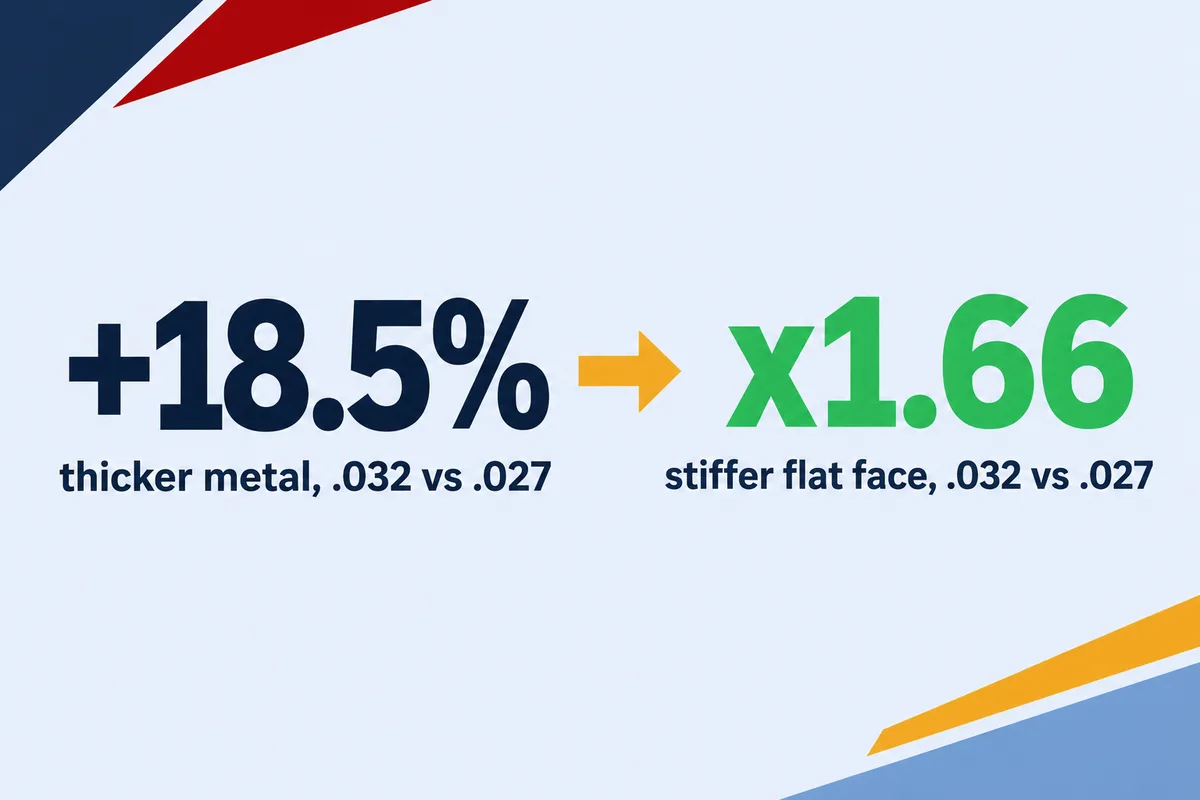
The metal is 18.5% thicker, and the flat parts of the gutter are about 1.66 times as stiff. The thickness goes up by 5 thousandths on 27, which is 18.5%. Stiffness grows much faster than that, because a flat sheet resists bending in proportion to the cube of its thickness. That is the plate rigidity formula, D = E t³ / 12(1 - ν²), as given in the RoyMech tables for flat plates. E and ν belong to the aluminum, so for two coils of the same alloy only t changes, and the ratio is 32³ against 27³.
Those ratios describe the flat parts: the front face and the bottom of the trough, which is exactly where a ladder rail, a hailstone or a falling branch lands. The bends of a K-style profile add stiffness of their own, so a whole run is not precisely 1.66 times as hard to bend. The ratio still tells you which way the answer goes and roughly how far. The weight line matters too: the extra metal hangs on the same fascia, so heavier coil is only worth it on hangers that can carry it.
Where .032 earns its money on a north-suburb house
Climate alone does not settle it, since every house from Palatine to Northbrook sees the same winter. What decides it is what the gutter carries and what hits it. This is how we sort a house when the owner asks which coil to buy.
| What your gutter lives with | Our pick | Why |
|---|---|---|
| A steep roof or a metal roof that sheds snow in one slab | .032 | In our worked example of snow sliding off a roof, one slab put 120 to 360 pounds per foot of eave against the gutter. No coil stops that, but the stiffer lip bends less where the slab rides over it. |
| A ladder leaned on the gutter for cleaning, every fall | .032 | The ladder rails press on the front face, the flat part the 1.66 ratio is about. Better still is a ladder stand-off, or cleaning from the ground. |
| Oaks or maples hanging over the roof line | .032 | Branches and wet leaf mats load the face and the bottom of the trough. |
| A gutter guard that sits on top of the gutter | .032 | The guard, and the snow that sits on it, adds weight on the front lip. Our guide to gutter guards in the north suburbs covers which guard fits which house. |
| A street that gets hail every few summers | .032 | A stiffer face takes fewer and shallower dents from the same stones. What a hail claim pays for gutters is in our hail damage to gutters article. |
| A one-story ranch, low slope, no trees over the eave | .027 | Nothing heavier than rain and a little ice reaches it. Put the money into hangers every 18 inches instead. |
Measure the gutters you already have
You need a digital caliper from any hardware store and five minutes on a ladder set against the wall, not against the gutter. This tells you what to match when one run is replaced, and what a past job actually used.
- Find a bare cut edge. The hole for a downspout outlet works, so does the end of a run behind the end cap, or an offcut if the last installer left one in the garage.
- Close the caliper jaws with nothing between them and press zero, so the reading starts from true zero.
- Close the jaws on the edge, square to the metal and without squeezing hard, and read in inches to three decimals.
- Round to the closest of the three standard figures: .025, .027 or .032. Paint on both sides makes a reading come out slightly over the coil's own number.
- Measure two or three runs. Two different readings on one house usually mean the runs went up at different times.
If a quote says .032 and the new gutter reads about the same as the old .027 run beside it, ask about it before the last payment, not after the first snow.
Problems a thicker coil does not fix
Some owners ask us for .032 when the real trouble sits behind the gutter. Heavier metal on the same weak support only gives the support more to hold. Look at these first:
- Hangers too far apart, or spikes backing out of the fascia. The makers' sheets we read for our article on gutters sagging or pulling away ask for one hanger every 18 inches where snow and ice are normal, and a .032 run on 36-inch spacing still sags.
- Soft or rotted fascia board. Screws hold only as well as the wood they go into, and our page on soffit and fascia shows what failing wood looks like from the ground.
- Pitch that runs the wrong way or leaves a puddle. Standing water freezes into a heavy block in any coil, so the slope comes first; it is set out in our gutter pitch and downspout placement guide.
- A trough too small for the roof above it. That is a question of size, which our 5-inch vs 6-inch gutters article answers, and thickness does not change it.
What a gutter quote should name
A quote you can compare line by line names the parts. Ask for each of these in writing, with numbers:
- The coil thickness as a figure, .027 or .032, instead of "heavy duty" or "premium".
- The gutter size and profile: 5 inch or 6 inch, K-style or half-round.
- The downspout size, 2x3 or 3x4, and how many there are.
- The hanger type and the spacing in inches.
- Where each downspout lets the water out, and how far from the foundation.
Installed one-piece aluminum gutters run about $6 to $14 per foot in our area, as our gutter cost per foot guide lays out, and the coil is one of the things that moves a job inside that range. When you ask us for a quote through our gutter installation page, ask which coil the price is for and compare the number, not the adjective.
Related reading: what gutters are made of and telling K-style, half-round, box and fascia gutters apart.
Frequently asked questions
Is .032 aluminum worth it for gutters in Illinois?
Yes on a house where snow slides off the roof into the gutter, where a ladder leans on it, under big trees or under a guard that sits on top. There the flat face of .032 is about 1.66 times as stiff as .027. On a low one-story house with nothing hitting the gutters, .027 hung every 18 inches does the job.
Is .027 gutter thick enough?
For most houses, yes. It is the common coil for one-piece aluminum gutters. Hung on hangers every 18 inches into sound fascia, with the pitch right, it carries water and ordinary ice for years. It is the face that dents first under a ladder or hail.
How can I tell what thickness my gutters are?
Measure a bare cut edge, such as the downspout outlet hole or the end of a run behind the end cap, with a digital caliper zeroed first. Round the reading to the closest of .025, .027 and .032. Paint makes it read slightly over the coil's own number.
Pricing new gutters before the snow? Book a free inspection or call (866) 992-2982, Monday to Friday 7:00 AM to 7:00 PM and Saturday and Sunday 9:00 AM to 5:00 PM. We serve the north and northwest Chicago suburbs from our office in Lincolnshire.