
 Volodymyr Lukaniuk
You can clean gutters without a ladder if two things line up: a tool long enough to hook over the lip of your gutter from the lawn, and a tool that suits what is actually in there. A hose wand flushes grit and light leaves. A blower nozzle clears dry leaves and nothing wet. A wet/dry vac kit lifts seeds and needles. Packed black sludge only comes out with a scoop on a pole, slowly. Work toward the downspout, clear the downspout from the bottom, then run a hose test to prove the water leaves the way it should.
We install seamless gutters and guards and we clean gutters across the north and northwest Chicago suburbs, so we see the results of ground-level cleaning every season. The most common one: the trough looks clear from the driveway and the downspout is still packed solid at the bottom elbow. The steps below are written to stop that.
How high is your gutter? Measure it from the lawn first
Every pole, wand and vac kit prints a reach on the box. That number is useless until you know the height of your own eave, and you can get it without leaving the ground. Siding and brick are built in even rows, so you count rows and multiply.
Lap siding
Hold a tape against the wall at the bottom and measure one lap, from the bottom edge of one board to the bottom edge of the next. Count the laps up to the soffit. Add the strip of foundation that shows below the siding.
Example: 5-inch laps, 22 laps, 12 inches of foundation.
22 × 5 + 12 = 122 in, about 10 ft
Brick
Standard modular brick rises 8 inches for every 3 courses, mortar included. Count the courses up to the soffit, divide by 3, multiply by 8. Measure one set of 3 courses first to be sure your brick is the standard size.
Example: 42 courses, 10 inches of foundation.
42 ÷ 3 × 8 + 10 = 122 in, about 10 ft
Now subtract the height of your hands when you hold a pole over your head and add a few inches for the hook that has to drop over the front lip. On a one-story eave around 10 feet, a wand of 6 to 8 feet works. On a two-story eave, often 18 feet or more, you need 14 feet or longer, and at that length the hook end swings around so much that you can't feel what it is touching. That is the honest limit of ground tools: they reach a second story, but you are cleaning blind.
Many homes here have both, like the two-story house with an attached one-story garage in the photo further down. Plan the low runs and the high runs as two different jobs.
Which ground tool works on which debris
What's in the gutter decides the tool far more than the brand of the tool does. In our area the mix changes by season: maple seeds in late spring, oak and maple leaves after the fall drop, pine needles all year under evergreens, and shingle granules wherever the roof is aging or took hail. A gutter that hasn't been touched for a few years holds a layer of wet black sludge at the bottom no matter what fell into it.
| In the gutter | Hose wand | Blower nozzle | Wet/dry vac kit | Pole with scoop or tongs |
|---|---|---|---|---|
| Dry leaves | Partly | Works | Works | Works |
| Maple seeds | Partly | Partly | Works | Partly |
| Pine needles | Partly | Partly | Works | Works |
| Granules and grit | Works | No | Partly | No |
| Wet black sludge | No | No | Partly | Slow |
| Ball or nest at the outlet | No | No | Partly | Works |
"Partly" means it moves the debris but leaves some behind or pushes it into a mat at the outlet. Most gutters hold two or three kinds at once, so most homeowners end up using two tools: something to lift the bulk, then the hose to flush the fine stuff.
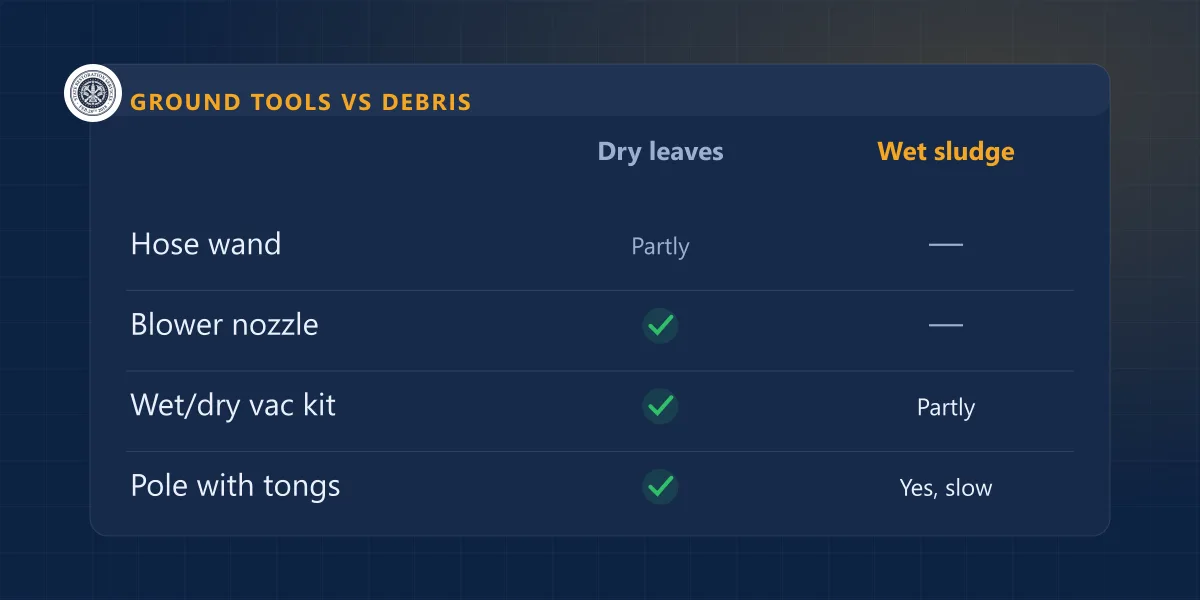
A blower is the tool people buy first and regret first. On dry leaves it's fast and fun. On anything damp it just presses the mat flatter, and what does blow out tends to land on the roof or in the beds. A hose wand has the opposite problem: it's great on grit and granules, but it floats leaves and seeds toward the downspout, where they jam in a ball right at the outlet.
The order that actually clears a gutter from the ground
- Pick a dry day for leaves and seeds, and wait a day after rain if you plan to vacuum, because wet debris clogs a vac hose within a few feet.
- Start at the end of the run farthest from the downspout. Everything you loosen should move in one direction, toward the outlet, not back into the part you already cleaned.
- Lift the bulk first with the vac kit or the scoop, then flush the fine material with the hose wand. Doing it the other way round turns dry leaves into the sludge you were trying to avoid.
- Look inside before you call it done. Tape your phone to the end of a paint pole or a selfie stick, start a video, and drag it along the run just above the lip. You'll see what's left in thirty seconds.
- Clear the downspout from the bottom, not the top. Most downspouts are held to the bottom elbow with two screws or simply slip over it. Take the elbow off, look up the pipe, and push the hose up from below. Clogs sit in the elbows far more often than in the straight pipe.
- Put the elbow back and run the hose test: lay the running hose in the far end of the gutter for a few minutes and watch the whole run from the ground.
What the hose test tells you once the gutter is clean
This is the part none of the tool reviews cover, and it's where a clean gutter starts telling you about the gutter itself. Watch where the water goes.
- Water spills over the front lip while the trough is clean
- The gutter is out of pitch, too small for the roof area above it, or the downspout is too far away. More cleaning won't fix it. Our article on gutter pitch and downspout placement explains how much fall a run needs.
- Water runs down behind the gutter, against the fascia
- Usually the shingles stop short of the gutter or there's no metal edge directing water into it. See how far shingles should hang past the drip edge.
- A drip at one corner or one end
- A seam, a miter or an end cap has let go. A gutter formed in one piece still has those joints, as our piece on leaking corners and end caps shows.
- Water backs up and pours out of the top of the downspout
- There's still a clog below. Go back to the bottom elbow, or the underground line if the downspout drains into one.
- The water is full of coarse dark sand
- Those are shingle granules. A little after a new roof is normal; a steady supply on an older roof is wear or hail. Read what granules in the gutter mean before you assume the roof is fine.
- A section sags or pulls away when it fills
- The hangers or the wood behind them have failed. Don't load that run with a vac wand or a scoop. Our guide to sagging and pulling gutters covers why.

Five things we'd ask you not to do from the ground
- Don't point a pressure washer up at the roof edge. The spray can lift the first course of shingles, drive water under it and strip granules off the shingle.
- Don't use boiling or hot water overhead to melt a frozen gutter. Whatever doesn't stay in the gutter comes down on the person holding the wand.
- Look up before you raise any pole. The service wire that brings power from the street usually lands near an eave, and an aluminum pole, or a wet one of any kind, should never come near it.
- Don't rest a pole, a vac wand or your weight on the gutter lip. The lip is thin aluminum and bends, and a bent lip throws water over the front for good.
- Don't climb out of a window onto the roof to finish the last corner. A ground method that needs the roof to finish isn't a ground method.
When to hand it over, and what our cleaning visit includes
Ground tools make sense on one-story runs with dry debris. They stop making sense on a two-story run full of wet sludge, on a downspout that won't clear from the bottom, and on any section that sags when you touch it. On a gutter cleaning visit we clear each run by hand, flush every downspout and clear it if it's blocked, check the pitch and the hangers, seal small leaking joints on the spot, bag and haul the debris, and send you photos, including anything we notice on the roof, fascia or soffit while we're up there. You get a firm price for your address before we start.
If you'd rather clean far less often, gutter guards are the other route. They keep leaves out, but fine grit and granules still get through, so no guard ends the cleaning for good. Whether they pay off depends on your trees; our article on whether gutter guards are worth it goes through it, and we install them along with seamless gutters and downspouts.
Questions homeowners ask about cleaning gutters from the ground
How do I get maple seeds out of gutters without a ladder?
A wet/dry vac with a curved gutter attachment does the best job, because the seeds are light and lift easily when dry. A hose tends to float them into a ball at the downspout outlet, so if you flush, take the bottom elbow off afterwards and check.
Can I clean a two-story gutter from the ground?
You can reach it with a long pole or vac wand, but at 14 feet or more of pole you can't feel or see what the end is doing, and wet debris won't come out. Use the phone-on-a-pole video to check the result, and hand packed two-story runs to someone with the right equipment.
How often should gutters be cleaned in the north Chicago suburbs?
Twice a year for most homes, in late spring and after the leaves come down in late fall. Under mature oak, maple or pine, three times is realistic. The fall clean matters most, because a gutter full of wet leaves freezes solid in winter.
Is a blower or a hose better for gutters?
A blower for dry leaves, a hose for grit and granules. Neither one moves wet, packed debris, and the hose can push light debris into a clog at the outlet, so check the downspout after either one.
Gutters still overflowing after you've cleaned them? Book a free inspection or call (866) 992-2982, Monday to Friday, 8 AM to 5 PM. We serve the north and northwest Chicago suburbs.
Related reading: where downspouts should drain and frozen gutters and downspouts in Illinois.