
 Volodymyr Lukaniuk

Snow sliding off the roof tears gutters off because the gutter sits in the path of the slab, and a slab of settled snow weighs more per foot of eave than any gutter hanger is meant to hold. The fix is to get the gutter out of that path: its front lip belongs below the line of the roof, so a slide passes over it. Where the roof sheds snow fast, such as a metal roof or the glass of a skylight, snow guards hold the snow up there until it melts. Hanging the same gutter back up in the same spot only sets up the same morning next year.
Why the snow lets go all at once
Snow on a roof sits on a thin wet layer. Heat from the attic and the sun melts the bottom of the pack, and that water works like grease on a smooth surface. Once the bond lets go, the whole sheet moves together. Pitch decides how often that happens: FEMA notes that snow tends to slide at about a 6:12 to 7:12 slope, as we covered in our guide to how much snow a roof can hold. The surface matters as much as the slope. Asphalt shingles have grit that grips the pack, which is why most shingle roofs here hold their snow until it melts. A metal roof sheds it in sheets, and the same goes for skylight glass and solar panels.
Ice in the gutter makes it worse. A gutter that is already packed with ice gives the slab something to catch on, and the slab then pulls on the front lip like a lever.
Which parts of a house lose gutters
Walk around the house once with this list. On most houses we see in the north suburbs, the damage lands in the same few places.
- The eave under a metal porch or bay roof
- The rest of the house may be shingled, but a small standing seam roof over a porch or a bay window sheds snow onto a short gutter that was hung for rain.
- Below skylights and solar panels
- Snow slides off the glass first, piles onto the shingles below and pushes that pile into the gutter in one go.
- Where an upper roof drops onto a lower one
- The gutter on the lower roof gets the snow from both roofs, and the snow from above arrives at speed.
- A short eave over a door or a walk
- This is the one that hurts people. A gutter here is worth guarding even if it has never come down.
- A run that was already loose
- Our article on gutters pulling away from the house covers hanger spacing. A slide often finishes a gutter that was already hanging on two good hangers out of six.
The straightedge test you can do from a ladder
You can check whether your gutter sits in the path of a slide in five minutes, on a dry day, from a ladder set against the fascia. You need a straight board or a 4-foot level.
- Lay the board flat on the shingles near the edge, running straight down the slope, so a foot or so of it sticks out past the roof edge over the gutter.
- Look at where the outer lip of the gutter sits compared with the bottom of the board.
- If the board touches the lip or the lip sits above it, a slide will hit the gutter. If there is a gap between the board and the lip, snow has room to pass.
- Do it at both ends of each run and in the middle, because gutters are pitched toward the downspout and the gap changes along the way.
How big should that gap be? Mike Litchfield's article Sloping and Placing Gutters in Fine Homebuilding gives the depth of the front lip below the projected roof line by pitch:
| Roof pitch | Front lip below the roof line |
|---|---|
| 5 in 12 | 3/4 inch |
| 7 in 12 | 1/2 inch |
| 12 in 12 | 1/4 inch |
A gentler roof needs a bigger gap, because snow leaves it at a flatter angle. The same article puts the front of the gutter about an inch lower than the back.
One slab, worked in pounds
A hanger can't stop a slide, and one ordinary roof face shows it. The snow weights below come from our snow load guide.
- Roof face
- 12 feet from eave to ridge, measured flat across the attic floor
- Eave
- 40 feet of gutter along that face
- Fresh snow
- 2 feet of fresh powder, about 10 pounds per square foot
- Old snow
- 18 inches of old, packed snow, about 30 pounds per square foot
- Hangers
- one every 18 inches, the spacing for snow country, so each hanger carries 1.5 feet of gutter
Fresh powder: 12 x 10 = 120 pounds per foot of eave. Old snow: 12 x 30 = 360 pounds per foot of eave.
Across the 40-foot eave that is 4,800 pounds of fresh snow or 14,400 pounds of old snow, all moving toward one gutter.
Per hanger, if the slab catches the lip: 1.5 x 120 = 180 pounds, or 1.5 x 360 = 540 pounds, pulling outward and down at once.
A gutter is built to carry water and hold its own weight, plus some ice. It is not a fence. Even a well-hung run with good hangers every 18 inches is there to let the slab pass, not to stop it. The arithmetic also explains why a slide often takes the whole run: once two hangers tear out, the load jumps to their neighbors and they go one after another.
Fixes matched to what you found
| What you found | The fix | What it costs or needs |
|---|---|---|
| Front lip at or above the roof line | Re-hang the run lower on the fascia, with new hidden hangers every 18 inches and the pitch to the downspout kept. | If the old run is bent or kinked, a new one-piece aluminum run is usually cheaper than fighting it. Our gutter cost per foot guide puts that at $6 to $14 per foot installed. |
| Metal roof or metal porch roof over the gutter | Snow guards made for that panel, laid out by the guard maker's chart for your pitch and snow load. | Ask the panel maker which guards keep its warranty. The layout is priced per roof. |
| Skylight or solar panels above a gutter | Guards on the shingles below the glass, across the width of the slide. | Shingle-mounted guards go in under the course above them, so the shingle seal has to be handled in cold weather. |
| Upper roof dumping onto a lower roof | Guards on the upper roof above that section, and the lower gutter checked with the straightedge. | Often only one short section needs it, not the whole house. |
| Fascia torn or soft where the hangers pulled out | Replace the bad fascia board first, then hang the gutter. Screws in rotten wood come out in the next storm. | Our soffit and fascia guide covers what that repair involves. |
Our gutter repair crews do re-hanging and fascia work, and a full new run goes in through our gutter installation service. What we will not do is screw a bent gutter back into the same holes and call it fixed.
The morning after a slide
If the gutter is already hanging off the house, do these before anything else.
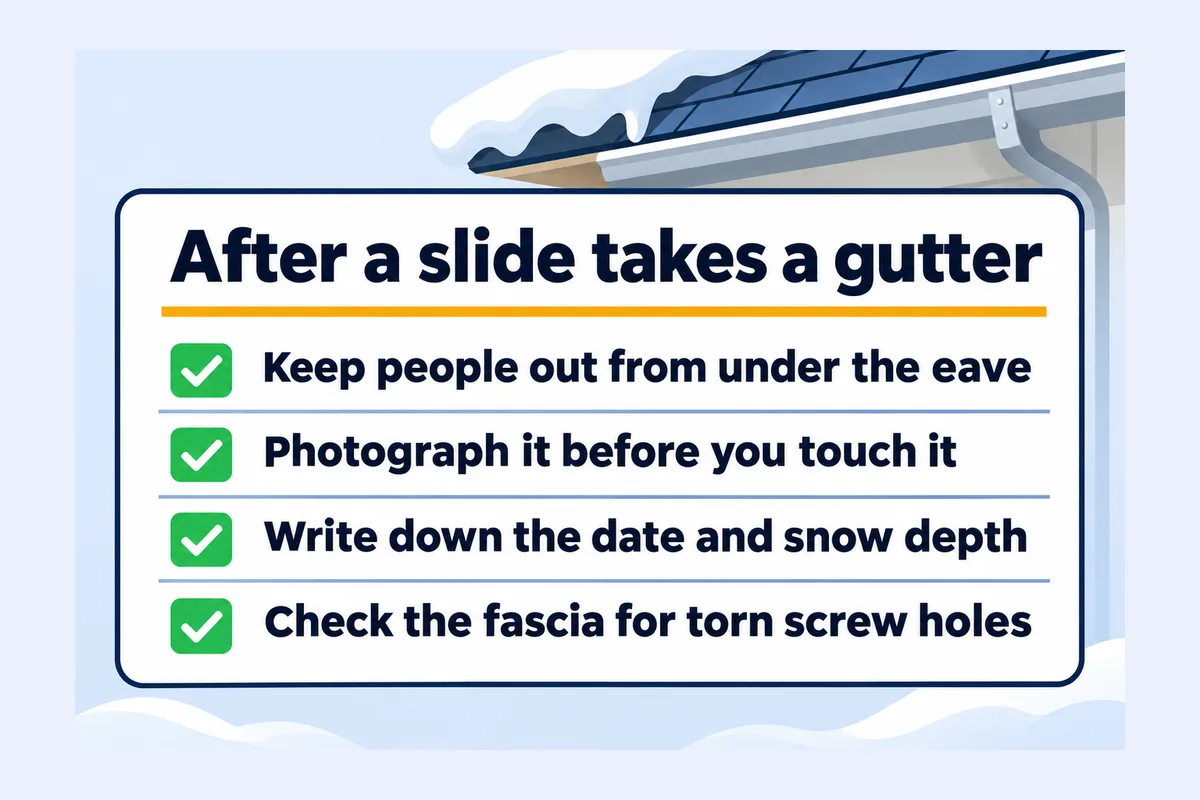
- Keep people and cars out from under that eave. A gutter hanging by one end can drop the rest of the way, and the roof above may still have snow on it.
- Take photos from the ground before anyone moves it: the torn run, the hangers, the holes in the fascia and the snow pile below.
- Write down the date, roughly when it happened and how much snow was on the roof. A slide that tore a sound gutter off and a gutter that was already falling down are different stories, and the photos tell which one you have.
- Leave the ice alone. Chipping it out of a bent gutter makes the damage bigger.
If you think the damage belongs on an insurance claim, the photos come first and the repair second. The coverage question is one for our partner, the licensed Illinois public adjuster State Adjusting Services; our part is to document the damage and write the repair estimate. One thing we hear every winter: a fellow with a ladder on his truck offers to put it all back up today for cash. Ask him about the straightedge. If he looks at you funny, you have your answer.
Frequently asked questions
Do asphalt shingle roofs need snow guards?
Most do not. Shingles grip snow, so it usually melts in place or comes down in small amounts. The exceptions are steep slopes over a door, a walk or a lower roof, and spots below skylights or solar panels, where the smooth glass lets snow go sooner. Guards there are laid out from the guard maker's chart for your pitch.
Can I knock the snow off before it slides?
From the ground with a roof rake, on a one-story eave, yes, and pull it down in small bites rather than one big sheet. Stay off the roof and off a ladder on ice. Never chip ice out of the gutter with a hammer or a shovel, because that bends the gutter worse than the slide would.
Will lowering my gutters stop ice dams?
No. Lowering the gutter lets sliding snow pass over it. Ice dams start higher up, where warm attic air melts snow that refreezes at the cold eave. That is an attic air and insulation problem, and the gutter only shows the result.
Does insurance pay for gutters torn off by snow?
It depends on the wording of your policy and on whether the gutter was sound before the slide. Photograph everything before it is moved. Our partner, the licensed Illinois public adjuster State Adjusting Services, can read the policy with you; we document the damage and write the repair estimate.
Related reading: frozen gutters and downspouts in an Illinois winter and why ice dams form and what actually fixes them.
Lost a gutter to a slide, or want the straightedge test done for you? Call (866) 992-2982, seven days a week (weekdays 7:00 AM to 7:00 PM, weekends 9:00 AM to 5:00 PM), or book a free inspection online. We work across the north and northwest Chicago suburbs.