
 Volodymyr Lukaniuk

To unclog a downspout, start at the bottom, not on the ladder. Take off the extension at the foot, run a garden hose into the pipe from below and from above the ground, and watch where the water stops or leaks out. That tells you which part of the downspout holds the clog. Then clear that one part with a hose, a hand auger or by taking a single elbow apart, and test again from the top. Most downspout clogs on houses in the north suburbs are wet leaves packed into an elbow, and most of them come out without anyone standing on the top rung.
This is the week it happens. The leaves are coming down across Lake and Cook County, the first hard rain carries them off the roof, and a downspout that ran fine in September starts spilling over the gutter. We flush and clear downspouts on every gutter cleaning visit. At your own house, the same job goes in an order that keeps you off the ladder as long as possible.
Where a downspout clogs: the four spots to check
A downspout looks like one straight pipe. It is really a short chain of pieces, and leaves stop at the places where the water has to turn or narrow.
- The outlet at the gutterThe hole in the bottom of the trough where the pipe starts. Leaves pile on top of it and mat into a lid, especially when a strainer basket sits there.
- The two elbows under the eaveMost downspouts jog in toward the wall right below the gutter: elbow, short piece, elbow. Two bends this close together are the classic place for a packed clog: the leaves hit the first turn and stop.
- The bottom elbow and the extensionThe last bend that turns the water out across the lawn. Silt, shingle granules and seeds settle here when the flow is slow.
- The buried pipeIf your downspout runs into the ground, the adapter at grade and the first few feet of the buried line catch whatever makes it through the elbows above.
The opening is small to begin with. A standard 2x3 downspout, the size that goes with 5-inch gutters, has 6 square inches of opening. The 3x4 size used with 6-inch gutters has 12. A handful of wet maple leaves closes a 2x3 completely.
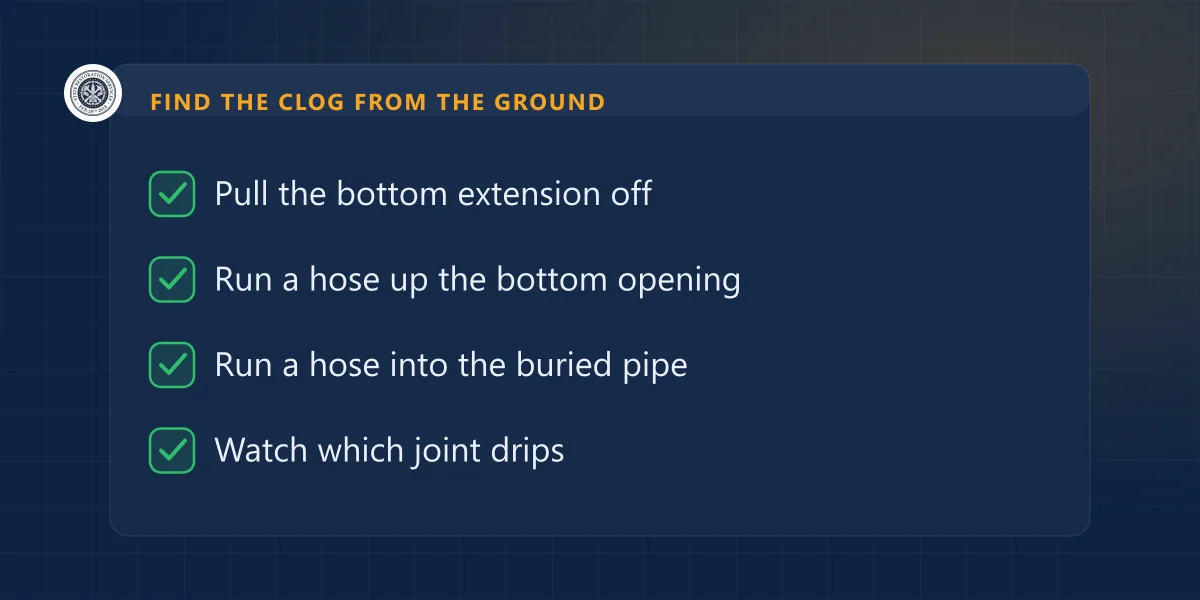
How to find the clog without climbing
You can test three of the four spots from the lawn. Use a hose with a jet nozzle, and do it on a dry day so the pipe is empty when you start.
| Test from the ground | What you see | Where the clog is |
|---|---|---|
| Pull off the extension and look into the bottom elbow | Leaves, mud or a wasp nest right at the opening | Spot 3. Clear it by hand and you may be done. |
| Push the hose up into the bottom opening and turn it on | Water comes straight back at you | Low in the pipe, within a few feet of the hose |
| Same test, longer run | Water drips or sprays from a joint higher up | Just below that joint. Water backs up and leaks out at the first seam above the clog. |
| Hose into the buried adapter at grade | The adapter fills and overflows, or water bubbles up in the lawn | Spot 4, in the buried line |
| All three run clear, but the gutter still overflows in rain | Water pools in the trough over the outlet | Spot 1 or the upper elbows. That one needs the ladder. |
The dripping joint is the most useful clue on the list. Each piece of a downspout slides into the one below it, so a seam only leaks when water is standing above a blockage. Whatever joint weeps first, the clog sits right under it.
How to clear each spot
The bottom elbow and extension
Pull the debris out with a gloved hand or a garden trowel, then flush down from the open end with the hose. If the extension is a corrugated plastic one, take it off and shake it out; the ridges hold mud. Put it back pointing away from the house.
A clog in the straight pipe
Run the hose up from the bottom first. Pushing from below drives the plug back the way it came in, toward open space, instead of packing it tighter into the next bend. If water alone will not move it, feed a hand auger (a small drain snake) up from the bottom and turn it as you go. Tapping the side of the pipe with your palm while the water runs can break a plug loose.
The elbows under the eave
These are the stubborn ones, because two bends sit close together. An auger usually gets through from below. If it does not, the quickest fix is to take that section apart: remove the two or three small screws that hold the elbow, slide it off, clean it on the ground and put it back with new screws in the same holes. That is a ladder job at the height of your eave.
The outlet at the gutter
Scoop the leaves off the outlet, then run the hose down into the opening from the gutter. Water that drains away fast and comes out clear at the bottom means the whole pipe is open. Water that stands in the trough means the clog is in the top elbow, which you can reach with the auger from above.
Skip the pressure washer and the hammer. Most seamless gutter and downspout in this area is rolled from aluminum about 0.027 inches thick. A pressure washer at close range, or a mallet on a packed elbow, dents the pipe and opens the joints, and a dent is a ledge where the next clog starts.
The buried pipe
Disconnect the downspout from the adapter at grade and look in with a flashlight. Leaves you can reach, pull out. Then push the hose into the line and let it run: if the water comes out at the far end, carrying debris and then clear, the line is open. If it backs up after a few feet, run the auger in from the house end. When the auger hits something hard and will not turn through it, stop. That can be a root, a crushed section or a joint that pulled apart, and pushing harder makes a small problem bigger. A drain company with a sewer camera can see it before anyone digs. Buried lines in the Chicago area sit well above the frost line, which is one reason they collect ice in winter, as we explain in our article on frozen gutters and downspouts.
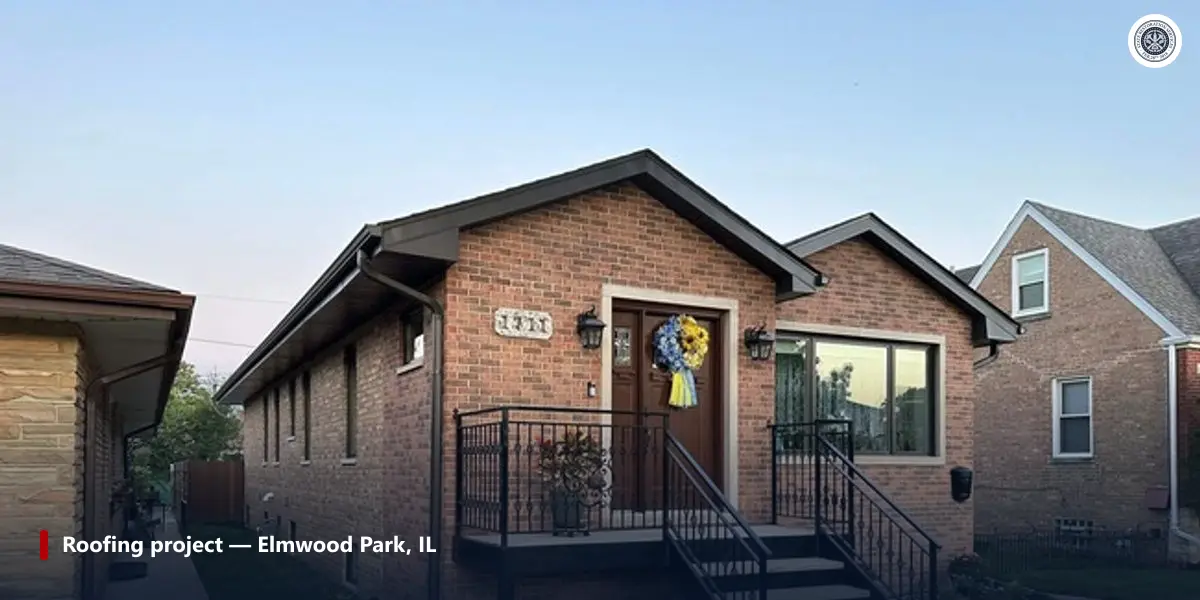
When you do need the ladder, set it up the way the rule says
Almost all of the risk in this job comes from the ladder. The federal ladder rule for workers is a good guide for a homeowner too. For a ladder that leans against the house, it reads:
"Non-self-supporting ladders shall be used at an angle such that the horizontal distance from the top support to the foot of the ladder is approximately one-quarter of the working length of the ladder."29 CFR 1926.1053(b)(5)(i), from the eCFR text of the OSHA ladder standard
In plain numbers, that is about one foot out from the wall for every four feet up. For the two heights we see most often on houses around here:
Do not lean the ladder on the gutter itself; aluminum gutter bends under that load. Rest it on the wall beside the downspout, keep your belt buckle between the rails, and have someone hold the base. The same rule says the rails must stand at least 3 feet above an upper landing, which matters only if you plan to step off onto the roof. For downspout work you should not need to.
Why the same downspout keeps clogging
If one downspout clogs every fall while the others run clear, the cause is usually upstream of the pipe, not inside it.
- It drains too much roof. Every inch of rain on 500 square feet of roof is about 312 gallons, and when an upper roof empties onto a lower one, a single 2x3 can end up carrying both. Upsizing that run to 3x4 doubles the opening; our comparison of 5-inch and 6-inch gutters shows when the bigger size earns its place.
- A tree hangs right over that corner. The outlet under it gets the most leaves on the house.
- There is a strainer basket on the outlet. It keeps leaves out of the pipe, but leaves mat on top of it and block the water even faster. A basket needs checking after every big leaf drop.
- The pipe has a dent or a bad joint, often from a ladder that leaned on it years ago. Debris catches on the ledge.
Guards on the gutter cut down on how much reaches the outlet. Whether they make sense depends on your trees, and we go through that honestly in our article on gutter guards in the north suburbs. When the pipe itself is dented or undersized, the fix is a new run, which we form and hang as part of seamless gutter installation.
Frequently asked questions
Can I unclog a downspout without a ladder?
Often, yes. A clog in the bottom elbow, in the straight pipe or in the buried line can be found and cleared from the ground with a hose and a hand auger fed up from the bottom. A clog sitting on the outlet in the gutter, or packed into the elbows right under the eave, needs someone at gutter height.
Why is water leaking from the seam in my downspout?
Because something below that seam is blocking the pipe. The pieces slide into each other, so a joint stays dry while water runs through it and only leaks when water stands above a clog. Clear the pipe just below the leaking joint and the leak usually stops. If it keeps dripping in normal rain after the pipe is clear, the joint has been bent open.
Can a clogged downspout freeze?
Yes, and in November it is the usual way a downspout freezes solid: wet leaves hold water in the pipe, and the first cold night turns it into a plug. Clear the leaves before the hard freezes. If it is already frozen, do not chip at it; wait for a thaw and flush it.
How often should downspouts be cleared?
Check them every time the gutters are cleaned, which for most yards with trees here is after the fall leaf drop and again in spring. Running a hose down each outlet takes a minute per downspout and tells you right away whether the pipe is open.
Related reading: where downspouts should drain and why gutters overflow in heavy rain.
Downspout still backing up, or a two-story one you would rather not climb? Book a visit or call (866) 992-2982. We clean, repair and install gutters and downspouts across the north and northwest Chicago suburbs.