
 Volodymyr Lukaniuk
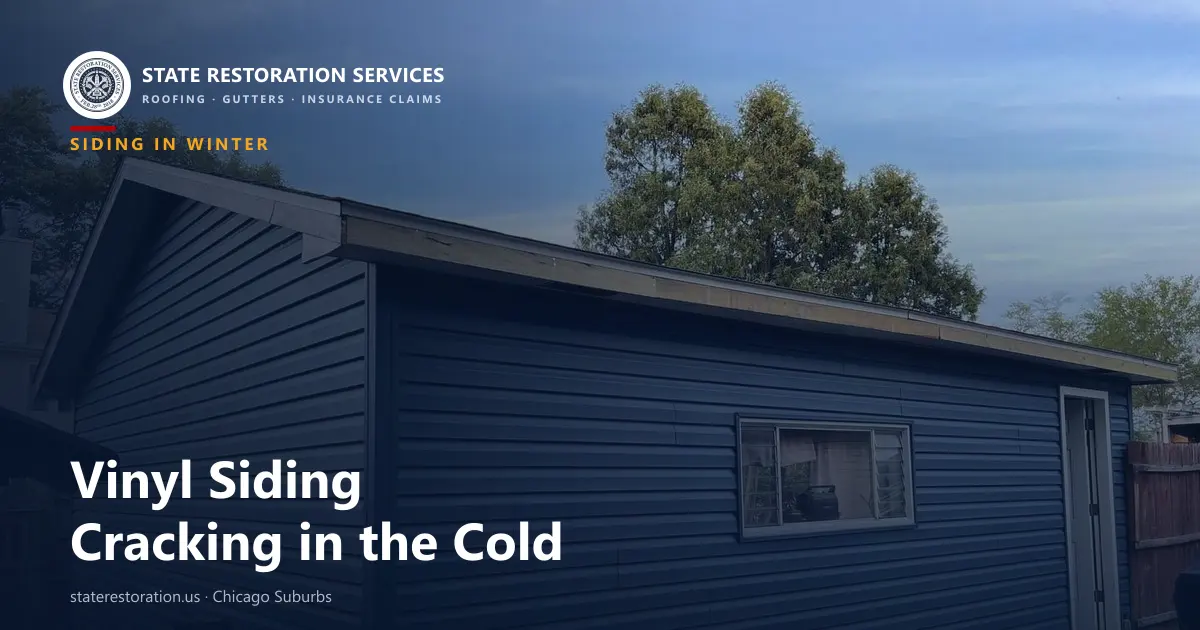
Vinyl siding cracking in cold weather comes down to one fact: below freezing the plastic turns stiff and brittle, so a knock it would shrug off in July splits it in January. That explains some cracks. Where the crack sits and which way it runs usually tells you more: whether it was an accident, or a wall that was nailed too tight years ago. That decides whether you swap one panel or start asking harder questions about a whole side of the house.
We repair and replace vinyl across the north and northwest Chicago suburbs, and late fall is when these calls start. The snow blower throws a chunk of ice at the garage wall, the ladder for the holiday lights leans on a course, or a panel by the back door gives up on a ten-degree morning. Most of those cracks can be sorted from the ground, without anybody climbing a ladder.
Why cold makes vinyl crack, and why it moves at all
Vinyl siding is PVC. Warm, it bends; cold, it snaps. It also grows and shrinks along its length as the temperature changes, so every panel is hung loose on purpose and slides back and forth all year. The installation manual written by the siding makers' trade group, the Polymeric Exterior Products Association, puts numbers on that looseness:
- 1/4 inch
- Gap left between a panel end and every corner post and channel.
- 3/8 inch
- The same gap when the siding goes up below 40°F, because a cold panel is at its shortest and will grow.
- About 1/32 inch
- Space left under the nail head, which the manual calls "about the thickness of a dime", so the panel can slide.
- 1/4 inch bigger
- The hole cut around a faucet, a light or a railing that passes through the siding.
- About 1 inch
- Overlap where two panels meet end to end.
Each of those numbers exists so the panel can move. A panel that can't move gets strained every time the temperature swings, and the cold is when the plastic has the least give. That's why a crack you find in December is often a mistake from the day the siding went up, showing itself late.
Read the crack: where it sits says what caused it
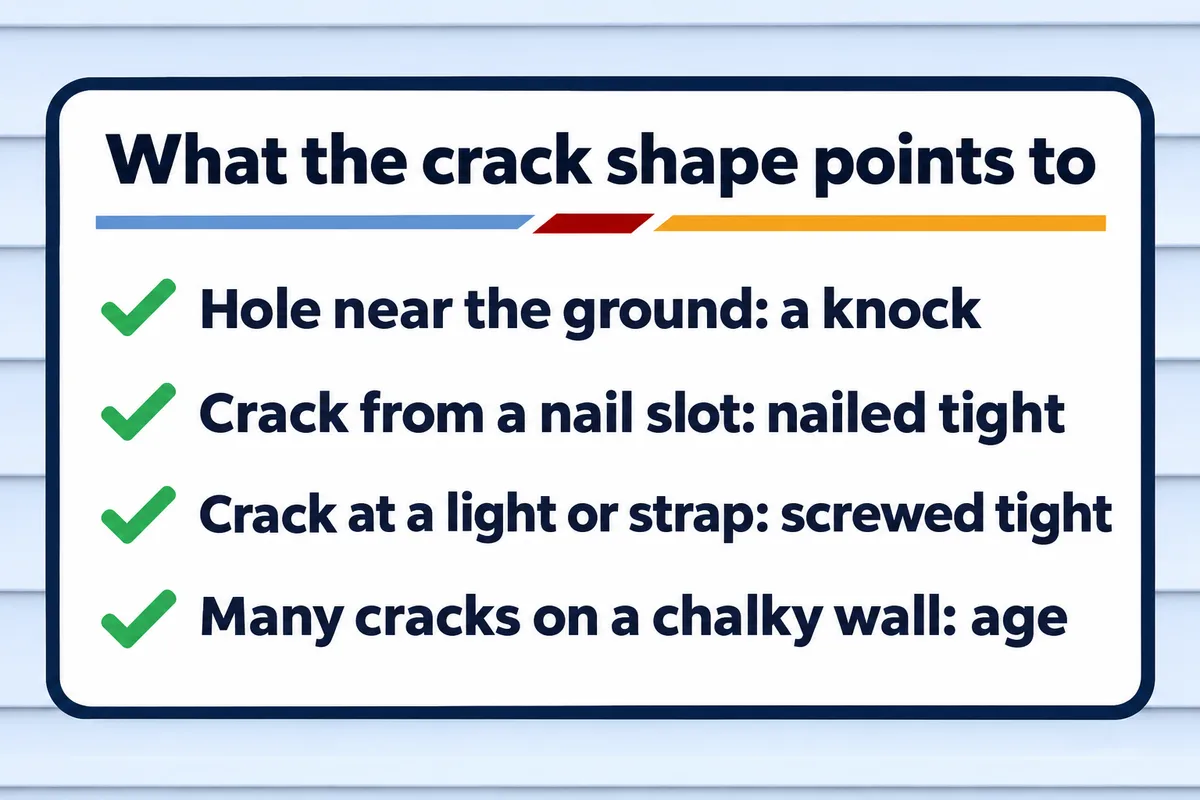
Walk around the house in daylight and note where each crack is. These five spots are where cracked vinyl usually turns up, and each points to a different cause.
| Where on the wall | What it looks like | Usual cause | Can it wait? |
|---|---|---|---|
| Bottom courses by the driveway, walk or patio | A hole or a short split, often with a pale stress mark around it | A knock: ice thrown by a snow blower, a shovel, a ball, a ladder foot | Usually, if it's small and nothing behind it shows |
| Along the top edge, next to a nail slot | A crack that starts at the nail line and runs down or sideways | The panel was nailed tight and couldn't shrink when it got cold | Check the rest of the wall first with the slide test below |
| Around a light, hose bib, downspout strap or satellite bracket | Cracks fanning out from the screw or from the cut-out | The item was screwed tight through the vinyl, or the opening was cut snug | Yes, but the fastening gets fixed with the new panel, or it cracks too |
| At a panel end, by a corner post or channel | A split at the end, or the end lifted out of the channel | The panel was cut too long, jammed in summer heat and kinked | Not if the end has popped out of the channel |
| All over a sunny wall that is faded and chalky | Many small cracks, and panels that snap when you press them | Years of sun have made the vinyl brittle all the way through | Till spring, but plan to re-side that wall, not patch it |
A chalky wall is easy to check: rub the panel with your palm. If your hand comes away white, the surface has broken down. One cracked panel next to clean, glossy neighbors is a different story from a wall where every course leaves powder.
The slide test you can do from the ground
This tells you whether a crack by a nail line is a one-off or the way the whole wall was hung. Do it on a day above freezing if you can, when the vinyl is less likely to crack under your hands.
- Pick a panel at chest height on the same wall as the crack, away from the corners and windows.
- Put both palms flat on it a foot or two apart and push sideways along the wall. Firm, steady pressure, no yanking.
- A panel hung the way the manual asks will shift a little and come back, sometimes with a small tick from the channel.
- If it doesn't move at all, try the courses above and below. Several panels that won't budge mean the wall was nailed tight.
- Repeat on another side of the house, so you know whether you're dealing with one wall or all four.
A tight wall tends to tell on itself in other ways too. On a cold night you may hear sharp pops as the panels shrink in jerks against the nails, and in August the same wall ripples. New panels nailed the same way go on to crack the same way, so on a tight wall the repair has to include re-hanging, not only replacing the broken piece.
What can wait for spring and what can't
Get it looked at now
- A panel that has unlocked from the one below and flaps in the wind. Wind gets under it and can take the course above with it.
- A hole you can see the house wrap or the wood through, on a wall that takes wind-driven rain or sits under a roof edge where snowmelt drips.
- Cracks on the side that faced a storm, if you plan to claim them. The work can wait; the photos and the storm date can't.
Can wait for a warmer day
- A small crack low on a sheltered wall, with nothing showing behind it.
- A cracked panel by a light or a strap that is still locked in place.
- Gaps or ripples at the channel ends that come and go with the season.
Keeping snow out until the panel is replaced
If a hole has to be covered for a few weeks, cover it, don't fasten it. A strip of exterior tape over a clean, dry crack keeps snow and meltwater out and peels off when the panel comes out. Two well-meant fixes make things worse. A screw or nail through the face of the panel pins it, and it cracks again right beside the fastener. A thick bead of caulk run along the lock can glue the panel to the one below so it can't slide, and it can block the gaps vinyl relies on to let water drain out from behind.
The real repair is a panel swap: the course above is unhooked with a zip tool, the cracked piece comes out, and a new one locks in. Our siding repair page shows how that's done and what happens when the old color is no longer made. Cold makes the job slower, not impossible. The new vinyl is handled gently, the cut ends get the wider 3/8 inch gap the manual asks for below 40°F, and the nails stay loose in the slots. A panel fitted snug on a January afternoon has nowhere to go in July, and that is how winter repairs turn into summer ripples.
When a storm cracked it, or the whole side is worn out
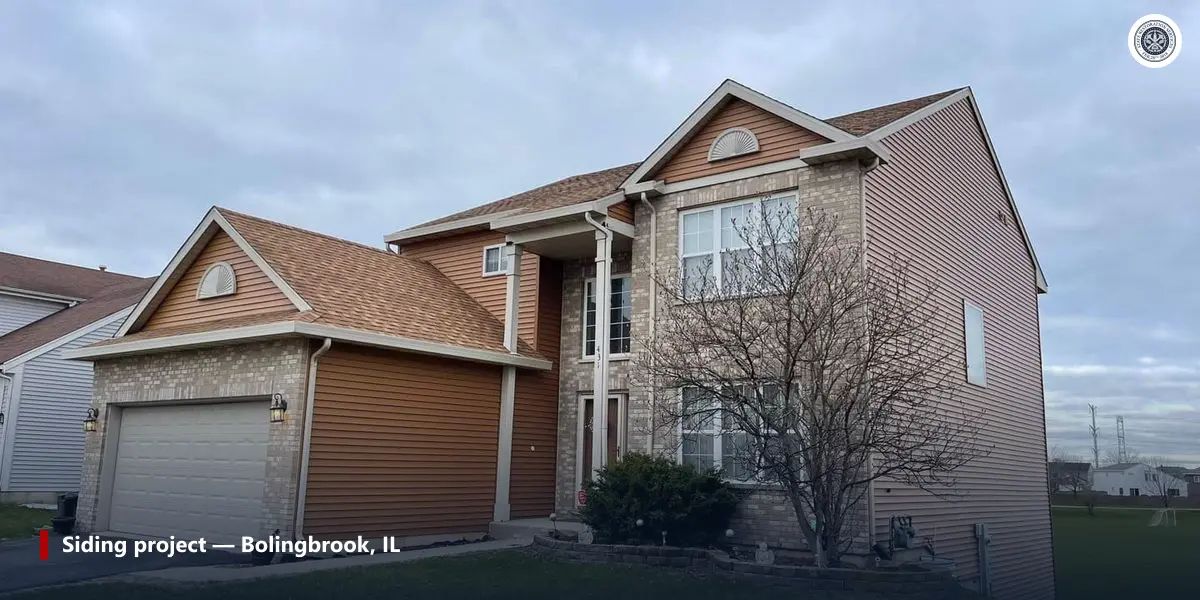
Hail and wind marks on siding often go unnoticed until someone is out on a ladder hanging lights. Hail cracks and punctures cluster on the side of the house that faced the storm, while the sheltered walls stay clean. That pattern, together with a storm date, is what separates storm damage from wear in an insurance file. Our guide to siding storm damage and insurance shows how we document it, and our article on the date of loss explains why the storm date carries so much weight.
Our part is the evidence: photos, measurements and a written estimate. Your insurer decides what it pays, and Illinois law doesn't let a contractor negotiate a claim, so our partner, the licensed Illinois public adjuster State Adjusting Services, is the one who can represent you. Our insurance claim page explains where they come in.
If the slide test says the whole house is nailed tight, or a south or west wall is chalky and cracking everywhere, swapping panels one at a time only buys a winter or two. That's when vinyl siding replacement on that wall makes sense. Before you pick the material again, our comparison of vinyl and fiber cement lays out the costs side by side.
Questions about cracked vinyl siding in winter
Can vinyl siding be repaired in winter?
Yes. A cracked panel can be swapped in cold weather as long as the new vinyl is handled carefully and fitted with the wider 3/8 inch gap at channels that the makers' manual asks for below 40°F. Very cold days make vinyl brittle, so the work goes slower and is best done in the warmest part of the day.
Why does my vinyl siding pop and crack at night when it's cold?
The panels are shrinking and sliding in their nail slots. Soft ticks are normal. Loud pops on several walls usually mean panels nailed tight that can only move in jerks, and the slide test above tells you which you have.
Does homeowners insurance cover cracked vinyl siding?
A crack from a sudden event such as hail, wind or a falling branch is often part of a covered claim, while cracks from age or a poor installation usually are not. Your insurer decides. We document storm damage, and our partner public adjuster can represent you on the claim.
Found a crack in your siding? Book a free inspection or call (866) 992-2982. We serve the north and northwest Chicago suburbs.