
Siding repair when only part of the wall is damaged
State Restoration Services repairs vinyl, fiber cement, engineered wood and aluminum siding across the north and northwest Chicago suburbs. A cracked panel, a course pulled loose by wind or a dented corner post usually comes out on its own, and the rest of the wall stays where it is. On the first visit we tell you whether a repair will hold and whether it will match. When it won't, you hear that before you pay for it.
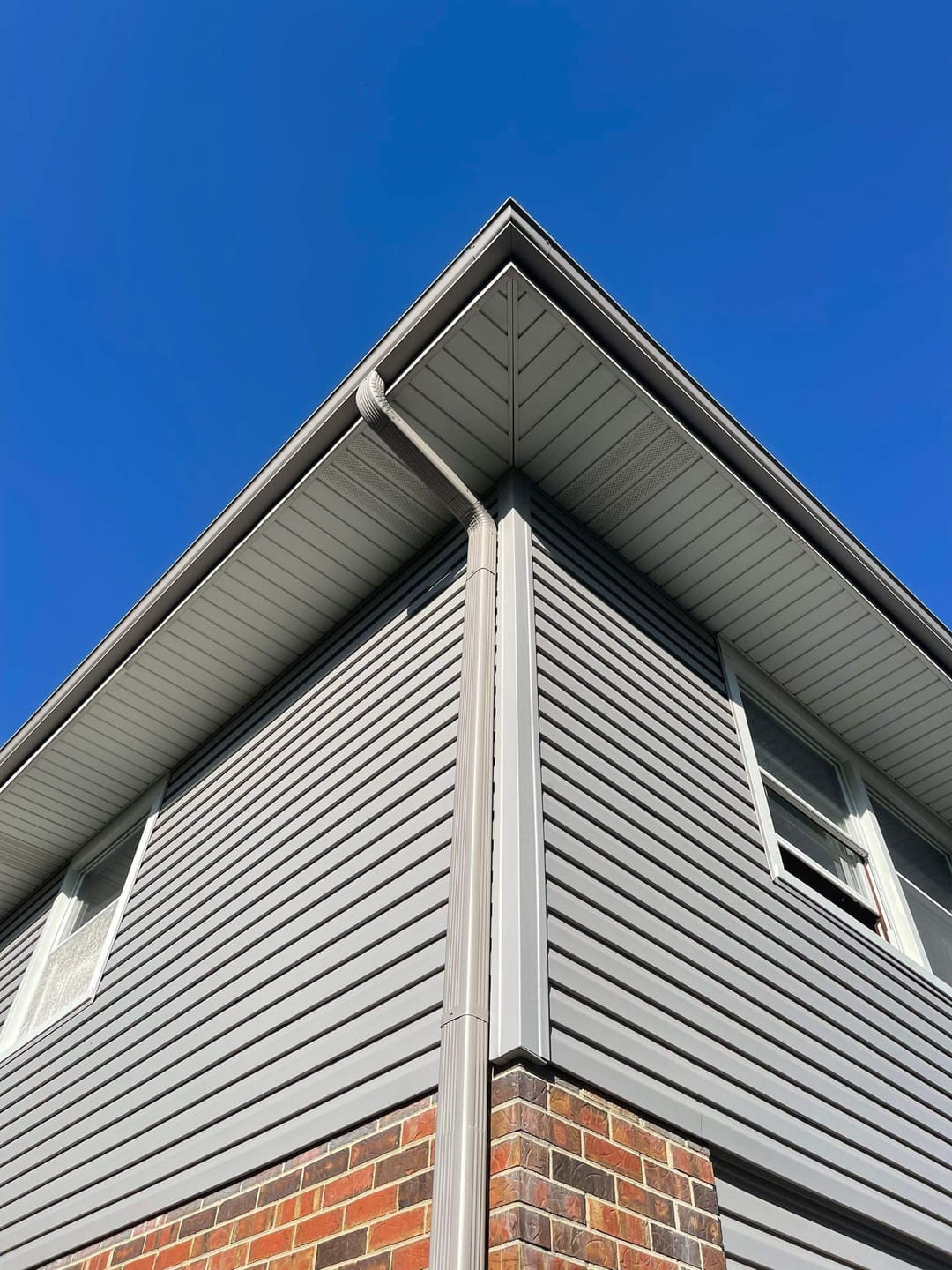
One damaged vinyl panel comes out without opening the wall
Each vinyl course hooks onto the one below it at its bottom edge, so the course above the damage is released first. These are the steps in the installation manual published by the Polymeric Exterior Products Association, the trade group of the vinyl siding makers.
- A zip tool slides behind the bottom of the panel above the damaged one and unhooks it.
- That upper panel is bent out gently, and the nails come out of the damaged panel.
- The new panel locks onto the course below and is nailed up. Like all vinyl, it hangs on slotted holes with room to slide, because a panel nailed tight buckles the first time a 10°F morning turns into a 40°F afternoon.
- The zip tool hooks the upper panel back over the lock of the new one.
A dented corner post has its own fix in the same manual: the damaged face is cut away, a new corner goes over what is left and gets one rivet at the top on each side. Anything screwed through vinyl, such as a downspout strap, needs a hole drilled 1/4 inch wider than the screw, so the panel can still move.
What a repair involves on each kind of siding
The material on your wall decides how a damaged piece comes out and how visible the new one will be. These are the four we work on, as listed on our siding page.
Panels are swapped, not patched
The repair blends in only if the same profile and color can still be bought. Vinyl gets brittle in cold weather, so a ladder bump or a branch in January can crack a panel that would have flexed in July. That alone doesn't mean the rest of the wall is failing.
A cracked board is cut out and refitted
Fiber cement is nailed on rigid, so the new board has to meet the old joints. Every cut edge is primed and every joint caulked, or water wicks in and the seams swell over a few winters. We cut it with a fiber cement blade to keep the silica dust down, and the new board is painted to the wall.
The split length comes out, then the sheathing is checked
On engineered wood such as LP SmartSide the damaged length is cut out, the new piece goes up on the same nailing line and the face is painted. Before it is closed up we push on the wall around it, because a soft spot means water has already reached the sheathing.
The hard part is finding a match
Aluminum dents instead of cracking, and you can feel a hail dent with your hand. Old aluminum profiles and factory colors are rarely still made, so on an older house the question is where a matching piece comes from. Repainting the wall is one answer, and the Island Lake house in our gallery is painted aluminum siding.
When the old color is no longer made
Siding colors get discontinued, and a wall that has been in the sun for years has faded anyway. An Illinois siding case decided by a federal appeals court shows how far that argument can go.
Windridge of Naperville v. Philadelphia Indemnity
U.S. Court of Appeals for the Seventh Circuit, No. 18-2103- May 20, 2014
- A hail and wind storm damages the aluminum siding on the south and west sides of the association's condominium buildings.
- After the claim
- The insurer pays $2.1 million for that damage and refuses to pay for the north and east sides, which the storm did not hit.
- The problem
- Siding that matches the untouched north and east sides is no longer sold.
- August 7, 2019
- The court affirms that the insurer must pay to replace the siding on all four sides.
What it does and doesn't mean for a house
The court found the policy unclear about whether the damaged property was each panel, each side or the whole building, and under Illinois law an unclear policy is read in favor of coverage. Buildings left in two colors, it said, had not been put back as they were before the storm.
It also set a limit: one damaged slate shingle with no match does not buy a new roof. The case was a commercial policy on condominium buildings, and your own policy's wording still decides your claim. You can read the full opinion on govinfo.gov.
Our part is the paperwork that shows whether a match exists. We identify the product and color from a leftover box, the original contract or a panel taken to the supply house, ask the supplier in writing whether it is still sold, and photograph a new piece against your wall in the same light. That packet goes to you. Arguing the claim belongs to a licensed public adjuster, and our partner, the licensed Illinois public adjuster State Adjusting Services, does that work. The same matching question on a roof is covered in our guide to shingle color matching.
Repair a few panels or re-side the wall
Most houses we see are not all one or the other. A thirty-year-old wall often has a storm-damaged section next to plain wear, so the written estimate can split the house.
| What we find | What we recommend |
|---|---|
| A few cracked or dented panels on one wall, and the product is still sold | Replace those panels |
| Hail marks across one storm-facing wall while the other walls are clean | Price that wall, and photograph the clean walls too |
| Panels loose or wavy on several walls because they were nailed tight | Re-hang or re-side, since new panels on the same nailing buckle again |
| Soft spots, rot or peeling paint inside behind the wall | Open the wall first, because the sheathing sets the scope |
| The color is discontinued and the damage is on the front of the house | Price the repair and the full wall side by side |
A repair is priced once we have counted the panels and seen how hard they are to reach. For comparison, re-siding in our area runs about $4 to $9 a square foot installed in vinyl and $8 to $14 in fiber cement, which puts a two-story house with 2,000 to 2,400 square feet of wall at roughly $10,000 to $18,000 in vinyl. A typical single-family house is re-sided in three to five working days. If the choice of material is open, our comparison of vinyl and fiber cement has the full numbers.
Should a few panels go through insurance?
For a handful of panels, paying for the repair yourself is often the better deal, especially when your deductible is close to what the repair costs. A small claim can still count against you when the policy renews.
When the storm hit a whole wall, or the roof as well, we document siding and roof together with photos and a code-compliant estimate. Your insurer decides what it pays. Illinois doesn't let a contractor negotiate the claim, which is why our insurance claim page explains where our partner adjuster comes in. Our guide on siding storm damage shows how hail marks differ from age.
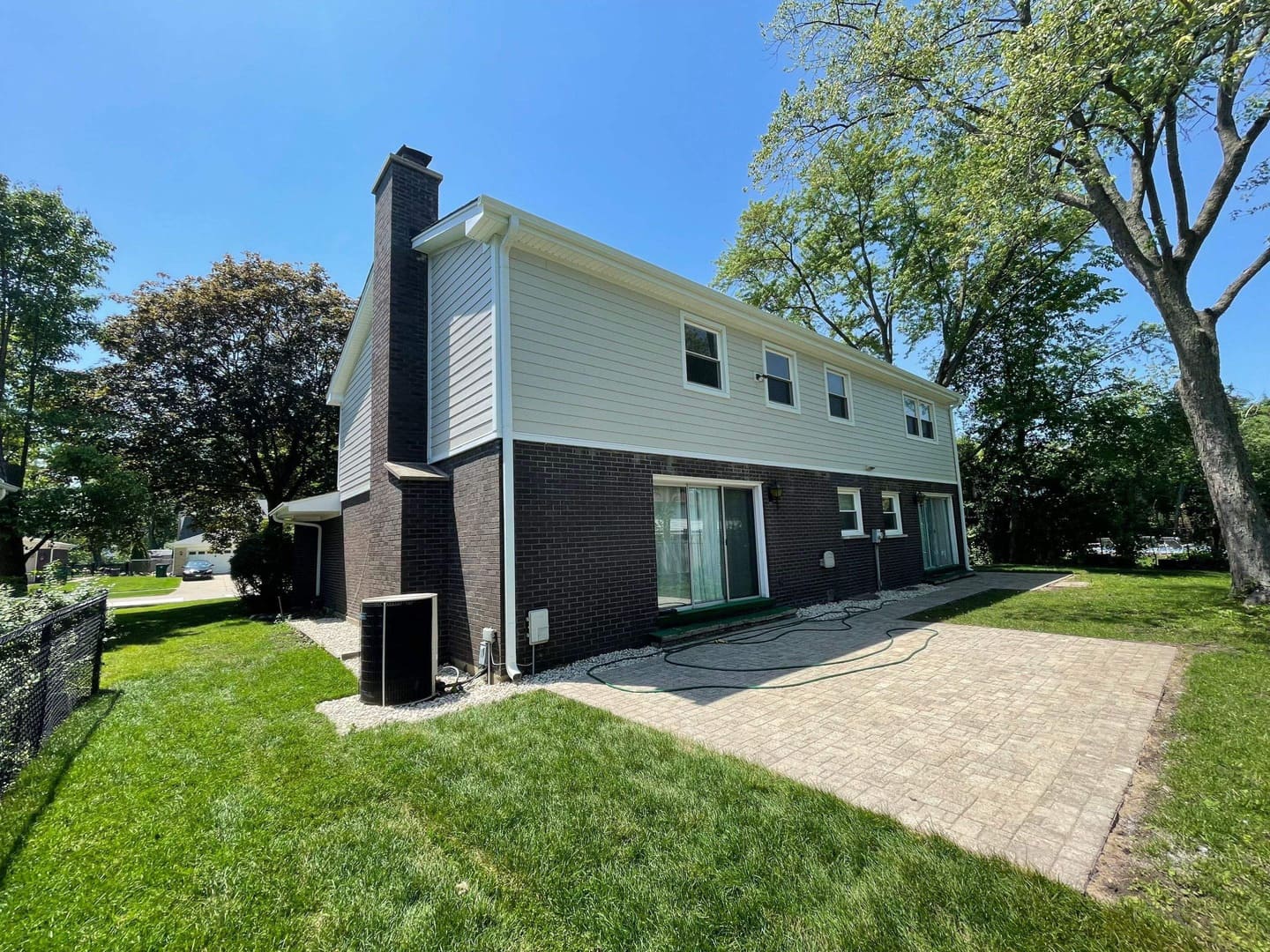
Fiber cement siding in a cobblestone color on a house in Northbrook, listed in our gallery under siding repairs.
What people ask before a siding repair
Can you replace just one vinyl siding panel?
Yes, as long as a panel in the same profile and color can still be bought. The course above is unhooked with a zip tool, the damaged panel is unnailed and a new one is locked in, so the wall around it stays on.
Will a new siding panel match the old ones?
Often not exactly. Colors get discontinued and the old wall has faded, so a new panel can read lighter or darker. We photograph a sample against your wall in the same light before you decide, and tell you if the difference will show from the street.
Is it worth repairing siding on an older house?
It is when the damage is in one place and the rest of the wall is sound and tight. If the panels are chalky all over, loose on several walls or there is rot behind them, repairs only delay re-siding, and the written estimate will say so.
Does insurance pay for siding repair after hail?
When the damage is functional and tied to a storm date, siding is often part of a covered claim, sometimes on the same claim as the roof. Your insurer decides what it pays. We document the damage and write the estimate, and our partner public adjuster can represent you.
Want this looked at?
We inspect for free, document what we find and prepare a code-compliant estimate you can hand to your insurer. Our partner, a licensed public adjuster, State Adjusting Services, can represent you on the claim.
Call (866) 992-2982. Free Inspection