
 Volodymyr Lukaniuk
Quick answer: Vinyl siding costs less to install ($4-$9/sq ft) and never needs painting, but it can crack in hard hail and softens in extreme cold. Fiber cement costs more ($8-$14/sq ft), handles hail and wind better, and lasts longer — but it needs repainting every 10-15 years. For most Chicago-suburb homes, vinyl is the better value; fiber cement earns its price on homes that take a lot of storm exposure or where the owner wants a 30+ year material.
We get asked vinyl siding vs fiber cement almost every week, usually from a homeowner standing in front of a damaged wall wondering whether to replace like-for-like or switch materials while the siding's already off. Both are good products. Neither is the "right" answer for every house. Here's how we actually walk people through the decision, with real Chicago-suburb numbers instead of national averages that don't mean much once you're getting bids.
What's the real difference between vinyl and fiber cement siding?
Vinyl is a hollow PVC panel that snaps onto the wall over house wrap; fiber cement (Hardie board is the brand most people know) is a solid composite of cement, sand, and cellulose fiber that's nailed on like a rigid board and needs field or factory paint. Vinyl is lighter, cheaper, and installs faster. Fiber cement is heavier, denser, more fire-resistant, and holds paint and detail (wood-grain texture, real shadow lines) better than vinyl ever will.
| Trait | Vinyl | Fiber cement |
|---|---|---|
| Material | Hollow PVC panel | Solid cement/fiber board |
| Weight | Light, snaps on | Heavy, nailed on |
| Finish | Color molded in | Factory or field paint |
| Fire rating | Melts/softens in heat | Non-combustible core |
How does each one hold up to Illinois weather?
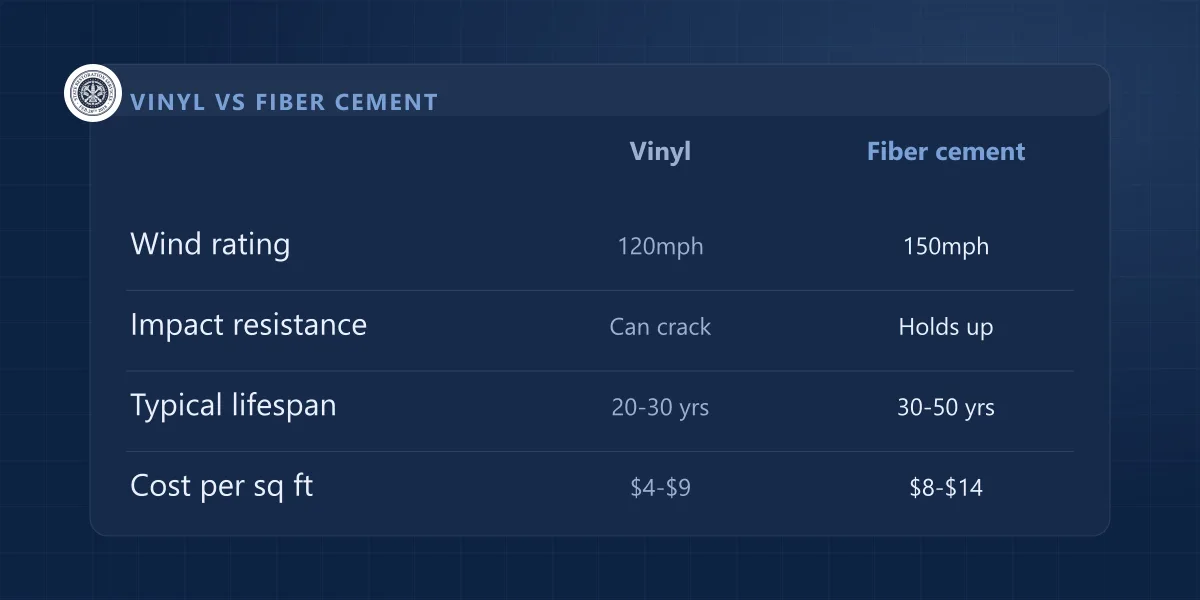
Fiber cement wins on storm resistance — it's rated for higher wind speeds and shrugs off hail that dents or cracks vinyl. Vinyl's weak spot shows up on the coldest days of the year, when it turns brittle and a stray branch or a ladder bump can crack a panel that would've flexed in July. Neither material is bulletproof; we've replaced storm-damaged sections of both.
Freeze-thaw is the other Illinois-specific stress test, and it's less about the siding surface than what's behind it. Vinyl siding is installed to float — it expands and contracts with temperature, which is why panels have slotted nail holes, not fixed ones. Crews who nail it too tight (to make it look "tighter" on install day) cause buckling the first time it swings from a 10°F morning to a 40°F afternoon, which happens constantly here from November through March. Fiber cement doesn't move the same way, but it does need every cut edge back-primed and every joint properly caulked, or it'll wick water and swell at the seams over a few winters.
Both materials carry real wind ratings that matter after a derecho or straight-line wind event, which is why we quote the range instead of a single number — it changes by panel profile, fastening pattern, and manufacturer. Ask your contractor for the actual ASTM D3679 (vinyl) or ASTM C1186 (fiber cement) rating on the specific product they're quoting, not a marketing brochure number.
What does each one cost installed in the Chicago suburbs?
Vinyl runs roughly $4-$9 installed per square foot depending on panel thickness and profile (thin builder-grade vinyl vs. a heavier insulated or Dutch-lap style). Fiber cement runs $8-$14 installed, mostly because of labor — it's heavier, has to be cut with a fiber-cement blade (or scored and snapped) to control silica dust, and takes longer per square to hang and finish. On an average two-story Chicago-suburb home (roughly 2,000-2,400 sq ft of wall area), that's the difference between a $10,000-$18,000 vinyl job and an $18,000-$30,000 fiber cement job, before you add trim, soffit, or storm damage repair scope.
| Cost factor | Vinyl | Fiber cement |
|---|---|---|
| Material only | $1.50-$4/sq ft | $3-$6/sq ft |
| Labor | $2-$5/sq ft | $5-$8/sq ft |
| Repainting (every 10-15 yrs) | Not needed | $3,000-$6,000/house |
The line item people forget is repainting. Fiber cement's up-front number looks worse, but a lot of that gap closes — or reverses — once you count 25-30 years of vinyl staying maintenance-free against 2-3 repaint cycles on fiber cement, unless you spring for a 25-year factory finish (ColorPlus and similar), which narrows that gap but doesn't erase it.
Which one do we actually recommend?
For most homes we quote, vinyl is the better value: lower upfront cost, zero repainting, and modern insulated panels close a lot of the old "vinyl looks cheap" gap. We steer people toward fiber cement when the house sits in an open, storm-exposed spot, when the homeowner specifically wants the crisper architectural look fiber cement holds better, or when they've already decided they're staying 20+ years and want the longest-life exterior they can get. Neither choice is wrong — it's a budget-vs-longevity call, and we'd rather walk you through the real numbers than push whichever one we happen to have more of in the truck that week.
One thing we won't do is tell you your 15-year-old vinyl siding needs full replacement when three cracked panels would fix the problem — see our breakdown of how we decide repair vs. replace for the same logic applied to a roof, because the reasoning carries over directly to siding.
Quick decision checklist
- Budget-driven, want zero maintenance: vinyl, insulated panel if you can afford it
- Storm-exposed lot, want maximum wind/impact resistance: fiber cement
- Planning to sell in 5-7 years: vinyl, lower cost recouped faster
- Staying 20+ years, want the crispest look: fiber cement with a factory finish
- Replacing storm damage on existing siding: match the existing material unless the whole elevation needs replacing anyway
If the reason you're looking at new siding is storm damage — hail dents, wind-torn panels, a tree limb through a wall — that's often an insurance claim before it's a remodeling decision. Illinois law doesn't let a roofing or siding contractor negotiate your claim for you, so we document the damage and build a code-compliant estimate, and our affiliated licensed public adjuster at State Adjusting Services can represent you directly with the insurance company if you want that help.
We install both materials across the north and northwest Chicago suburbs — see our siding installation page for the brands we carry, or check whether we're already working near you on our Arlington Heights and Northbrook service pages. Every quote includes both material options side by side, with real numbers, so you can see the trade-off for your specific house instead of taking our word for it.
Related reading: Siding storm damage: when hail and wind make it an insurance claim
Frequently asked questions
Is fiber cement siding worth the extra cost over vinyl?
It depends on how long you're staying and how storm-exposed your home is. Fiber cement earns its higher price with better wind/impact resistance and a longer service life, but if you're budget-conscious or moving within a decade, modern vinyl gives you most of the durability at roughly half the installed cost.
Does vinyl siding crack in Illinois winters?
It can. Vinyl gets more brittle as temperatures drop, so an impact that would just flex the panel in summer can crack it in January. Quality matters here — thicker, well-installed vinyl with proper floating (not over-nailed) handles our winters far better than thin builder-grade panels installed too tight.
How long does each siding type actually last?
Vinyl typically runs 20-30 years before fading, warping, or cracking adds up enough to justify replacement. Fiber cement runs 30-50 years structurally, though the paint finish needs attention every 10-15 years to keep it looking (and performing) its best.
Can I mix vinyl and fiber cement on the same house?
Yes, and it's common — fiber cement on street-facing walls or accent gables where the look matters most, vinyl on side and rear elevations to control cost. We'll flag it upfront if a transition point will be visible from the street so it doesn't look like an afterthought.
Thinking about your siding? Book a free inspection or call (866) 992-2982 — we serve the north and northwest Chicago suburbs.