
 Volodymyr Lukaniuk
Prior hail damage on a roof does not stop a new storm from being a new claim, but the second claim pays for what the second storm did, and the first question the adjuster asks is whether there were earlier storms at your address. So the claim turns on proof of age: which hits on the shingles, vents, gutters and siding are fresh, and what the roof looked like before. If the new storm alone damaged the roof enough to need repair or replacement, that is the loss being claimed. If most of the hits were already there, the insurer can say they belong to an older storm that was never reported, or one it already paid for.
We are a roofing company in Lincolnshire, and after every hail season we meet owners in Arlington Heights, Palatine and Wheeling who skipped a claim two summers ago, or bought the house with hits already on it, and now have fresh ones on top. Below: why insurers ask about earlier storms, which parts of a house keep a dated record of hail, three histories we see most and what each needs on paper, how two storms can mean two deductibles, and what to photograph now, before the next storm.
Why the adjuster asks about earlier storms
Because a homeowners policy pays for a loss caused by one event, and an adjuster has to separate what this storm did from everything else on the roof. Hail in the northern suburbs is not rare, and many owners never climb up after a storm unless something leaks. The result is a roof that can carry hits from two or three seasons. When the adjuster sees bruised shingles, dented vents and a gutter full of dings, the job is to decide which of them came on the date you reported. If you cannot point to the date, look up the official storm reports first, as our guide to finding the hail storm date of loss shows.
None of this means the insurer is wrong to ask. Sometimes most of the damage really is old. It does mean the owner who can show what changed on the date of loss has a much shorter conversation.
Which parts of a house keep a record of hail, and for how long
Some marks fade within a season and some stay for the life of the material. Haag Engineering, a Texas firm whose engineers study hail damage to roofs, describes them in Scott Morrison's article "Holy hail!" in Professional Roofing. The bars below show how long each mark tells you the hit is recent.
That last row is the trap. Morrison puts it in one line:
"Remember, metals are permanent records of all the hailstorms the metals have endured."Scott J. Morrison, P.E., Haag Engineering, Professional Roofing, May 2009
So a dented ridge vent proves only that hail fell on it at some point. To date a dent, you look at what sits around it and next to it, which is how we read a roof with more than one storm on it:
| Part of the house | A hit from this storm | A hit from an older storm | What it can prove |
|---|---|---|---|
| Asphalt shingles | Fracture or bruise with dark, clean asphalt, crisp edges, loose granules in the gutters and at the downspout outlets after the storm | The bare spot has gone dull gray in the sun, edges look rounded, sometimes dirt or algae sits in the pit | Whether the shingle damage is new. Missing granules alone are normal wear, Haag says; damage means a fracture |
| Vents, flashing, gutters | A dent with a clean spatter halo around it on a weathered or oxidized surface | A dent the same dull color as the metal around it | Which dents are recent, for about a year |
| Two sizes of dents on one run | One set of dents, all about the same size | A second set, larger or smaller, with no halo | That two storms hit, and roughly how big each one's hail was |
| Air conditioner fins | Crisp dents in the thin aluminum fins | Fins already flattened earlier, often combed out | Hail size: Haag says a dent is typically 80 percent as wide as the hailstone |
| Painted siding and trim | Chipped paint with bright wood or primer showing; fresh orange inside a wood split | Chips that have grayed or collected dirt | That hail reached the walls on this date, which supports the roof |
None of these is a verdict on its own. Put together, and set against photos from before, they usually tell a clear story. Our article on what hail damage on an asphalt roof looks like has more on telling a hit from a blister or a scuff.
Three histories we see, and what each one needs
The answer depends less on the shingles than on what happened after the first storm. These are the three stories owners tell us most often.
You never knew about the first storm
What the insurer can say: part of the damage is from an older storm that was never reported, and notice of that one is late.
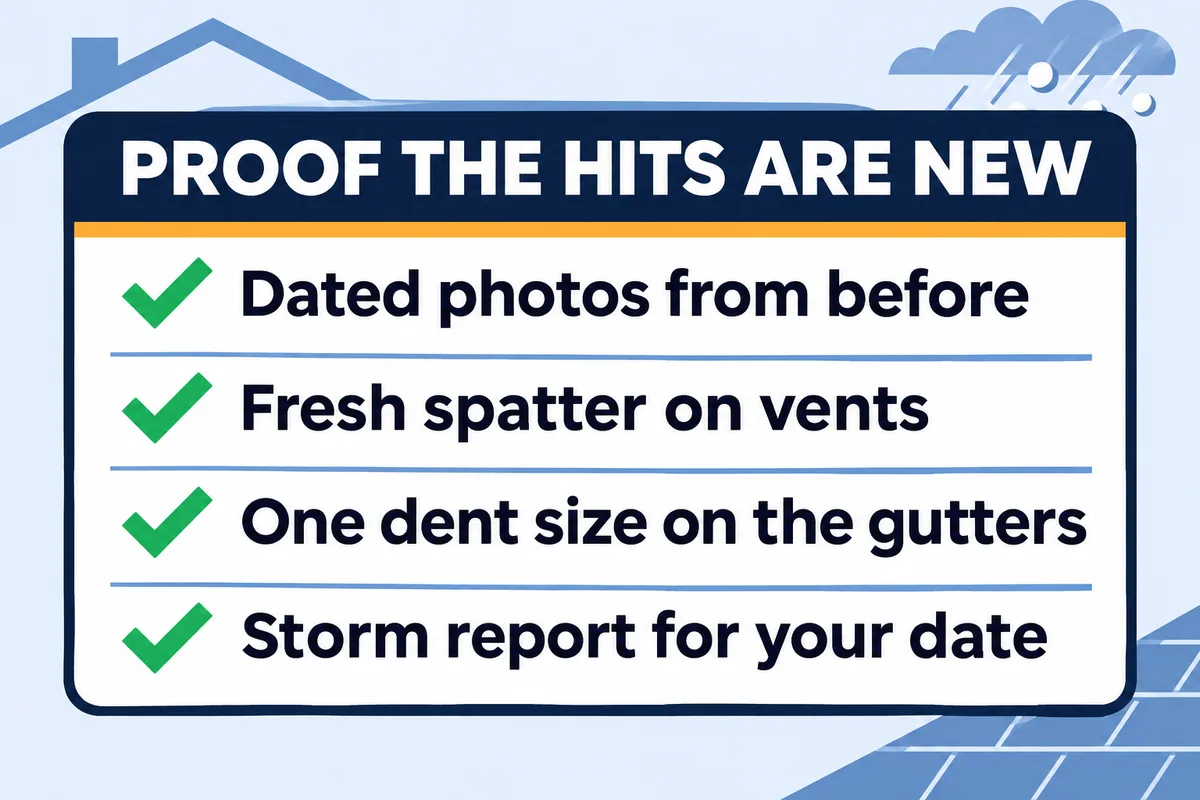
What you show: photos from before the new storm (a home inspection, a real estate listing, an old drone shot, even a street view image), plus fresh spatter and one dent size tied to the new date.
You were paid before and never fixed it
What the insurer can say: it already paid for that damage once, so it will not pay for the same shingles again.
What you show: the old estimate, so the two scopes can be compared line by line, and proof of what the new storm added. Our article on keeping the insurance money without fixing the roof covers this history in detail.
You bought the house with old hits on it
What the insurer can say: the damage was there before your policy began.
What you show: your home inspection report and the photos from the sale. An inspector who wrote "roof in fair condition, no visible damage" is a witness for you. Sellers' side of this is in our guide to selling a house with an open roof claim.
In all three, the open question is the same: was the roof working before the new storm, and is it damaged now? A roof that kept water out on the morning of the storm and has fresh fractures that evening has a new loss, whatever it went through years ago. A roof that was already leaking from old hits is harder, and the paperwork has to carry more of the weight.
Two storms can mean two deductibles
Each storm is its own event, so a claim for each one carries its own deductible. Many Illinois policies now use a separate wind and hail deductible set as a percentage of the dwelling coverage, often 1 or 2 percent, and that is where the "which storm" question turns into real money. Here is one example roof in round numbers, using a replacement price inside our usual $9,000 to $18,000 range for architectural shingles:
Same roof, same storm, and the payment runs from nothing to five figures depending on which hits are counted as new. That is why the proof in the sections above matters more than any argument about the roof's age. Our page on the roof insurance deductible in Illinois explains flat and percentage deductibles and why the first check is often short.
Photograph the roof now, before the next storm
The cheapest evidence is the one you take on a quiet day. It takes about twenty minutes from the ground and the driveway.
- Walk around the house and photograph every slope you can see from the ground, from the same spots each time. Stand back far enough that the house number or a window is in the frame.
- Take close-ups of the metal you can reach without climbing: downspouts, the gutter ends, the air conditioner fins, the meter cover, a painted mailbox. These are the parts that keep a record.
- Note any dents that are already there. A small piece of painter's tape next to an old dent, photographed, settles later arguments about it.
- Keep the photos with their original dates. Email them to yourself or store them in a cloud folder named for the year.
- File the home inspection report, any roof inspection report and the roofer's invoice from the last repair in the same place.
- After any storm with hail, take the same set again within a few days, before the spatter marks start to fade.
What we do on the roof, and where our partner comes in
When we inspect a roof with more than one storm on it, we document what we find: test squares on each slope, the hits counted and photographed, the dents measured on the soft metals, and the hits we believe are old marked as old. Then we write a code-compliant estimate for the work the roof needs. We do not argue the claim. Illinois law does not let a roofing contractor negotiate an insurance claim for you. Our partner, the licensed Illinois public adjuster State Adjusting Services, can represent you on the claim if you want someone in your corner, as our insurance claim page explains. If the insurer turns the claim down as old damage or wear, read our guide to a roof claim denied for wear and tear before you reply.
If the roof does need replacing, our hail damage roof replacement page walks through the job from tear-off to final inspection, and we install GAF, Owens Corning and IKO systems across the north and northwest suburbs.
Related reading: the appraisal clause when you and the insurer disagree on the amount and Class 4 impact-resistant shingles in Illinois.
Frequently asked questions
Can I file a hail claim if my roof already had hail damage?
Yes. The new storm is a new event, and the claim covers what that storm did. The insurer will try to separate old hits from new ones, so photos from before, fresh spatter marks on metal and a storm report for your date carry most of the weight.
How can an adjuster tell old hail damage from new?
By the condition of each hit. A fresh shingle fracture shows dark, clean asphalt, and a recent dent on oxidized metal has a clean spatter halo around it, which Haag Engineering says typically lasts about a year. Old hits look weathered, and dents of two different sizes point to two storms.
Will insurance pay for the same roof twice?
Not for the same damage. If an insurer paid for hail damage and the roof was never repaired, it can refuse to pay for those hits again. Damage the new storm added is a separate question, and the old estimate helps compare what was there before with what is new.
Do I pay a deductible for each hail storm?
Usually yes, because each storm is a separate event with its own claim. With a percentage wind and hail deductible, a small new-storm repair can fall below the deductible even when the roof has plenty of older damage on it.
Want old and new hits sorted on your own roof, with photos you can keep? Ask for a free roof inspection. Our phone is (866) 992-2982, and the office in Lincolnshire answers seven days a week: weekdays from 7 in the morning to 7 in the evening, weekends from 9 to 5.