
 Volodymyr Lukaniuk
Attic frost is moisture from the house that freezes on the coldest things in the attic: the nail tips poking through the roof deck first, then the deck itself, then the underside of the ridge vent. It forms when warm, damp house air reaches the attic faster than outdoor air can thin it out, on a night cold enough to drop the deck below that air's frost point. The roof doesn't make the moisture. It does decide how fast the attic is flushed with dry outside air, and it is what gets hurt when all that frost melts at once.
We get these calls every November and again in the first January thaw, usually from someone who climbed into the attic for the holiday boxes and found the nails wearing white fur. Here is the arithmetic of why it happens on some nights and not others, then the attic read the way we read it, from the eave up to the ridge.
At what temperature does house air start to frost?
Every parcel of air has a dew point: cool a surface below it and water comes out of the air onto that surface. Below 32°F the water arrives as frost. For air at 70°F, the dew point depends only on how humid the house is. We worked these with the standard Magnus approximation, rounded to the nearest degree.
| Indoor humidity at 70°F | Dew point | What that means in the attic |
|---|---|---|
| 25% | 33°F | Dry winter house. A leak of this air wets only the coldest metal. |
| 30% | 37°F | Leaked into the attic, it frosts the nails on any night below freezing. |
| 35% | 41°F | Any deck colder than 41°F that this air touches gets wet. |
| 40% | 45°F | Easy to reach with a humidifier running all winter. |
| 45% | 48°F | Frost builds on most cold nights where this air leaks up. |
| 50% | 51°F | Even a 40°F autumn night will wet the nails. |
The right-hand column describes undiluted house air. In a real attic it mixes with outdoor air first, which is the whole point of the next section.
The roof deck in winter sits close to the outdoor temperature, and on a clear night it can drop a little below it, because a roof facing an open sky loses heat to it. Nails are worse still: the tips stick through the deck into the attic while the heads sit under the shingles, so they're the coldest thing up there. That's why frost shows up on the nails first, in neat rows along every rafter line.
One January night, worked three ways
Take a night at 10°F with outdoor air at 70% relative humidity, and a deck at about 10°F. Inside, the house is at 70°F and 35%. What matters is how much of the attic's air came up from the house and how much came in from outside. We worked the frost point of the mixed air for three cases.
The attic's frost point sits seven degrees below the deck. Nothing condenses. This is what a well-vented attic with a tight ceiling looks like.
The frost point is right at the deck temperature. The colder nail tips frost; the wood mostly stays clear. This is the classic "fuzzy nails" attic.
Seven degrees above the deck. Frost covers the nails, the sheathing and the ridge vent, and it keeps building every night of the cold snap.
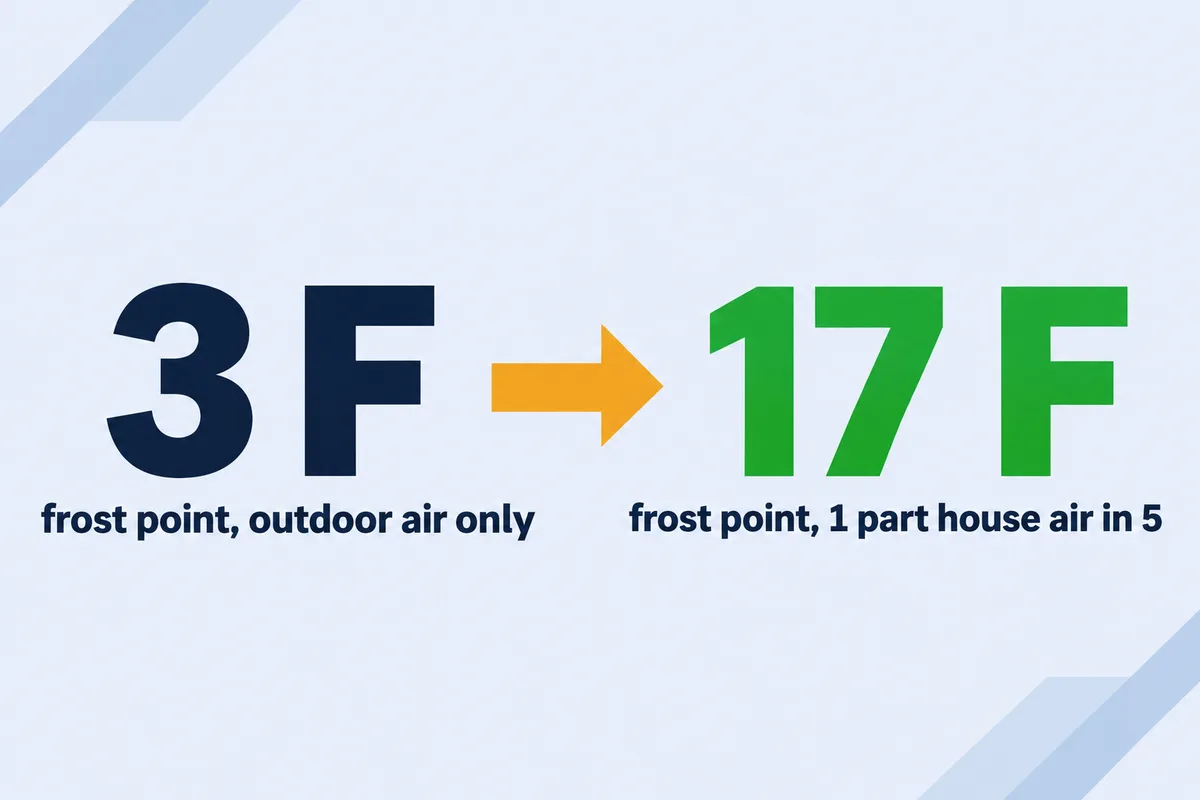
Two things move a house from the first card to the third. More house air getting into the attic, through an open bath fan duct, an attic hatch with no weatherstrip, or gaps around lights and pipes. Or less outdoor air getting in to dilute it, because the soffit vents are blocked or the exhaust at the ridge is starved. The first is house work. The second is roof work, and it's where a roofer actually earns the visit.
The attic read from the eave to the ridge
When we inspect a frosted attic, we start at the low edge and work up, because air is supposed to travel that way: in at the soffits, up under the deck, out at the ridge. Take a flashlight on a cold morning and look in this order.
The soffit intake, from outside first
Look up at the soffit from the yard. Vented panels that were painted shut, solid wood soffits with a few round vents, and vented panels with no hole cut in the board behind them all choke the intake. Our page on attic ventilation repair covers what we change here.
Roof sideThe baffles where the rafters meet the wall
From inside, shine the light toward the eaves. You want to see a channel between the insulation and the deck. Insulation packed tight against the sheathing means outdoor air stops at the soffit. Frost heaviest along the lower few feet of the deck points here.
Roof side, often done with a roof jobThe deck on the north slope
The north side gets no sun to dry it, so frost lingers there for days and the sheathing shows the damage first. Black or gray staining across a whole slope reads differently from a single stain under a vent or valley.
What we check before quoting a roofThe nail tips
Frosted or rusty nails in even rows across the roof mean condensation. One wet patch with a drip trail down a rafter means a leak, and our article on tracing a roof leak from a stain picks it up from there.
Tells you which problem you haveThe bath fan and dryer ducts
Follow each duct to its end. A duct lying loose on the insulation, or pointed at a roof vent without being fastened to it, pours warm wet air straight onto the deck. Heavy frost in a circle around one spot nearly always ends at one of these. Our guide to bathroom exhaust fans through the roof shows how the duct should end at its own roof cap.
Roof cap is ours, the fan is the houseThe ridge vent and any other exhaust
Frost on the underside of the ridge vent means moist air is reaching the top and leaving slowly. If there are gable vents or a power fan next to a ridge vent, they can draw from each other and leave the soffits idle; we explain that in our article on gable vents next to a ridge vent.
Roof side
The morning it warms up
Frost on its own sits there quietly. The trouble comes when a sunny 40°F day follows a week of single digits and the whole attic melts in an afternoon. That's when people call us about a "roof leak" dripping out of a light fixture on a dry day. If you have a lot of frost and a thaw coming:
- Look before the warm day, not after. Photograph the frost with the date on the picture.
- Lay plastic sheeting or tarps over the insulation under the heaviest frost so melt runs onto plastic and not into the insulation below.
- Don't switch on a powered attic fan. With weak intake it pulls more house air up through the ceiling and feeds the problem.
- Run the bath fans for a full hour after showers for the rest of the cold spell, and check that each one actually vents outside.
- After it dries, press a screwdriver into the stained sheathing. Firm wood is fine. Wood that gives is the next table.
When the frost has already hurt the deck
A winter or two of light nail frost rarely does more than rust the nails and freckle the plywood. Years of heavy frost and melt are another matter, because the same sheets get soaked every thaw and never fully dry on the north slope. This is what we look for and what it means for the next roof.
| What you see on the sheathing | What it usually means | At the next roof |
|---|---|---|
| Rust rings around nail tips, wood firm | Condensation on the nails, wood unharmed | Nothing to replace; fix the airflow |
| Dark staining across a slope, wood firm | Years of wetting that dried out each spring | Usually stays; we photograph it |
| Plywood face peeling, OSB edges swollen | Glue lines or strands have failed | Those sheets come out |
| Sheet gives under a screwdriver or flexes between rafters | Rot; it won't hold a nail | Replaced, and the soft spot shows up from the roof too |
Our roof decking replacement guide puts a bad sheet at $75 to $120 installed in the north and northwest suburbs, and a slope that has been wet for years can need ten or more. When we replace a roof over an attic that has frosted, the ventilation gets corrected in the same job, because a new deck over the same airflow will frost again next January. That's part of every roof replacement we write up.
The door-knocker who promises a ridge vent will fix everything is half right on a good day. A ridge vent with nothing feeding it at the soffits is a hole in the top of a sealed box, and if the bath fan is still breathing into the attic, no amount of exhaust will outrun it.
Frequently asked questions
Is frost in the attic a roof leak?
Usually not. Frost in even rows on many nail tips, found on cold, clear mornings, is condensation from house air. A leak shows as one wet area with a drip path, and it shows up with rain or melting snow rather than on a dry, frigid night.
Will a new roof stop attic frost?
Not by itself. New shingles don't change where the moisture comes from. What a roof replacement can change is the intake at the soffits, the baffles and the exhaust at the ridge, and those get corrected as part of the job. The house side, meaning fan ducts and air leaks into the attic, still has to be closed off.
Is a little frost on the nails a problem?
A light coat on the nail tips during a hard cold snap is common and seldom harms the wood. It becomes a problem when the frost spreads to the deck itself, comes back every week, or the melt drips onto insulation and through light fixtures.
Should I add more roof vents to stop attic frost?
Only after checking intake and the moisture sources. Extra exhaust without enough soffit intake can pull more house air into the attic. We look at the soffits, the baffles and every duct first, then decide whether anything needs to be added, closed off or left alone.
Related reading: what causes ice dams and what stops them and how attic heat ages your shingles.
Found frost on the nails this week? Call (866) 992-2982 or book a free inspection online. We check the attic as part of every roof inspection across the north and northwest Chicago suburbs.