
 Volodymyr Lukaniuk
Should you cover turbine roof vents in winter? No. Leave the whirlybirds open from November to March. A turbine is there to carry warm, damp air out of the attic, and in a Chicago winter that damp air is the main thing it has to remove. Bag it, and the moisture from showers, cooking and breathing stays in the attic, settles on the cold underside of the roof deck and turns to frost. The reasons people give for covering, heat loss and blowing snow, are real, but each one has a fix that keeps the vent working.
We are roofers in the north and northwest Chicago suburbs, and we check the vents and the attic on every free roof inspection. Below are the maker's own words on winter covers, the airflow of one turbine on a normal winter day here, and a fix for each worry that makes people reach for a bag.
What the company that makes them says about winter covers
Lomanco, the Arkansas company behind the Whirlybird, answers it on the second page of its BIB and BEB Whirlybird installation instructions, in a boxed note:
IMPORTANT Do not cover WhirlyBirds in colder months. WhirlyBirds will help remove damaging moisture present in all attics. If this moisture is not removed, it could condense and ruin your insulation.
Lomanco, "How to Locate and Space WhirlyBird Wind Driven Turbine Ventilators"
The building code points the same way. The roof ventilation section of the International Residential Code, as printed in this ICC committee document for section R806, asks for vent openings "protected against the entrance of rain or snow" and says ventilators "shall be installed in accordance with manufacturer's installation instructions". Snow protection is supposed to be built into the vent and the attic layout, not added as a bag in December.
Turbine covers are still sold in hardware stores, so the question keeps coming back every November. The maker's sheet is the one that has to stand behind the product, and it says leave the vent open.
How much air one turbine moves on a Chicago winter day
A turbine spins with the wind, so the useful number is the wind we actually get in winter. The Illinois State Climatologist publishes the O'Hare monthly normals, including average wind speed and relative humidity. Here are the five cold months:
Monthly averages at O'Hare. Humidity is the outdoor air; the air leaking up from your house is warmer and carries more water.
Our winters are windier than our summers: July and August average 8.4 and 8.0 mph. Lomanco's turbine user guide gives airflow at three wind speeds in metric units. Converted to the units on an American spec sheet:
| Turbine | About 5 mph | About 8 mph | About 15 mph |
|---|---|---|---|
| 12-inch (BIB 12) | 347 cfm | 547 cfm | 1,030 cfm |
| 14-inch (BIB 14) | 418 cfm | 706 cfm | 1,324 cfm |
Lomanco's columns are 8, 13 and 24 km/h; cfm means cubic feet of air per minute. A normal winter day here sits between the 8 and 15 mph columns, so one open 12-inch turbine moves somewhere between about 550 and 1,030 cubic feet of attic air every minute. A sample attic over a 1,500 square foot ranch, about 4 feet high on average, holds roughly 6,000 cubic feet. At the low end of that range, one turbine swaps out the whole attic about every 11 minutes, as long as the soffit vents let fresh air in at the bottom.
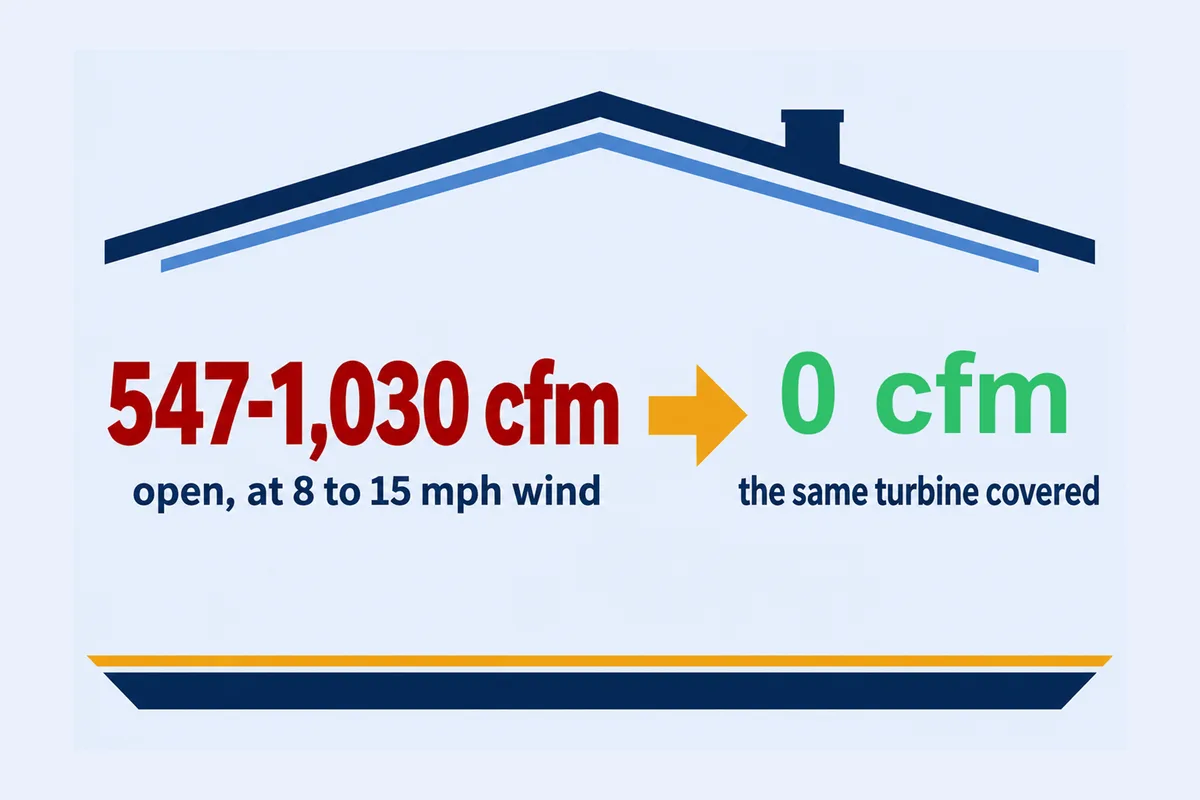
Put a cover on it and that number drops to zero. Every hour of every windy day from December to March, the damp air stays put. That is how an attic that looked fine in October ends up with frost on the nail tips and a wet, dark deck by February, the problem explained in our article on attic frost on the roof deck.
Why people cover them, and what is really going on
Nobody bags a turbine for fun. There is usually a specific worry behind it, and each one has a cause you can fix.
"It sucks the heat out of the house"
The turbine pulls air out of the attic, not out of your rooms. If warm air from the house is reaching the attic, it is leaking through the ceiling: around light fixtures, the attic hatch, plumbing and wiring holes.
Fix: seal and insulate the ceiling below. That is insulation work, priced separately from anything on the roof.
"Snow blows in through it"
Most often the attic is short of intake at the eaves, so the turbine pulls air from wherever it can, including back through itself or a nearby vent. Lomanco's own sheet says "Improper intake may lead to snow or rain infiltration into the exhaust vents."
Fix: open or add soffit intake, and stop mixing vent types.
"It rattles or grinds all night"
A worn bearing or a head knocked out of balance by hail, a branch or someone stepping on it. Lomanco's current heads have sealed, permanently lubricated ball bearings, so oil is not the fix.
Fix: replace the head. A bag only silences a part that has already failed.
"There is a drip under it"
A turbine is a hole in the roof with a flashing around it, and that flashing can fail like any other. A drip after a thaw can also be attic frost melting, which covering makes worse.
Fix: find which one it is before anyone touches the vent.
For the drip, our page on roof vent leak repair sorts a real flashing leak from condensation by when the water shows up.
Cover or leave open: find your attic
The answer for the turbine itself does not change: leave it open. What changes is what else needs work. Find the row that looks like your house.
| Your setup | What happens in winter | What to do |
|---|---|---|
| Turbines near the ridge, open soffit vents along the eaves | Air comes in low, leaves high. This is how Lomanco draws it. | Leave it alone |
| Turbines and a ridge vent on the same attic | The turbine can pull air, and snow, in through the ridge vent instead of from the soffits. | Leave open now; pick one exhaust type at the next roof |
| Turbines plus gable vents in the end walls | Same short-circuit through the gable louvers, often with snow on the insulation under them. | Leave the turbine open; read our gable vent guide first |
| Turbines, but the soffits are solid, painted over or packed with insulation | Not enough fresh air in, so the turbine pulls from the house and lets snow in. | Leave open; restore the intake |
| A head that does not turn in a steady wind, or wobbles | Works only like a small static vent, and catches more snow. | Replace the head, do not bag it |
Lomanco's sheet is direct about the mixed setups: "DO install ONLY ONE TYPE of Exhaust Ventilation within a common attic area." If your roof has a turbine next to gable vents, our article on gable vents and a ridge vent explains which one to close and when.
One case is different. On some Cape Cod houses, a turbine sits over a finished upstairs with no real attic in between, and it vents the rooms themselves. That is no longer a roof vent question. Have the space looked at before you block anything, because the moisture still has to leave somehow.
After a big snow: what to check from the ground and the attic
O'Hare averages 7.6 inches of snow in December, 11.3 in January and 10.7 in February, according to the same state climatologist table. After a heavy one, this short check is the only winter job a turbine needs:
- From the yard, look at each turbine with binoculars the morning after. A turbine that is spinning or clear of snow is fine. A head buried in a drift, or caked into a white ball, is not moving air.
- Leave it on the roof. Climbing a snowy roof to clear one vent is how people get hurt, and a buried turbine clears itself on the first sunny day. Raking snow from the lower edge from the ground is a different job, covered in our guide on how much snow a roof can hold.
- Look in the attic with a flashlight a day or two later. A light dusting of snow under the turbine that stays dry and powdery is minor. A wet patch on the insulation, frost on the nail tips or water stains on the deck means moist air or intake is the real problem.
- If a head froze into an ice ball, listen for it on the next windy day. Ice that has bent the vanes leaves it grinding or knocking, and that head needs replacing in spring.
When the turbine itself is the problem
Sometimes the honest answer is that the vent has reached the end. The bearings wear out, hail dents the vanes, and the flashing around the base fails. Lomanco's own steps call for the top half of the flashing to slide under the shingles, with the seams sealed. A base that was set on top of the shingles and buried in roofing cement will leak sooner or later, cover or no cover. We replace the fitting and seat it under the course above, as described on our roof vent repair page.
The bigger chance comes with the next roof. With the shingles off, we look at the whole attic: how much intake the soffits give, how long the ridge is, and which vents compete. On many houses the cleaner answer is a continuous ridge vent fed by open soffits, with the turbine holes decked over and shingled. Our attic ventilation page shows how we work out that balance on paper, and it matters for the warranty too: GAF, Owens Corning and IKO, the systems we install as part of a roof replacement, list balanced attic ventilation as a condition of their full material warranty.
Related reading: why attic temperature wears out shingles and why ice dams form on Illinois roofs.
Frequently asked questions
Should I cover my turbine roof vent in winter?
No. Lomanco, the company that makes Whirlybird turbines, prints "Do not cover WhirlyBirds in colder months" on its installation sheet, because the turbine carries moist house air out of the attic all winter. If heat loss or blowing snow is the worry, fix the cause: air leaks in the ceiling below, or missing soffit intake.
Why does snow get into my attic through the turbine?
Usually because the attic does not have enough intake at the eaves, or because a turbine sits next to a ridge vent or gable vent and pulls air, and snow, in through it. Lomanco warns that improper intake may lead to snow or rain getting into exhaust vents. A head that has stopped spinning also lets more snow fall straight through.
Is it a problem if my turbine stops spinning in winter?
Not on a calm day: it still lets warm, moist air rise out like a static vent. If it stays still in a steady wind, or it grinds or wobbles, the bearing has worn or the head is out of balance, and the head should be replaced rather than covered.
Not sure whether your turbines are working or just spinning? Book a free inspection and we will check the vents, the soffits and the attic under them. We answer the phone seven days a week, and you can also reach us through our contact page.