

Roof vent leak repair, from the pipe boot to the dryer cap
Count the things sticking out of the roof above. Every one is a hole cut through the deck, sealed by its own flashing, and most ceiling stains on a roof with years left in it start at one of them. We find which one, replace that fitting and leave the rest of the roof alone.
- 1A tall metal stack, sealed where it passes through the shingles.
- 2A row of small square caps down the slope. Each has a flange under the shingles above it.
- 3A round cap, a different fitting with its own seal.
- 4The chimney, which leaks in its own ways. Chimney flashing repair has its own page.
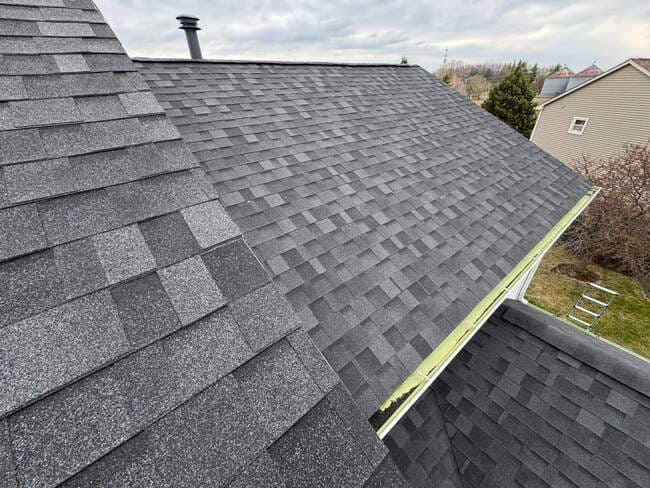
A finished roof from our gallery, in the north suburbs.
Four fittings, four different ways to let water in
The shingles around a fitting usually outlast the seal on it. Each card shows what gives out on one fitting and how we repair it.
Plumbing vent pipe boot
The rubber collar sits in full sun, hardens and splits where it grips the pipe. Rain then runs down the outside of the pipe and onto the deck.
We lift the course above, pull the nails, slide a new boot under it and nail the flange into sound deck. Our pipe boot guide has the detail.
Bathroom fan roof cap
A cap glued on top of finished shingles instead of woven into them, or a flap stuck open. The fan air itself has to leave the house: the code bans blowing it into the attic.
We reset the cap with its flange under the upper courses and look in the attic at where the fan duct actually goes. More in our bathroom fan roof vent guide.
Dryer roof cap
Lint packs the damper open and wet air drips brown onto the shingles. The cap needs a backdraft damper, no screen, and may never be shared with a bath fan.
We set a new cap into the roof the same way as a boot, not caulked on top. See dryer vents through the roof.
Box vent on the slope
Hail dents the hood and wind lifts the top flange, so the nails under it start to back out. Water gets in at the upper edge.
We replace the vent and seat it under the course above. Whether the roof has the right number of them is an attic ventilation question.
Rain, thaw or shower: when the drip shows tells you the cause
Water from a fitting rarely lands right under it, because it runs along the deck and a rafter first. Timing is the better clue. You can also trace the stain back to the roof yourself on a dry day.
During a steady rain
A ring that grows slowly over months, a few feet from a bathroom or kitchen.
Points to a split boot or a failed flange.
Only in wind-driven rain
Dry in a downpour, wet when the rain comes sideways.
Points to a cap or vent facing the wind.
A cold morning, no rain
Drips right after a freezing night.
Points to condensation in a vent stack.
First warm day after a cold snap
A wet ring around the fan trim with nothing in the forecast.
Points to frost melting in the attic.
Only while someone showers
Never tied to weather at all.
Points to the plumbing, so call a plumber first.
The two middle cases look exactly like a roof leak, and a new boot won't stop them. That's why we go into the attic before we quote any leak.
What one visit includes and what it costs
Most of the money on a vent repair is the trip, the ladder and the shingle work around the flange. The part itself is cheap, so a second fitting done on the same visit costs far less than the first.
Vent leak repair
Prices in the Chicago suburbs, standard two-story house
A steep pitch or hard access moves these numbers. You get a firm price after we have looked at the roof, not from a phone call.
Caulk on the crack, or a new fitting under the shingles
Both stop the drip this week. Only one of them is still dry in two winters.
Sealant over the split
A bead of caulk on a cracked collar or around a cap flange. It shrinks and cracks again with Illinois freeze and thaw, usually within a season or two.
In late fall, when the real repair has to wait for spring, it can buy you the winter. Call it a stopgap, not a repair.
A new fitting, woven into the roof
The courses above lap onto the new flange and the courses below run under it, so water is handed downhill with no caulk asked to hold it back.
Rubber boots are the standard. Lead boots cost more and usually last as long as the roof, which makes them worth it on a young roof.
When a vent leak means more than the vent
Most vent leaks are a small job. Three things found under the shingles change that.
- On a roof past about twenty years, the course above the boot can break as we lift it. Then the real choice is between a patch around it and repair or replacement of the roof.
- Spongy wood around the pipe means water has been coming in for a while. Those sheets are replaced and priced one by one, as our roof decking guide explains.
- Three boots, the valley and the drip edge all going together is the roof showing its age, not one bad part.
Does homeowners insurance pay for a leaking pipe boot?
A collar that cracked from age is wear and tear, which a policy doesn't cover, and a few hundred dollars of repair sits below most roof deductibles anyway. A fitting broken by a storm is different: hail can crack a collar or dent a cap, and wind can tear a flange loose, usually with other damage on the same slope. We photograph that and write it down with the storm date.
What Illinois law lets a roofer do
Illinois does not allow a roofing contractor to negotiate an insurance claim. We inspect, document and write a code-compliant estimate. Our partner, the licensed Illinois public adjuster State Adjusting Services, can represent you with the insurer. Our storm and insurance page covers the steps.
Who comes out to your roof
State Restoration Services is a family-owned roofing contractor in Lincolnshire, working since 2018 across the north and northwest suburbs, including Arlington Heights, Buffalo Grove and Northbrook. Illinois roofing license 104.018671.
Homeowners give us 4.9 from 91 Google reviews.
Call during these hours
We pick up from 7 AM to 7 PM on weekdays and from 9 AM to 5 PM on Saturday and Sunday.
Questions about roof vent leaks
- How do I know the leak is coming from a roof vent?
- Look at where and when it shows. A vent leak usually makes a round stain a few feet down-slope of a bathroom, kitchen or laundry, and it grows during ordinary rain. In the attic you can often follow a dark streak on the deck uphill to the pipe.
- Should all the pipe boots be replaced at once?
- If one rubber boot has split and the others went on the same day, they are the same age and close behind it. Each extra boot on the same trip costs $100-$200, much less than a second visit later.
- Can a roof vent leak be fixed with caulk?
- Only for a while. Sealant over a split collar dries, shrinks and cracks again, often within a season or two. A lasting repair replaces the fitting and sets its flange under the shingle course above.
- Does homeowners insurance pay for a leaking pipe boot?
- Rarely, because a collar cracked by age is wear and tear and the repair is usually below the deductible. A boot or cap broken by hail or wind is storm damage, and we document it with the date for your claim.
Want this looked at?
We inspect for free, document what we find and prepare a code-compliant estimate you can hand to your insurer. Our partner, a licensed public adjuster, State Adjusting Services, can represent you on the claim.
Call (866) 992-2982. Free Inspection