
 Volodymyr Lukaniuk

Does insurance cover gutter damage? Usually yes, when something sudden did it: hail, a windstorm, the weight of ice, a falling tree or limb. The gutters are fastened to the house, so they are insured with the house under the dwelling coverage of a standard homeowners policy. Insurance does not pay for gutters that rusted, leaked at the seams for years, pulled away from rotted fascia or overflowed because nobody cleaned them. The real argument sits in between: a run of gutter covered in small hail dents that still carries water. Some insurers call that cosmetic and pay nothing for it.
We install and replace gutters across the north and northwest Chicago suburbs and measure storm-damaged ones for claims every season. Below is each cause with the policy words that decide it, the four checks that separate a cosmetic dent from a gutter that no longer works, and one house priced by the foot against three different deductibles.
Which gutter damage the standard policy pays for
The common homeowners form, the ISO HO-3, insures the house against "risk of direct physical loss". That means the insurer pays unless it can point to an exclusion. You do not have to prove your gutters were on a list of named perils. The table follows the cause to the sentence the answer hangs on. The wording is from the sample HO-3 published by the Insurance Information Institute; your policy may number it differently.
| What happened to the gutters | Usual answer | What decides it | What to keep |
|---|---|---|---|
| Hail dented the gutters and downspouts | Depends on the dents | Hail is a covered cause. A cosmetic damage endorsement, if your policy has one, can remove dents that only change how the metal looks. | Close photos with a coin or tape for scale, the storm date |
| Wind ripped a run off the fascia | Usually paid | A sudden physical loss. The insurer may look at whether the hangers were already loose. | The torn pieces, the hangers, photos of the fascia behind |
| Ice or packed snow pulled the gutters down | Usually paid | The ice exclusion covers what sits around and under the house: pavement, pools, footings, piers. Gutters are not named in it. | Photos with the ice still in place, if you can take them safely |
| A tree or a limb fell on them | Usually paid | Direct physical loss to the dwelling. Removal of the tree is a separate, capped line. | Photos before the limb is cut up, the tree service invoice |
| Rust holes, leaking seams, peeling paint | Not paid | "Wear and tear, marring, deterioration" and "rust or other corrosion" are excluded. | Nothing for the claim; this is a replacement you budget for |
| Overflow from a clogged gutter wet the wall | Not paid | Read as a maintenance problem that built up over time, not a sudden loss. | Dates of your last cleaning, in case the insurer asks |
| Gutters sag because the fascia board rotted | Not paid | Wet or dry rot is excluded, and the gutter fell because the wood behind it gave out. | Nothing for the claim; the wood and the gutter are one repair |
Notice the pattern. The gutter itself never decides the claim. The cause does, and the insurer reads the cause from what the metal and the wood behind it look like.
When a dent counts as cosmetic, and how to tell
A dent is cosmetic when it changes how the gutter looks and nothing else. Some policies carry an endorsement that excludes exactly that. These endorsements are written state by state, so the best way to see one is to read one that a regulator published in full. This is the wording the Texas Department of Insurance adopted for an optional hail exclusion:
"Cosmetic loss or damage means only that damage that alters the physical appearance of the roof covering but does not result in damage that allows the penetration of water through the roof covering or does not result in the failure of the roof covering to perform its intended function, to keep out elements over an extended period of time."
Texas Department of Insurance, Bulletin B-0030-98, Endorsement HO-145
Two things in that sentence matter for gutters. It talks about the roof covering, and a gutter is not a roof covering, so an endorsement written that narrowly does not reach your gutters at all. And it defines cosmetic by function: once the damage stops the part from doing its job, it is no longer cosmetic. Endorsements sold in Illinois are not all worded like this one. To find out whether yours has one, look at the list of forms and endorsements on your declarations page for a title with "cosmetic" in it, or ask your agent to read it to you.
Because function is the line, these are the four things we check on a dented gutter. Each one can be done from the ground or from a ladder at the downspout, without walking the roof.
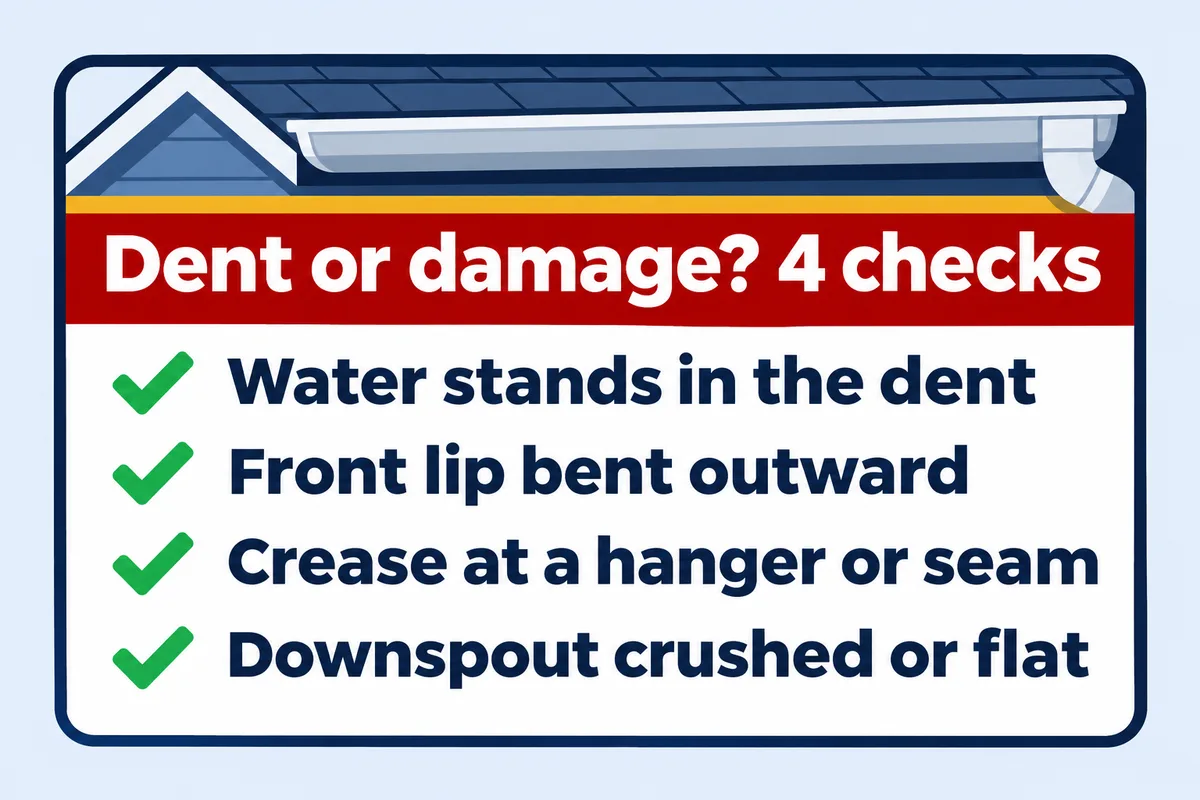
- Run a garden hose into the high end of the run for two minutes, then wait ten. Water that is still sitting in the dents means the bottom of the gutter no longer falls toward the outlet. Standing water freezes, and in a Chicago winter that is weight on the hangers.
- Sight down the front edge. Hail that hits the top lip bends it out or flattens it, and a bent lip lets water sheet over the front in a heavy rain instead of reaching the downspout.
- Look hard at the hangers and the corners. A sharp crease next to a hanger, or a corner miter split open, is damage to how the gutter holds its shape and its seal, not to how it looks.
- Check the downspouts, especially the elbows near the ground. A 2x3 downspout has 6 square inches of opening; crush one side and it carries a good deal less, so the gutter above it backs up.
Rounded, shallow dents along the face of the gutter that pass all four checks are the ones most likely to be called cosmetic. Write down what you found on each check and photograph it. That record is worth more than an argument about whether dents are ugly.
Why the adjuster looks at your gutters first
Gutters, downspouts and the metal vents on the roof are soft metals. Hail marks them more clearly than it marks shingles, and the spacing and size of the dents tell the adjuster how big the stones were and which way the storm came from. That makes the gutters evidence for the roof claim, even when the gutter line on the estimate is small. If you replace dented gutters before the insurance company has seen them, you have thrown away the clearest proof your house was hit.
Photograph every side of the house with something for scale in the frame, a quarter or a tape measure held against the dents. Then read our guide to what hail damage on an asphalt roof looks like, because the shingles are where the money is, and our walk-through of the insurance adjuster's roof inspection so you know what happens at the visit.
One house worked: is a gutter claim worth filing?
Take a two-story house in the northwest suburbs with 160 feet of 5-inch aluminum gutter, formed on site in one piece per run, and 80 feet of downspout, every run dented by the same hailstorm. We price that kind of aluminum gutter at roughly $6 to $14 per foot installed, and downspouts in about the same range, as our page on gutter cost per foot sets out.
Now set that against the deductible. On a lot of Illinois policies the hail deductible is a percentage of what the house is insured for, not a flat amount. On a house insured for $350,000:
| Wind and hail deductible | You pay first | Gutters alone, at the top of the range |
|---|---|---|
| Flat $1,000 | $1,000 | Up to $2,360 left for the insurer |
| 1% of the dwelling limit | $3,500 | Nothing left; the deductible is bigger |
| 2% of the dwelling limit | $7,000 | Nothing left |
So a claim for the gutters alone rarely makes sense on a percentage deductible. The same storm that dented the gutters, though, usually marked the roof, the window wraps and the siding too, and a claim pays one deductible per occurrence for everything that one storm damaged. The gutters ride along on the roof claim. Our piece on how roof insurance deductibles work in Illinois goes through finding your own number on the declarations page.
One more subtraction applies to older gutters. Most replacement cost policies pay the actual cash value first, the price of new gutters minus depreciation for their age, and release the rest after the work is done. Twenty-year-old gutters can lose a good part of their value on paper. Illinois gives you the right to see how the insurer got there. Under 50 Ill. Adm. Code 919.80(d)(8)(A), "Upon the insured's request, the company shall provide a copy of the claim file worksheet(s) detailing any and all deductions for depreciation, including, but not necessarily limited to, the age, condition, and expected life of the property." Ask for it in writing if the gutter line looks thin.
When the estimate replaces only the dented section
The gutters we hang are made on site from one coil, in one piece from corner to corner, so the only joints are at the corners and the downspout outlets. An estimate that pays to replace ten dented feet out of a forty-foot run asks someone to cut the gutter and splice in a new piece. That adds the kind of lapped joint a one-piece run is bought to avoid, and a fresh piece of painted aluminum next to a run that has faded in the sun for fifteen years will not look the same.
What we do as the contractor: measure every run, photograph the damage section by section, and write a line-by-line estimate for the work needed to put the system back the way it was built. Illinois law does not let a roofing contractor negotiate your claim with the insurer, so we do not. Our partner, the licensed Illinois public adjuster State Adjusting Services, can represent you on the claim if you want someone in that seat. You can read how the claim side works on our insurance claim help page, and what goes into a new system on our gutter installation page.
After a storm hits your gutters, in this order
- On the day of the storm, photograph every side of the house and every downspout from the ground, with the date on the files. Keep any gutter pieces that came down.
- Before the next rain, put back any downspout extension that came loose so water is not dumping against the foundation. Small, sensible steps to protect the house are usually reimbursable as reasonable repairs; our article on whether insurance pays for an emergency roof tarp explains that clause.
- Within a few days, find your wind and hail deductible on the declarations page and check the forms list for a cosmetic endorsement.
- Have the roof looked at before you call the insurer. Our inspection is free, and the gutters, the roof and the soft metals go into one written report.
- When the insurer's estimate arrives, compare its gutter and downspout footage with your own measurements, and ask for the depreciation worksheet if the payment looks low.
Frequently asked questions
Are downspouts covered the same way as gutters?
Yes. Downspouts are part of the same drainage system attached to the house, and the same causes decide them. Crushed elbows at the bottom are a common hail and snow-shovel find; only the hail one is a claim.
Will insurance pay for water damage inside the house from an overflowing gutter?
If the gutter overflowed because it was clogged, the insurer will usually treat it as a maintenance problem. If a storm tore the gutter off and rain then got into the wall, the interior damage is part of the same sudden loss and is usually covered.
Are gutter guards covered if hail damages them?
Guards fastened to the gutters are part of the dwelling like the gutters themselves, so hail damage to them is treated the same way, cosmetic endorsement included. Keep the invoice for the guards, since an adjuster will not always know what they cost.
What about the gutters on a detached garage?
They fall under the other structures coverage instead of the dwelling coverage. Our article on hail damage on a detached garage roof shows how one storm across the house and the garage is still one deductible.
Dented, sagging or torn gutters after a storm? Book a free inspection or call (866) 992-2982, and we will measure the whole system and the roof above it in one visit.