
 Volodymyr Lukaniuk
Homeowners insurance covers chimney damage when a storm on a specific date broke it: lightning that knocked bricks loose, wind that tore the flashing or blew the cap off, hail that cracked the crown, or a limb that came down on it. It does not cover a chimney that wore out. A crown that cracked over ten winters, mortar that washed out of the joints, or a chase cover that rusted through is wear, and wear is written out of the policy in plain words. Most chimney claims are decided on one question: is this damage new, or was it already there? This guide shows how that question gets answered on a roof in the north and northwest Chicago suburbs, and when a chimney claim is worth filing at all.
"We do not insure, however, for loss ... caused by ... (1) Wear and tear, marring, deterioration; ... (6) Settling, shrinking, bulging or expansion, including resultant cracking, of pavements, patios, foundations, walls, floors, roofs or ceilings."
"Collapse does not include settling, cracking, shrinking, bulging or expansion."
From the standard homeowners form HO 00 03 (ISO, 1991 edition), as filed with the Nevada Division of Insurance. Newer editions and each carrier's own form word it a little differently; your declarations page names the form you have.
Those two sentences are why "my chimney cracked" so often gets a no. A crack on its own reads like settling or age. A crack with a lightning mark beside it, or a cap lying in the yard the morning after a wind storm, reads like a covered loss. The adjuster is looking for the event.
Four storm events that break a chimney, and the policy words each falls under
Coverage for the house itself works by exclusion: a direct physical loss is covered unless the policy carves it out. Each of these four events is a named peril in the same form, which is why they pay when the damage is real and fresh.
Lightning
A strike on a masonry chimney can blow bricks off the top, split the crown or crack the flue liner from the inside. You usually find scorched brick or debris on the roof and lawn the next day.
Policy words: "Fire or lightning"
Wind
Gusts peel step and counter-flashing off the brick, lift the shingles beside the chimney and carry off a rain cap or a loose chase cover. On a sided chase, wind can strip the siding panels as well.
Policy words: "Windstorm or hail"
Hail
Brick shrugs off most hail. The soft parts do not: a sheet-metal chase cover, an aluminum cap and the flashing all dent, and a thin concrete crown can chip at the edges.
Policy words: "Windstorm or hail"
A falling limb or tree
A limb that lands on the chimney can push it out of plumb, crack it at the roof line or knock it down onto the shingles. Our guide to a tree on the roof covers the tree removal side of that claim.
Policy words: "Falling objects"
Heavy snow and ice get their own line too ("Weight of ice, snow or sleet"), but on a chimney that usually shows up as ice damming behind it, which is a flashing and cricket problem more than a broken chimney.
Fresh storm damage or old wear: what the adjuster reads on each part
An adjuster on your roof is sorting every mark into one of two piles. These are the signs we photograph for each part of the chimney, because they are the signs that decide which pile it lands in.
| Part | Reads as storm damage | Reads as wear |
|---|---|---|
| Rain cap | Cap missing or bent with clean, bright metal at the broken fasteners; cap found on the roof or in the yard | Rust streaks down the brick, screen packed with leaves, fasteners rusted away |
| Crown (the concrete top) | Chips at the edge with clean gray concrete inside; a fresh piece lying on the shingles | Hairline cracks across the top with dirt or moss in them; old caulk smeared over cracks |
| Brick and mortar | Loose or missing bricks at the top after lightning; a crack that runs through brick and mortar alike at the point a limb hit | Mortar sanded out of the joints, brick faces flaking off (spalling), white salt staining |
| Flashing | Counter-flashing pulled out of its mortar joint, metal folded back, hail dents with the paint knocked off | Dried, cracked sealant along the top edge; roof cement layered over old metal |
| Chase cover (sided chimney) | Fresh round dents in the metal; cover lifted at one corner after a wind storm | The middle sagging so it holds a puddle, rust holes, stains running down the siding |
Two things move a chimney from the wear pile to the storm pile: a date and a photograph. If you have a phone picture of the chimney from last summer, find it. A before shot that shows a whole cap is worth more than any argument on the roof. For pinning down which storm it was, our article on finding the hail date of loss walks through the public weather records.
Is a claim for the chimney alone worth filing?
Often not, and the reason is arithmetic. A standalone reflash on a sound chimney runs about $650 to $1,200 in our area, and a sealant stop-gap is $50 to $150. Many Illinois policies now carry a separate wind and hail deductible of 1% to 5% of the dwelling limit. On a house insured for $350,000, 1% is $3,500.
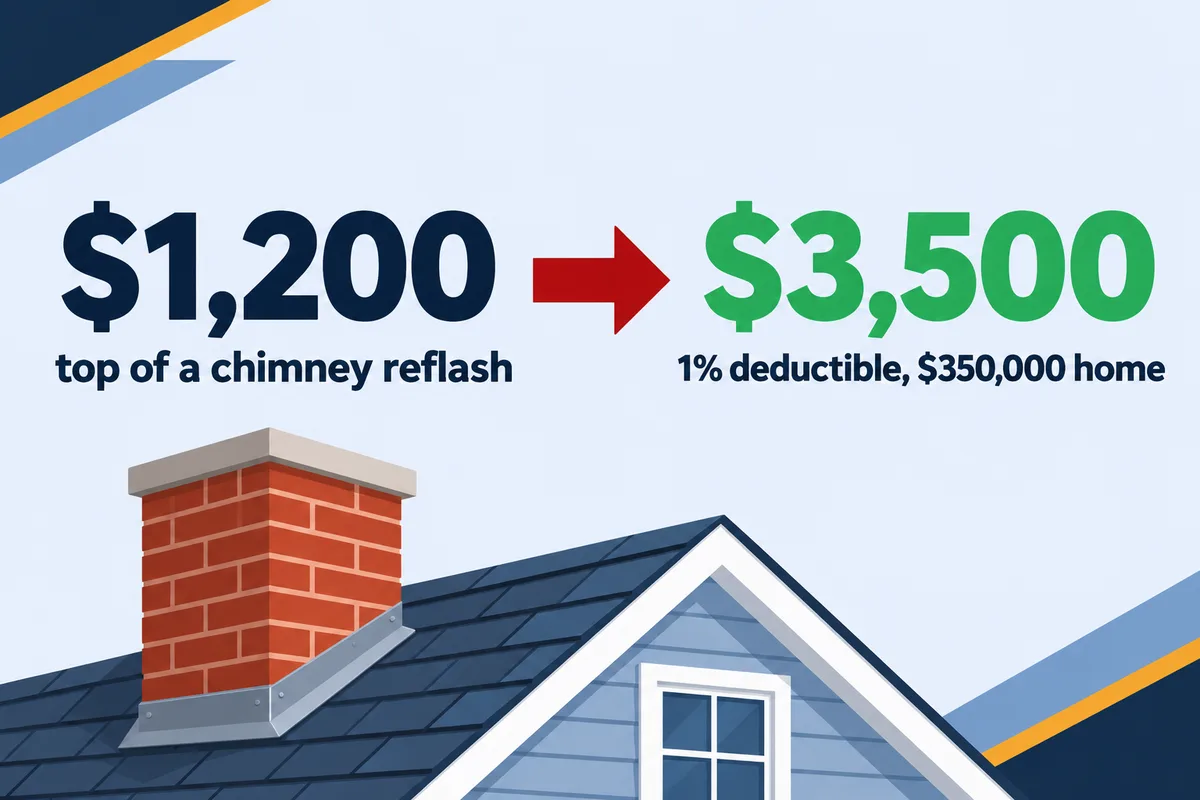
Put those side by side and a wind-torn flashing job pays nothing: the whole repair sits under the deductible, and the filed claim still lands on your claims record. Lightning and fallen trees are a different sum: the damage tends to run well past a reflash, and lightning is not a wind or hail loss, so it usually falls under the regular flat deductible instead of the percentage one. Read your declarations page before you call anyone. Our guide to roof insurance deductibles in Illinois shows where the percentage hides and how to multiply it out.
When the chimney rides along on a whole-roof storm claim
This is where the chimney money usually is. If hail or wind damaged the shingles enough that the roof is being replaced, the chimney flashing comes off with them. You cannot weave new step flashing into new shingles while keeping the old metal, so the flashing belongs in the same scope as the roof, not as a separate claim with its own deductible.
When we write the estimate for a storm roof with a chimney on it, these are the lines we want to see itemized:
- Step flashing on both sides of the chimney, new, woven course by course
- Counter-flashing set into a fresh cut in the mortar joint (a reglet), not sealed to the brick face
- Front apron flashing across the downhill side
- A cricket behind the chimney when it is more than 30 inches wide and does not sit on the ridge; our chimney flashing and cricket guide explains the code line, and a cricket typically adds $400 to $900
- Any storm damage to the cap or chase cover, photographed and listed on its own line
A cricket the old roof never had is a code item, and whether the policy pays for it depends on its ordinance or law coverage. Our article on code upgrade coverage on a roof claim explains how that line works.
What to do in the days after a storm hits the chimney
- Photograph it from the ground the same day, before anyone climbs up: the top of the chimney, the cap, anything lying on the roof or lawn. Write the date and time down.
- Look in the attic if you can reach it. A wet deck or wet framing beside the chimney tells you water is already getting in, which turns this into a leak you need to stop now.
- Stop further damage. The standard form says the insurer "will pay the reasonable cost incurred by you for necessary measures taken solely to protect against further damage." A tarp or a temporary seal counts. Keep the receipt and the photos of what it covered.
- Have the whole chimney looked at, not just the part you can see. A wind storm that bent the cap may also have lifted the counter-flashing on the back side, where nobody looks.
- Decide on the claim with the numbers in front of you: repair estimate on one side, your actual deductible on the other.
Our part is the roof work: we inspect, document what we find with photos and measurements, and write a code-compliant estimate for the chimney flashing repair and the roof around it. Illinois law does not let a roofing contractor negotiate your claim. If you want someone representing you with the carrier, our partner, the licensed Illinois public adjuster State Adjusting Services, can do that, and our insurance claim page shows how the two roles fit together. Your insurer decides what the policy pays.
Frequently asked questions
My chimney started leaning after a storm. Will insurance pay to rebuild it?
It can, if the storm caused the lean: a limb that hit it, or lightning that split it. A chimney that was already leaning and finally tipped is the textbook case the policy leaves out, because the form excludes settling and says collapse does not include settling or cracking. Photos from before the storm carry a lot of weight here.
Wind blew the cap off my chimney. Is that worth a claim?
Almost never on its own. A cap is a small part, and the cost to replace it sits far below most deductibles. Get it replaced soon, though: an open flue takes rain straight down the inside of the chimney.
Lightning hit the chimney but I see no damage. Should I still have it checked?
Yes. A strike can crack the flue liner inside the chimney while the brick outside looks fine, and you will not see that from the yard. Have the flue inspected before you light the next fire, and keep the date of the storm on record in case the inspection finds damage.
Related reading: reading a roof claim denied for wear and tear and our storm damage checklist.
Storm went through and the chimney looks wrong? Book a free inspection or call (866) 992-2982. We work the north and northwest Chicago suburbs seven days a week and will tell you plainly whether it is a claim or a repair.