
 Volodymyr Lukaniuk
Shingles not sealed on a roof that went on in October or November are normal, and on its own that is not a defect. The black strip of adhesive on each shingle needs the sun to soften it before it grabs the shingle below, and around Chicago the sun stops doing that job for most of the winter. What matters is what the crew did about it: Owens Corning asks for the shingles along the edges of the roof to be hand sealed with roof cement whenever the air and the roof are at or below 40°F, and IKO warns that sealing in the cold can take up to several weeks. If nobody hand sealed the edges of your roof, the strip simply waits for spring while the windiest months of the year blow across it.
We are a roofing company in Lincolnshire, and this time of year owners in Buffalo Grove, Palatine and Northbrook call us about tabs that flutter on a new roof. So we laid the local weather records next to the makers' cold-weather sheets. Below: what the strip glues, a month-by-month calendar of when it can seal here, what two shingle makers ask for in the cold, what you can check yourself, and how to tell a tab that never sealed from one the wind tore loose.
What the sealant strip glues, and what it does not
The strip glues one shingle to the shingle below it, not to the wood deck. The nails hold the shingle to the roof. The strip holds down its lower edge so wind cannot get under it, bend it back and crease it. Until the strip bonds, a nailed shingle is fastened at the top and loose at the bottom.
- The roof deck, the wood the shingles are nailed to.
- Nails hold the top of each shingle.
- The sealant strip under the lower edge of the upper shingle. It bonds when the sun warms it.
- The lower edge, where wind gets in if the strip has not bonded.
That is why the eaves, the rakes and the ridge matter most. The edges of a roof are where wind lifts first, and it is also where Owens Corning asks for hand sealing in cold weather. The first row at the eave has its own glue line from the starter strip shingles along the eaves and rakes, which have the same need for warmth.
When shingles seal in the Chicago suburbs, month by month
Owens Corning lists what sets the sealing time: where the house is, the slope of the roof, which way it faces the sun, and the average daily temperature during and after the job. You cannot change the first three, so the calendar is the part to watch. The tiles below use the 1991-2020 normals for O'Hare published by the Illinois State Climatologist: the normal daily high, the average wind speed and the number of cloudy days in each month.
Read the calendar from the day your roof was finished. A roof done in early October still has a month of highs in the 60s and usually seals before the cold. A roof finished after mid-November goes straight into December, January and February, when the normal daily high stays under 40°F and more than half the days are cloudy. Then look at the wind line: January through April are the four months with average wind above 11 mph. A late-fall roof without hand sealing sits unbonded through the windiest stretch of the year and seals somewhere in April. A roof that faces south and gets afternoon sun can grab sooner than its north side, which is why one slope of the same roof can be sealed while the other still lifts.
What Owens Corning and IKO ask for in the cold
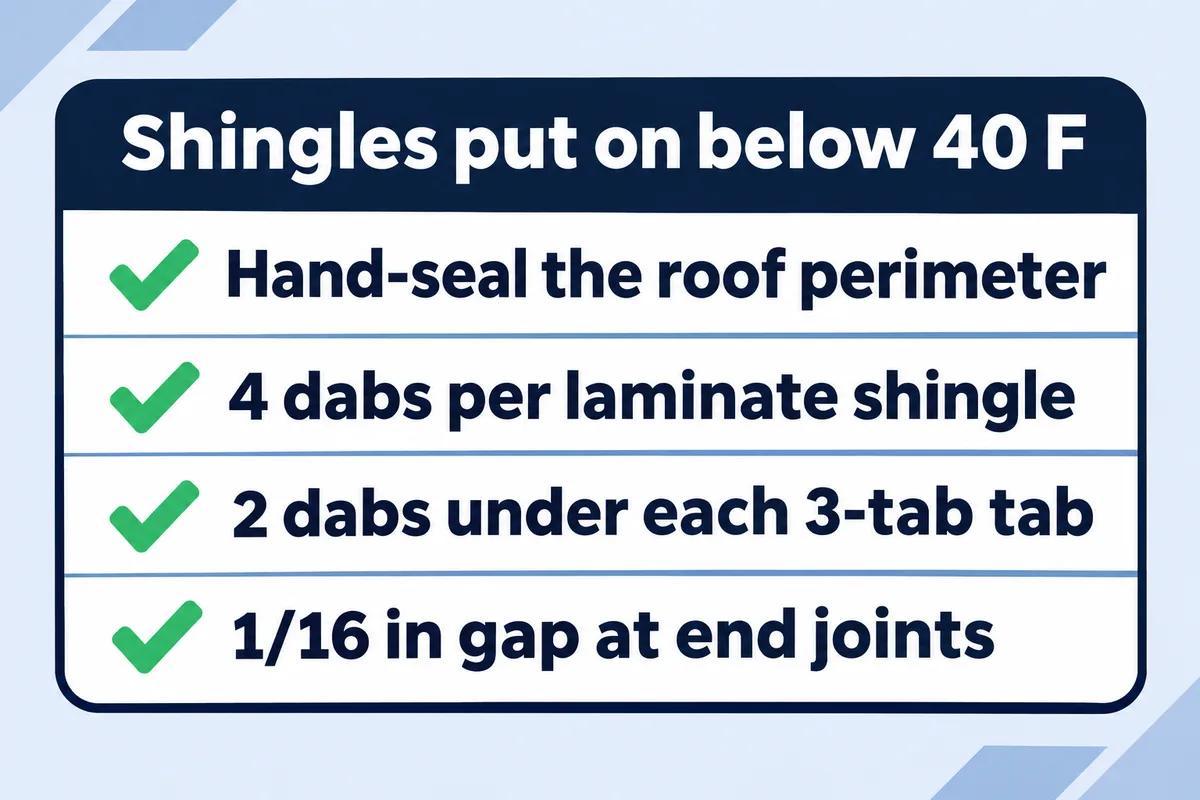
Both makers say the same thing in different words: when it is too cold for the strip, put roof cement under the shingles by hand. Owens Corning's own reason is printed in its cold weather installation bulletin TB-10022497-A:
"This protects against wind uplift which may occur when the temperature is too low for the adhesive strip of the shingles to activate."Owens Corning, Technical Bulletin TB-10022497-A, April 2026
| Point | Owens Corning, TB-10022497-A | IKO, bulletin R-52 |
|---|---|---|
| When it applies | Air and surface at or below 40°F | When shingles may not get enough time to seal before winter; shingles turn brittle at 50°F and below |
| Which shingles | All shingles along the entire roof perimeter | The shingles being laid, following the bundle wrapper |
| Laminate shingles | Four 1-inch dabs of ASTM D4586 roof cement, evenly spaced, about 1 inch from the lower edge, pressed in | Three evenly spaced dabs about the size and thickness of a quarter |
| 3-tab shingles | Two 1-inch dabs under each tab, at the corners | One quarter-size dab under each tab |
| Too much cement | Can make the shingles blister; must not squeeze out past the edge | Can make the shingle blister |
| Anything else | A gap of no more than 1/16 inch at end joints, so the shingles do not buckle when they expand in summer | Dirt on an unsealed strip can stop it from sealing later |
IKO's sheet is Residential Information Bulletin R-52, "Installing shingles in cold weather". Its point about dirt is worth a second look: a strip that stays open all winter collects grit, and a dusty strip may not bond well even in May. That is one more reason the cement goes in on the day of the job, not "if it is still loose in spring".
How to check whether your shingles have sealed
Most of this you do from the ground. Do not walk a roof in November, and do not pry shingles up on a cold day: IKO notes that asphalt shingles turn brittle at 50°F and below, and a cold tab bent back can crack across.
- After a windy day, stand back from the house with binoculars and look along each slope. A shingle that lifts and drops in the wind often shows a thin light line at its lower edge where it sits a little proud of its neighbours.
- Check the edges first: the eave, the rakes on the gable ends and the row under the ridge caps. These are the places wind works on hardest.
- On the next day above 50°F, set a ladder against the wall at the eave, not against the gutter. Press a finger up under the corner of a shingle in the second row. A sealed shingle resists and stays flat. An unsealed one lifts with almost no effort.
- Note which slope it was. Loose tabs only on the north side of a fall roof usually mean the sun has not reached that side long enough yet. Loose tabs on every side in July mean something else is wrong.
- Photograph what you see with the date. If a tab later creases or goes missing, the pictures show when it started.
Never sealed, or torn loose by the wind?
The two look alike from the driveway and mean different things. A shingle that never sealed is a question for the crew that installed it. A shingle that sealed and then broke free in a storm is wind damage, and wind damage on a roof is a possible insurance claim.
Signs it never sealed
- The strip on the shingle below looks clean and round, with no torn edge and no imprint of the shingle above.
- Many tabs lift the same way across one slope, often the shaded one.
- The roof went on after October and nobody mentioned roof cement.
Signs the wind broke a bond
- The strip shows torn adhesive, with bits of it stuck to the underside of the shingle above.
- A crease runs across the shingle where it bent back.
- The loose or missing tabs line up with the side the storm came from.
A few loose tabs on a new roof get hand sealed on a mild day. Creased or missing shingles get replaced, because a creased shingle will not lie flat again. In our area, replacing creased shingles and hand sealing a lifted section runs about $450 to $1,200, the same range as in our guide to roof repairs found in late fall, and our wind damage roof repair crews do this work across the north and northwest suburbs. If a storm tore shingles loose and you are weighing a claim, start with photos and dates. Illinois law does not let a roofer negotiate a claim for you; our partner, the licensed Illinois public adjuster State Adjusting Services, can represent you on it, as set out on our insurance claim page.
Getting a roof in December? Ask the crew three things before they start:
Will you hand seal the shingles along the eaves, rakes and ridge, and with how many dabs per shingle?
Which maker's cold-weather sheet are you following for these shingles?
Will you come back in spring to look at any tab that still lifts?
We install GAF, Owens Corning and IKO shingles, and our residential roofing page shows how a replacement runs from tear-off to cleanup.
Related reading: how many nails a shingle needs in Illinois and filing a wind damage roof claim in Illinois.
Frequently asked questions
How long does it take new shingles to seal in winter?
Around Chicago, a roof finished after mid-November often does not seal on its own until spring, usually April, when the normal high reaches about 59 F. IKO says sealing in cold weather can take up to several weeks even when the sun helps. That is why the makers ask for hand sealing with roof cement in cold weather.
Is it bad if my new roof shingles are not sealed?
Not by itself, if the roof went on in cold weather. Unsealed tabs are loose at the bottom edge, so wind can lift and crease them. Owens Corning asks for hand sealing along the whole roof perimeter at or below 40 F. Loose tabs in summer, months after the job, are a reason to call the installer.
Can I glue down a lifted shingle myself?
Only from a ladder at the eave, on a day above 50 F, with a small dab of asphalt roof cement under the corner. Do not bend a cold shingle back, it can crack, and do not use so much cement that it squeezes out or makes the shingle blister. Anything above the first rows is a job for a roofer.
Tabs lifting on your roof this fall? Book a free inspection or call (866) 992-2982, Monday to Friday 7:00 AM to 7:00 PM and Saturday and Sunday 9:00 AM to 5:00 PM. We serve the north and northwest Chicago suburbs from our office in Lincolnshire.