
 Volodymyr Lukaniuk
Late-fall roof repair comes down to one question about the thing you just found: is water getting into the house through it, or will it before spring? If yes, it gets dealt with now, either properly or with a winter stopgap that holds until the shingles are warm enough to work. If no, write it down, take a photo and let it wait for April. The second thing that sorts a repair into "now" or "later" is whether it needs new shingles to bend and seal. In November that is the hard part, because cold shingles crack when bent and their seal strips don't stick on their own.
We get these calls every November in the north and northwest suburbs, usually from someone who was up a ladder for the gutters or the holiday lights and saw something they didn't like. Below is how we sort the ten things people find most often, and what each choice costs.
How much season is left on November 9
Less than it feels like on a sunny afternoon. These are the National Weather Service numbers for O'Hare, the closest official station to our part of the suburbs:
Sources: NWS Chicago, normal first freeze and snow climatology, 1991-2020 normals.
So on a typical year, the nights are already freezing and the first snow sticks within about ten days. Snow on a slope stops almost all roof work, because nobody can see the shingles, let alone stand on them safely. Anything that needs a dry, bare roof should be booked now rather than after Thanksgiving. Why 40°F is the number roofers watch, and how a full replacement is built in the cold, is in our article on the best time of year to replace a roof.
What changes when the shingles are cold
Asphalt shingles get stiff. GAF, whose shingles we install, says that below 40°F they lose flexibility and can crack, and that the seal strip on the back of each shingle needs warmth and sun to activate. A shingle put down in November sits loose until it is sealed by hand: quarter-sized dabs of approved asphalt roofing cement under each tab, pressed down. GAF's cool-weather guidance also says the warranty is not affected when its cold-weather steps, hand sealing included, are followed. The shingles finish sealing by themselves once the sun gets on them in spring.
The harder problem for a repair is the shingles that are already there. To slide in a new piece, we lift the course above it, and a 15-year-old shingle at 30°F can snap along the nail line when lifted. The Asphalt Roofing Manufacturers Association warns about the same thing from the other side: walking on cold shingles can break them and pop the bond between courses. That is why a lot of our November work is a careful small fix, or a stopgap that keeps water out, with the real repair on the calendar for spring.
Ten late-fall finds, sorted
Find your problem in the left column. "Leave for spring" means nothing on that line lets water in this winter.
| What you found | Do it now | Winter stopgap | Leave for spring |
|---|---|---|---|
| Shingles gone after a windy day, bare underlayment or wood showing | Photograph it with the date, then cover it within days. New shingles can go in on a dry day with hand sealing. | A tarp fastened over the ridge, not weighed down with bricks. | Check that the shingles around the patch sealed. |
| Tabs lifted or folded back but still there | Photograph them. A fold line means the shingle is creased and has to be replaced. | Cement dabs under tabs that are flat and uncreased. | Replace the creased ones when they bend without cracking. |
| Rubber collar split on a plumbing vent pipe | A new boot, if the course above lifts without breaking. | Sealant around the collar. It shrinks and cracks again, so treat it as one winter. | The new boot, if the shingles above were too brittle in November. |
| Gap where the roof meets the chimney | Look at the ceiling and attic near the chimney after the next rain. | Sealant along the open joint of the metal. | New step and counter flashing, cut into the brick joints. |
| Ridge cap pieces cracked or lifted | Cover any open ridge vent slot, since snow blows into it. | Cement under the lifted pieces. | New cap shingles. They have to bend over the ridge, which cold caps don't like. |
| A nail head pushing up a shingle | Reset or replace the nail and seal the hole. Small, and fine in the cold. | Not needed. | Replace the shingle if the nail tore through it. |
| Leaves packed in a valley or a gutter | Clear it before the first snow, so melt water has somewhere to go. | Not needed. | Nothing. |
| A ceiling stain after rain, source not known | Find the source on a dry day, from the attic first. | Whatever the source needs: a tarp, a boot, sealant. | The proper repair of that source. |
| Wood that feels soft underfoot or sags between rafters | Keep weight off it and get it looked at from the attic. | A tarp if it leaks. | New deck sheets, which means taking the shingles off that area. |
| Granules in the gutters, no leak anywhere | Nothing. | Not needed. | An inspection to see how much life the shingles have left. |
Two of these need a word more. A nail head that pops up is almost always the wood under it moving with the seasons, which our article on roof nail pops explains. And a stain on the ceiling rarely sits right under the hole in the roof; our guide on tracing a roof leak from a ceiling stain shows how to follow it uphill from the attic.
Is a patch now and a repair in April worth paying for twice?
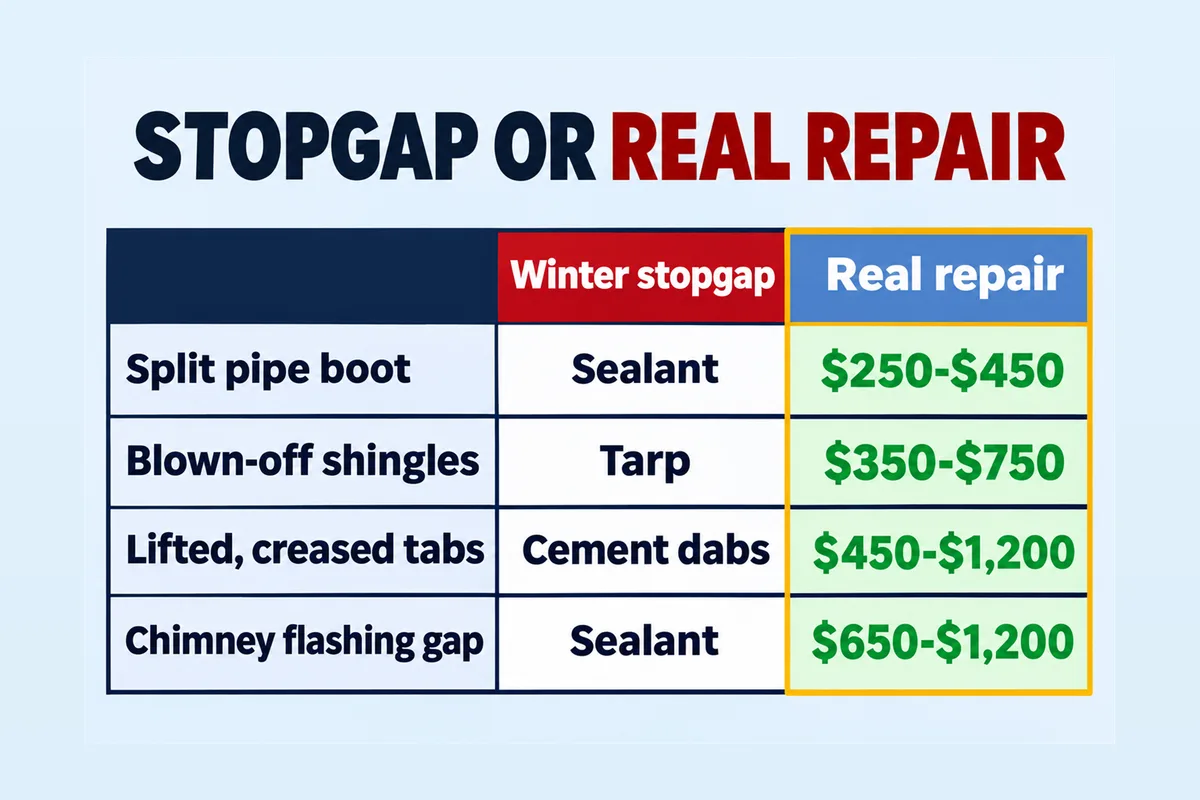
Sometimes, and the deciding fact is that most of the price of a small roof repair is the trip, the ladder and the shingle work around the part, not the part itself. These are the ranges we publish for the north suburbs on a standard two-story house:
- First plumbing vent boot replaced: $250-$450, and each more boot on the same trip $100-$200
- Blown-off shingles replaced on one slope: $350-$750
- Creased shingles replaced and a lifted section hand-sealed: $450-$1,200
- Chimney flashing redone: $650-$1,200
- Deck sheets, when the wood is rotten: $75-$120 per sheet
Worked through for a house with three rubber boots that went on the same day, one of them split: replacing all three on one visit is $450-$850 ($250-$450 for the first, plus two at $100-$200). Sealing the split one now, then coming back in spring for the boot and in a year or two for the other two, pays for the first-boot price three times.
The patch earns its place when the real repair has to bend cold shingles that might snap. Then a stopgap now and one proper visit in spring is cheaper than breaking a slope in November and replacing more than you needed to.
Repairs like these are what our roof repair crew does all year, and the chimney work has its own page on chimney flashing repair. Prices move with pitch and access; you get a firm number after we have seen the roof.
Wind damage found in November is a dated event
A lot of what people find this time of year came down in one storm: a row of tabs folded the same way, shingles in the yard, a cap piece on the driveway. That is storm damage, not wear, and it has a date. Before anyone patches it, take wide photos of the house and close ones of each spot, and write down the day of the wind. A tarp or a fresh strip of cement on top of the evidence makes it harder to show later what the wind did. Our guide to wind damage roof claims in Illinois covers what insurers look for on a lifted shingle.
Illinois law does not let a roofing contractor negotiate an insurance claim. We inspect, photograph and write a code-compliant estimate for the repair. Our partner, the licensed Illinois public adjuster State Adjusting Services, can represent you with the insurer. The steps are on our storm and insurance claim page.
What you can check from the ground this weekend
- Walk around the house with binoculars or a phone camera zoomed in. Look for color that doesn't match, which is usually a missing shingle, and for straight dark lines on a slope, which are often tabs that lifted.
- Look at the base of each vent pipe and at the chimney from two sides, since most of them sit on the back slope.
- After the next rain, go into the attic with a flashlight during daylight and look at the underside of the deck around pipes and the chimney for dark wet wood.
- Photograph anything odd with the date on it, even if you decide it can wait.
- Stay off a frosty or wet roof. Cold shingles are slick and they break under boots, which turns a small repair into a bigger one.
If the answer from any of those is a leak you can see, call before the snow. We also tarp roofs when the real repair has to wait for warmer days.
Frequently asked questions
Can a roof be repaired in winter in Illinois?
Yes, on a dry day with no snow or ice on the slope. Small repairs such as a vent boot, a nail pop or a few missing shingles are done in the cold with hand sealing. Repairs that bend old shingles, such as ridge caps or a section in the middle of a brittle slope, often get a stopgap first and the proper repair in spring.
Will roofing caulk hold through the winter?
Usually for one winter. Sealant over a split collar or an open flashing joint shrinks and cracks with freeze and thaw, often within a season or two. Treat it as a way to keep water out until spring, not as the repair.
Is it safe to walk on a frosty roof?
No. Frost and cold shingles are slippery, and cold shingles can crack underfoot, which the shingle makers warn about too. Look from the ground and from the attic instead, and leave climbing to a crew with fall protection.
Does a cold-weather repair void the shingle warranty?
Not when the maker's cold-weather instructions are followed. GAF, for example, says its warranty is not affected when its cool-weather steps, including hand sealing each shingle with approved cement, are followed.
Related reading: fixing a leaking roof pipe boot and what roof decking replacement costs.
Not sure which column your roof problem belongs in? Have us look at it before the first snow: book a free inspection, or phone (866) 992-2982. Our office answers from 7 AM to 7 PM on weekdays and 9 AM to 5 PM on Saturday and Sunday, for homes from Lincolnshire across the north and northwest suburbs.