
Wind damage roof repair, from one lifted tab to a whole slope
State Restoration Services repairs wind damage on roofs across the Chicago suburbs, from our base in Lincolnshire. We walk the whole roof, photograph every shingle the gust moved and write the repair down before work starts.
Most wind repairs are small. The plan on this page shows where to expect the damage, and the prices further down show what each size of job typically costs.
- The slope that faced the gust takes the most, and the damage often runs in rows.
- Rakes, the sloped side edges, give wind the first way under a shingle.
- Ridge and hip caps sit highest and lift along their length.
- Flashing at a chimney or wall can pull away. Our roof-to-wall flashing repair page shows that job.
Five conditions we find on a shingle after wind, and the repair for each
From the driveway most of these look the same. On the roof we lift each tab in the affected rows and sort it into one of five groups.
Sealed and flat
The tab is bonded to the course below. It stays as it is, and the photo goes in your report.
Lifted, no crease
The seal let go and the shingle itself is whole. We hand-seal the tab down to the course below.
Creased
A fold runs across the tab, hidden under the course above. Flexing cracked the mat, so the shingle gets replaced.
Torn
Part of the tab is gone. We replace it and re-nail the neighbors we lift into sound decking.
Missing
The underlayment is showing. We check it and the deck, cut out any wet sheathing and shingle over it.
Why a lifted tab that looks fine still needs work
“Not likely to re-seal themselves to the original sealing strength.”
That is shingle maker IKO on broken bonds, in its bulletin on high wind events. It names dust on the sealant and flexing in the wind as reasons, and recommends hand-sealing when the broken bond is the only damage.
A new shingle in an older field will show as a brighter patch for a while. We look for matching shingles on a hidden slope first, and our guide on shingle color matching explains how that plays out on a partial job.
How far the damage spread sets the size of the job
These are typical installed costs in the Chicago suburbs, from our guide to wind damage claims. Your written price comes after we have counted the shingles and looked at the access.
A handful of tabs blown off one slope, with everything around them still sealed.
Creased shingles replaced and a lifted section hand-sealed, on a roof with plenty of life left.
Creasing across one elevation, so one full slope of roughly 8 to 12 squares is re-shingled.
Damage on several slopes, or a roof already near its end, replaced in architectural shingles.
Age pushes a job toward the bigger scopes. Shingles turn brittle, and on an older roof lifting one to reach under it can crack its neighbors. Our roof repair page covers how we decide when wear is the bigger problem, and if hail came with the wind, hail damage roof replacement is the job to read about.
The two calls we get after a wind storm
Water is coming in
Stay off the roof, move what you can away from the drip and take dated photos from inside. Then call us during business hours. These calls go first, and we come out to tarp until the repair is scheduled.
Weekdays we are in from 7:00 AM to 7:00 PM, and weekends from 9:00 AM to 5:00 PM. What a tarp visit includes is on our emergency roof tarping page.
The roof is dry
Book the free inspection. We go over every slope, then the gutters and siding, because wind works on those too. Wind-torn panels are a siding repair and a loose run is a gutter repair.
You get a written scope before work starts, and photos of the finished repair. If a shingle is sitting in your yard, keep it.
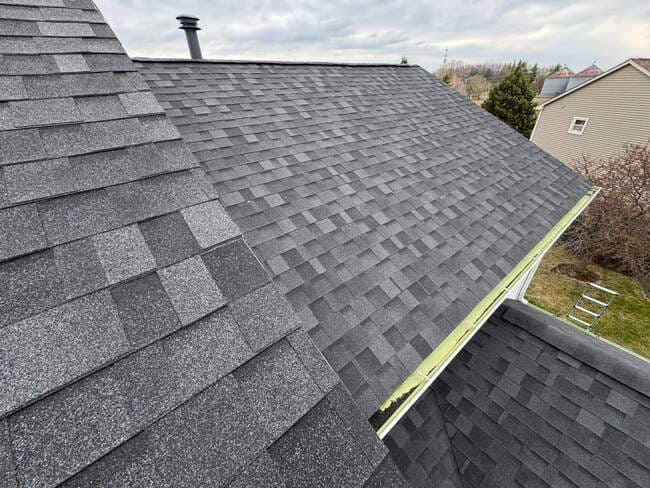
Read the wind class if a slope comes off
Two test standards appear on shingle wrappers and data sheets. Ask which class the shingle on your estimate carries, since the two scales measure different things and the letters do not line up.
| Standard | How it tests | Classes |
|---|---|---|
| ASTM D3161 | Fans blow air across sealed samples | A 60 mph, D 90 mph, F 110 mph |
| ASTM D7158 | Compares calculated uplift with the strength of the seal | D 115 mph, G 150 mph, H 190 mph |
What Illinois law lets a roofer do on a wind claim
Illinois does not allow a roofing contractor to negotiate an insurance claim. Our part is the roof and the record: photos of each fold line with the course held back, measurements and an estimate written to current code. Our storm damage roof repair page shows how that fits a larger storm job.
Our partner, the licensed Illinois public adjuster State Adjusting Services, can represent you with your insurer, and the carrier decides what it pays. A small repair can come in under your deductible, so check that number first. We hold Illinois roofing license 104.018671, listed on our licensed and insured page.
Questions people ask us after a wind storm
How much does wind damage roof repair cost?
Replacing blown-off shingles on one slope typically runs $350 to $750. Replacing creased shingles and hand-sealing a lifted section runs $450 to $1,200. One full slope costs far more, and you get a written price after the inspection.
Can a lifted shingle be sealed back down?
Yes, when the bond is the only thing that broke. A shingle lifted by wind is unlikely to re-seal by itself, so we hand-seal it. A shingle with a crease across the tab has a cracked mat and gets replaced.
Do you repair just a few missing shingles?
Yes. A few missing shingles on a sound roof is a normal repair for us. We still walk the whole roof, because the gust that took those shingles may have broken the seals on the rows around them.
Why are my shingles missing only on one side of the roof?
Wind comes from one direction, so it works on the slope facing the gust and on the edges it can get under. That is why wind damage often stays on one or two sides while the rest of the roof is untouched.
Want this looked at?
We inspect for free, document what we find and prepare a code-compliant estimate you can hand to your insurer. Our partner, a licensed public adjuster, State Adjusting Services, can represent you on the claim.
Call (866) 992-2982. Free Inspection