
 Volodymyr Lukaniuk
Quick answer: A seamless gutter is one piece along each straight run, but it still has joints: every inside and outside corner, every end cap, and every downspout outlet. Those joints are held watertight by sealant, and sealant ages. A gutter leaking at the corner usually means one of those sealed joints has opened, while the trough itself is still sound.
We get calls about a gutter leaking at the corner on gutters that are otherwise in good shape. Seamless gutters are sold partly on the promise of fewer leaks, and yet there is a steady drip off one corner whenever it rains, or a stripe of dirt down the siding under an end cap. It is a fair question: how does a gutter with no seams leak at a seam?
The short version is that "seamless" describes the straight runs, not the whole system. This guide walks through where the joints actually are, why they open, how much a long aluminum run moves between January and July, what the sealant manufacturer says about resealing, and how to tell a simple reseal from a corner that needs rebuilding.
Why does a seamless gutter leak if it has no seams?
Because "seamless" only means the straight runs are formed on site from a single coil, with no joint every ten feet. Wherever the gutter turns a corner, stops, or drains into a downspout, separate pieces still have to be joined and sealed. Every run therefore ends in at least one sealed joint, and usually two.
Amerimax's installation sheet for metal gutter systems lists the parts, and the list is a good map of where a seamless gutter can leak: an inside mitre, an outside mitre, a right end cap, a left end cap, an end drop or an outlet for the downspout, and seamers or slip-joint connectors where two lengths meet. A seamless run removes the seamers from the middle of the run. It does not remove the rest.
The same sheet tells the installer to seal each of those points. For corners, it says to "apply SeamerMate™ to inside mitre joint and all connecting points." For the end of a run, it says to "apply SeamerMate™ to end cap" before attaching it. For an outlet, the installer traces the opening on the gutter, drills a hole, and cuts it out with tin snips, so the outlet becomes one more sealed hole in the bottom of the trough.
Count them on an ordinary two-story house with an attached garage and the total can pass a dozen. Every one of them is a small line of sealant sitting in standing water, in sun, through a Chicago-area winter.
Where exactly does a seamless gutter leak?
At the joints, and each one leaks in a recognizable way. An inside corner drips from the underside of the miter. An end cap leaks from the bottom edge and stains the fascia or siding below it. An outlet leaks around the downspout where it enters the trough. A long run with no allowance for movement can pull its own corner joints open.
| Joint | What you see from the ground | Why it tends to open |
|---|---|---|
| Inside corner (miter) | A drip line from the corner, often heaviest in hard rain | Two runs meet here and it often sits under a roof valley, so it takes more water than a straight run |
| Outside corner (miter) | Staining on the corner trim or siding below | Both runs move toward and away from it with temperature |
| End cap | A stripe of dirt or peeling paint straight down from the end | Water stands against it if the run is pitched the wrong way |
| Downspout outlet | Wet wall or dripping around the top of the downspout | A cut hole in the trough bottom held by a sealed flange |
| Expansion joint (long runs only) | Drip in the middle of a long run | A flexible piece that ages like any other seal |
Location is also a clue about cause. If the only leaking joint is an end cap at the high end of a run, the run is probably holding water against that cap instead of draining away from it. Resealing the cap will not fix the pitch. We cover the slope side in our guide to gutter pitch and downspout placement.
How much does a long aluminum gutter grow and shrink?
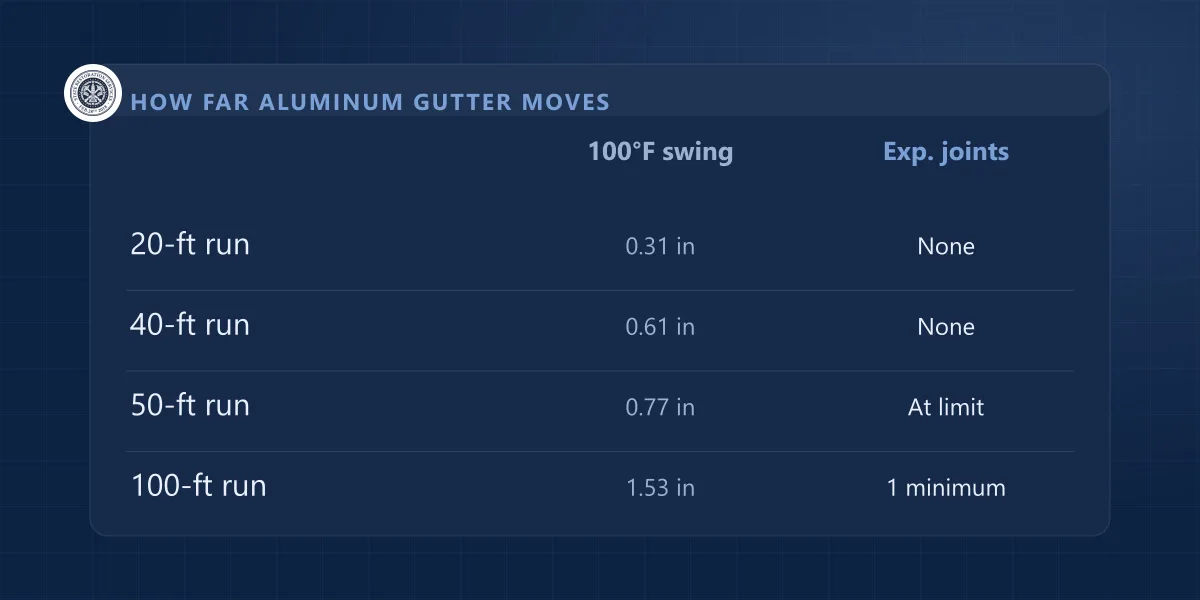
Enough to matter at the joints. Aluminum expands by roughly 12.8 millionths of its length for every degree Fahrenheit. Over a 100-degree swing, a 40-foot run changes length by about six tenths of an inch, and a 100-foot run by about an inch and a half. That movement has to go somewhere, and the sealed joints at the ends of the run are the parts that absorb it.
The figure comes straight from the material. The Engineering ToolBox table of linear expansion coefficients lists aluminum at 23 millionths per degree Celsius, which is about 12.8 millionths per degree Fahrenheit. The 100-degree swing is a conservative assumption for northern Illinois: air temperatures here run from below zero on a cold January night to the 90s in July, and a painted metal gutter in afternoon sun gets hotter than the air around it.
| Straight run | Length in inches | Movement |
|---|---|---|
| 20 ft | 240 | about 0.31 in. |
| 40 ft | 480 | about 0.61 in. |
| 50 ft | 600 | about 0.77 in. |
| 100 ft | 1,200 | about 1.53 in. |
This is why gutter manufacturers put a length limit on a run. Berger Building Products, which makes aluminum, copper and steel rainware, publishes a technical sheet on gutter and downspout sizing that sets it out plainly: "50 ft. (15.2 m) between ends or expansion joints is the limit unless the system is especially designed to accommodate the greater expansion." The same sheet adds that "gutters should expand away from downspouts and downspouts should not be located near gutter expansion joints."
An expansion joint is a deliberate break in the run that lets two halves move independently; Berger names two standard details for it, a lap type and a butt type. A house whose longest straight run is under 50 feet does not need one. On a long ranch, a wide colonial or a building with a continuous eave, it is worth asking whether the quote includes one, and where it goes relative to the downspouts.
Can you just caulk a leaking gutter corner?
Often, yes, if it is done properly and the gap is small. The sealant manufacturer says to remove the old sealant before applying new, and to work on a clean, dry joint. It also caps the size of joint the product is meant for, and a gap bigger than that is not a sealant job.
Geocel 2320 is one of the common gutter sealants, and Geocel's own product data sheet is specific. It says that "for best results, 2320 Sealant should be applied to a clean, dry surface which is free of foreign matter," and that "when resealing over old existing sealant, remove sealant before applying." The product page adds the limit: "Not recommended for joints larger than 1/4″ x 1/4″."
Those three lines explain why a quick corner reseal can fail. A fresh bead laid over old, cracked sealant is bonding to the old sealant rather than the metal, so it lets go along the same line. A bead laid over leaves and grit has nothing clean to grip. And a corner that has pulled open wider than a quarter inch is a joint that has moved, and a thicker bead of sealant will not hold it closed through another winter.
The same data sheet does list adhesion "even when damp or oily" and says the product "may be applied at any working temperature," with an application range of 0 to 140°F. That is useful for an emergency patch in bad weather. It does not change the instruction for a lasting repair: dig out the old material, clean the metal, and seal a joint that is still tight.
Is it the joint, or is water getting somewhere else?
Check that before paying anyone to reseal. Water running down the outside of a gutter at a corner can come from an overflowing trough, from water getting behind the gutter at the roof edge, or from a loose downspout section. Each of those looks like a corner leak from the lawn and none of them is fixed with sealant.
- Overflow at an inside corner. If water sheets over the front lip only in heavy rain, and only under a roof valley, the corner is being overwhelmed rather than leaking. That is a capacity or cleaning issue, and our gutter cleaning visit is the first step.
- Water behind the gutter. Staining on the fascia above the gutter line, rather than below it, points at water getting behind the trough at the roof edge. Amerimax's sheet has the gutter slipped under the drip edge for exactly this reason.
- A clogged outlet. A blocked downspout backs water up in the trough until it overflows or finds a weak joint.
- A loose downspout. Amerimax has each downspout section fitted "larger end of one over the smaller end of the other." Assembled upside down, water can run out of the joints on the way down the wall.
- A sagging run. A run that has dropped between hangers holds water in the dip and can pull its corner joints apart. We covered what holds a gutter up in gutters sagging or pulling away.
Reseal, rebuild the corner, or replace the run?
It depends on the gap and the metal. A corner that is tight with failed sealant is a reseal. A corner that has opened wider than the sealant is rated for, or a miter that is bent or split, is a rebuild of that joint. A run that keeps pulling its corners apart needs re-hanging or replacing.
| What we find | Usual call |
|---|---|
| Joint tight, old sealant cracked or peeling | Remove the old sealant, clean, reseal |
| Joint opened wider than 1/4 in. | Re-fasten or rebuild the joint, then seal |
| Miter bent, split or corroded | Replace the corner piece |
| End cap leaking at the high end of the run | Check and correct the pitch, then reseal |
| Long run pulling its corners open every year | Re-hang the run, and add an expansion joint if it is over 50 ft |
Cost follows that split. A reseal is small work. A rebuilt corner or a new run is priced like new gutter, and we set out current Chicago-area per-foot ranges in how much gutters cost per foot. The work itself falls under our seamless gutter installation and repair service, and we tell you which of the rows above you are in before we quote.
On insurance, one distinction is worth knowing. Sealant that has aged out over the years is maintenance, and homeowners policies exclude wear and tear. A corner crushed or punctured in a specific storm is a different matter, and we wrote about that side in hail damage to gutters and downspouts. Illinois law does not allow a roofing contractor to negotiate your claim; we document the damage, and our affiliated licensed public adjuster, State Adjusting Services, can represent you if the claim needs it. Our storm and insurance page explains how that works.
What can you check from the ground?
Quite a lot, and none of it needs a ladder. Stand under each corner during a steady rain and watch where the water leaves the gutter. A drip from the underside of a joint is a joint. Water over the front lip is overflow. Water on the fascia above the gutter is getting behind it. That one observation narrows the repair to the right conversation.
- Walk the house in the rain and note each corner, end cap and outlet that drips. Photograph them; it saves time at the inspection.
- Look for dirt stripes on siding or trim directly below a joint. Those mark a leak that has been running for a while.
- Pace off your longest straight run. If one run is past 50 feet with no break in it, mention that when you ask for a repair quote.
- Check the downspouts for water running out of the joints on the way down, which points at the downspout rather than the gutter.
Please leave the resealing to someone on a ladder with the right sealant and a way to clean the joint first. A free inspection will tell you whether you are looking at a reseal, a corner or a run.
Frequently asked questions
Why is my seamless gutter leaking at the corner?
Because the corner is a joint. Seamless gutters are one piece along each straight run, but every inside and outside corner is a separate miter joined to the runs and sealed. When that sealant ages, cracks, or is pulled open by the run moving with temperature, the corner leaks.
Can I put new gutter sealant over the old sealant?
The sealant manufacturer says not to. Geocel's product data sheet for its 2320 gutter sealant says to remove old existing sealant before resealing and to apply the new sealant to a clean, dry surface. A bead laid over old sealant bonds to the old material and tends to fail along the same line.
How long can a seamless gutter run be?
Berger Building Products' technical sheet sets 50 feet between ends or expansion joints as the limit, unless the system is specifically designed for more expansion. Aluminum moves about 0.77 inches over a 50-foot run across a 100-degree temperature swing, so longer runs need an expansion joint.
Does insurance cover a leaking gutter corner?
Usually not when the sealant has simply aged, because homeowners policies exclude wear and tear. A corner crushed or punctured in a specific storm is treated differently. Illinois law bars a roofing contractor from negotiating your claim, so a licensed public adjuster handles that side if needed.
Gutter dripping at the corners? Book a free inspection or call (866) 992-2982 — we serve the north and northwest Chicago suburbs from Lincolnshire, and our office is open Monday to Friday, 8:00 AM to 5:00 PM. You can also send us a photo through the contact page and we will tell you which joint it is.