
 Volodymyr Lukaniuk
Gutter guards do not void your roof warranty by themselves. GAF, one of the three shingle makers we install, says in its own technical bulletin that guards put on by a professional almost never affect the shingle warranty. The catch is in the next lines of the same bulletin: the warranty only ever covered defects in the shingles, not the guard and not any damage from installing it, and GAF names four installation methods to stay away from. So the question that matters is not the guard's brand. It is what the guard's installer does to the roof edge to hang it.
Below is GAF's bulletin read line by line, a second shingle maker's list next to it, the four ways guards attach and which line each one runs into, why November is a bad month to lift shingles, and the questions to put to a guard salesman before you sign.
What GAF's gutter cover bulletin says, line by line
The document is TAB-R-113, "Gutter Covers And Shingles", from GAF Technical Services. On the warranty it is short:
"The GAF Limited Warranty only covers manufacturing defects of the shingles and does not cover the gutter covers or damage due to their installation."
GAF Technical Advisory Bulletin TAB-R-113, Gutter Covers And Shingles
Then it lists the installation methods to avoid. Each one is about something specific at the bottom edge of your roof:
- First on the list is a fastener through the shingle to hold the cover in place. Every screw through the shingle is a hole above the deck. The first course at the eave is where meltwater sits all winter, so a hole there leaks long before one higher up would.
- Taking shingles off and putting them back to fit the guard. A shingle that comes off loses its seal and gets new nail holes when it goes back. Done badly it ends up nailed too low or too high, and wind lifts it.
- Pulling out the drip edge, or leaving it off. That edge is the bent metal strip that carries water off the roof edge into the gutter instead of behind it. Our article on gutter flashing and the drip edge shows what it does. Take it out to fit a guard and water runs down the fascia board instead.
- The last one is putting the guard under the underlayment. At the eave the underlayment is usually ice and water shield, the sticky membrane that keeps water backed up behind an ice dam out of the house. Our guide to how far up the roof ice and water shield goes explains why that strip matters here. Cut it or pull it loose and the eave loses its last layer of defence.
The bulletin also says homeowners should not install guards themselves unless they can get written instructions from the guard maker, because store-bought guards usually come without any.
Two shingle makers, one list
Atlas Roofing published nearly the same advice on its blog in 2018, reposted on RoofersCoffeeShop, and adds one line GAF does not have: no trimming or cutting shingles to make room. Side by side:
| What the guard's instructions ask for | GAF TAB-R-113 | Atlas (2018 blog) |
|---|---|---|
| A screw or nail driven through a shingle to hold the guard | Avoid | Avoid |
| Shingles taken off and put back to fit the guard | Avoid | Avoid |
| Drip edge taken off or left out | Avoid | Avoid |
| Shingles trimmed or cut to make room | Not on the list | Avoid |
| Guard tucked under the underlayment, or underlayment removed | Avoid (under it) | Avoid (both) |
| Shingle warranty pays for the guard or for damage from installing it | No | No |
We install GAF, Owens Corning and IKO shingles. For an Owens Corning or IKO roof, ask that maker's technical department for its answer in writing; we only quote papers we have read.
Where the back edge of a guard ends up
Guards differ less by their mesh than by where their back edge goes. Look at the product sheet or a photo of an installed one and you will find it in one of these four places.
- Sitting inside the gutter
- Drop-in screens, foam blocks and brush inserts rest in the trough and touch nothing on the roof. None of the four lines apply. They come out for cleaning, and leaves still pile on top of them. Roof contact: none.
- Screwed to the gutter's front lip and to the fascia
- Many rigid micro-mesh panels clip to the front of the gutter and fasten at the back to the fascia board or to the gutter's back wall, under the drip edge. Put on that way, the roof is left alone. Check: the drip edge stays where it is and no screw goes into the shingle.
- Slid under the first row of shingles
- The back edge is pushed up under the bottom course. This is not on GAF's list by itself, but it means lifting sealed shingles, and some instruction sheets then call for a fastener through the shingle to keep the guard from sliding out, which is line 1. Check: how the shingles are lifted, what holds the guard, and who reseals the row.
- Laid on top of the shingles and fastened there
- A guard whose back edge lies on the shingle surface and is screwed or nailed down puts holes in the first course, right where ice dams hold water. Check: this is line 1 on both lists.
Why a November install deserves a second look
Guards sell hardest right after the leaves come down, which in the north and northwest suburbs is also when the shingles are coldest. Asphalt shingles get stiff in the cold. As we explained in our piece on roof repairs found in late fall, GAF says that below 40°F shingles lose flexibility and can crack, and the seal strip on the back of each one needs warmth and sun to stick. Pry up a sealed shingle on a cold morning to slide a guard under it and two things can happen: it cracks along the bend, or it comes loose and does not reseal on its own until spring.
A loose bottom row is exactly what a January wind gets under. If a guard that tucks under the shingles has to go on in late fall, the installer should be hand-sealing the lifted row with dabs of roofing cement, and you should see it on the ticket. A guard that mounts to the gutter and fascia does not have this problem, which is one reason it is an easier choice this time of year.
The other gutter clause in GAF's paperwork
A second GAF bulletin, TAB-R-150, covers a setup common on two-story houses with a lower roof over a porch, garage or addition. When an upper gutter's downspout empties onto the lower roof, the stream wears the granules off the shingles below it, keeps that patch wet enough for algae and moss, and can push water up between shingles into a leak that may take years to show inside. GAF says the shingle defect warranty stays in effect, but erosion from upper gutters draining onto lower roofs is not its responsibility, and the warranty does not cover the design or installation of the gutter system.
The fixes GAF lists are plain: carry the water to the ground with a longer downspout, or run it into another gutter. Adding guards to the upper gutter does nothing for this; the water still lands in the same spot.
What to ask the guard salesman before you sign
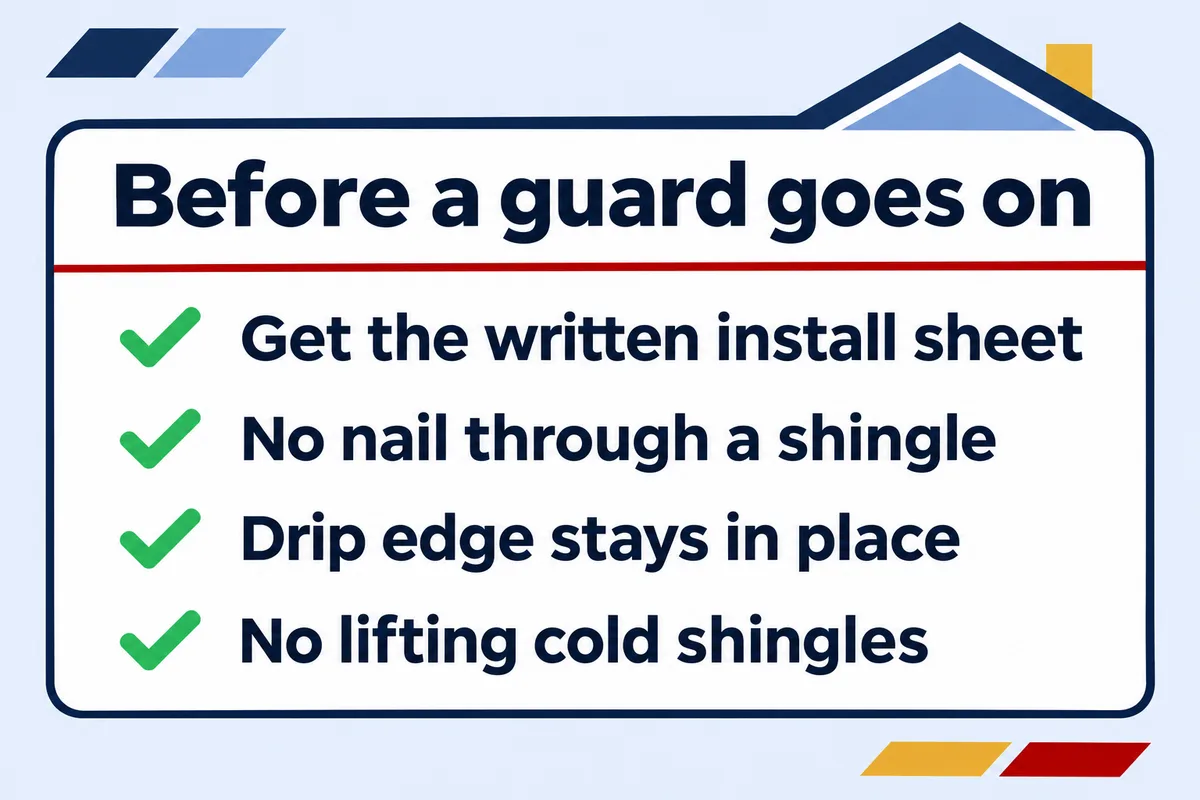
- Can I see the written installation instructions for this guard on a shingle roof?
- Where does the back edge go: fascia, gutter, under the shingles or on top of them?
- Does any screw or nail go through a shingle, and does the drip edge stay?
- If shingles are lifted, who reseals them, with what, and is that on the invoice?
- If a shingle cracks or the eave leaks after the install, whose warranty covers it, for how long, and where is that written in the contract?
The last answer matters most, because by GAF's own wording the shingle warranty will not. Our article on what a gutter warranty really covers walks through installer workmanship terms, and whether guards are worth paying for on your lot is its own question, answered in our honest take on gutter guards.
On price, professional micro-mesh guards run roughly $6 to $25 a foot in our area depending on the product, so 150 feet of gutter comes to about $900 to $3,750 before any gutter work. The LeafFilter cost breakdown shows where one well-known system lands. We quote gutters and gutter guards line by line, and bundling guards with new gutters, or with a roof replacement, costs less than two separate projects.
Frequently asked questions
Will GAF turn down a shingle warranty claim because I have gutter guards?
Not for that reason alone. GAF says in its bulletin TAB-R-113 that guards put on by professionals almost always follow good roofing practice and leave the warranty alone. What the warranty never covered is the guard itself, or damage caused by putting it on. A shingle that fails from a manufacturing defect is still GAF's problem; a shingle cracked or holed by the guard install is the installer's.
Can gutter guards go under the shingles?
GAF's list of things to avoid does not name sliding a guard under the first course. It names a fastener through the shingle, taking shingles off, removing the drip edge and going under the underlayment. Sliding under means lifting a sealed shingle, though, and that seal has to be restored by hand, which is hard to do well on a cold day.
Should gutter guards go on when the roof is replaced?
It is the simplest time. The drip edge and the first shingle course are going on anyway, so the guard's back edge can be planned around them, and one crew answers for the whole roof edge. We price guards next to new gutters and the roof line by line, so you can see what each part costs.
Related reading: how much gutters cost per foot and snow sliding off the roof and tearing gutters off.
Got a guard quote and want a roofer to look at the eave it will hang on? Book a free inspection or call (866) 992-2982. The office takes calls Monday to Friday from 7:00 AM to 7:00 PM and Saturday and Sunday from 9:00 AM to 5:00 PM, and our crews work from our Lincolnshire base across Lake and north Cook County.