
 Volodymyr Lukaniuk
Choosing between sectional and seamless gutters comes down to one kind of joint. Both systems have end caps, corner miters and downspout outlets in the same places. Sectional gutters add a seam every 10 feet along each run, where two pieces overlap and are held together with sealant and rivets or screws. Seamless gutters are formed on site from a coil of aluminum in one piece per run, so that seam does not exist. For the long runs on a house, seamless gutters are the better buy; for a run shorter than 10 feet, the two are the same thing.
We form seamless gutters from aluminum coil on our truck at the house across the north and northwest Chicago suburbs, and we take down a lot of old sectional systems to do it. Below we count the joints on one example house, put a price on the difference from our own published ranges, and show where a sectional piece still makes sense.
How to tell which kind you have from the driveway
Stand back far enough to see a whole side of the house, ideally in low morning or evening light, and look along the bottom of the gutter.
- Look for thin vertical lines across the face of the gutter at regular spacing. If you see one about every 10 feet on a long run, those are sectional seams. A run of seamless gutter shows no line between its two ends.
- Look at the underside right at those lines. A sectional seam often has a row of rivet or screw heads and a dark stripe of old sealant, and it is where drips, rust spots or a stain on the fascia show up first.
- Check how long the runs are. A run of 30 or 40 feet with no line anywhere along it is a seamless gutter. Some sectional gutters come in longer store lengths, so count the lines rather than guess from age.
- Ignore the ends and the corners. End caps, corner miters and the outlet where a downspout drops look much the same on both systems, so they tell you nothing about which one you have.
One example house, joint by joint
Take a two-story house with a gable roof, an attached two-car garage and a small front porch. The gable ends do not need gutters, so the water is caught on five straight runs and 136 feet of gutter in all. This is an example to count on, not a job of ours. Sectional seams are worked out at one per 10 feet of length, the spacing our gutter installation page shows for sectional systems.
| Run | Length | Sectional seams | End caps (both) | Outlets (both) |
|---|---|---|---|---|
| Front eave of the house | 40 ft | 3 | 2 | 2 |
| Back eave of the house | 40 ft | 3 | 2 | 2 |
| Garage front | 22 ft | 2 | 2 | 1 |
| Garage back | 22 ft | 2 | 2 | 1 |
| Front porch | 12 ft | 1 | 2 | 1 |
| Whole house | 136 ft | 11 | 10 | 7 |
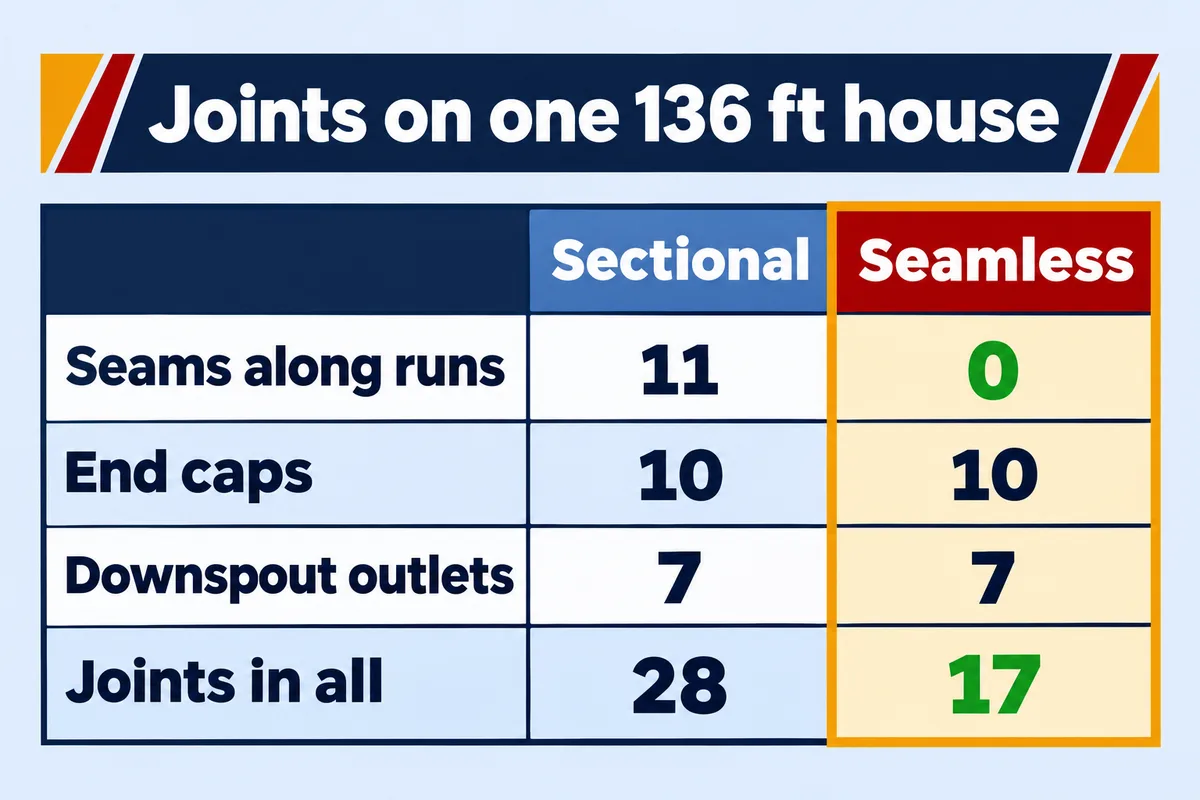
Add it up and the sectional version of this house has 28 joints that have to stay sealed, and with seamless gutters it has 17. That is 11 fewer places for water to get out, about 39 percent. A house with an L-shaped roof adds corner miters, which both systems need equally, so the gap in joints stays the same 11 while the total grows.
What each joint goes through in a north-suburb year
A joint is two pieces of metal held together and sealed. The metal moves a little every time the sun hits it and every time it freezes, and the sealant has to stretch with it. Four kinds of joint sit on a gutter system:
- Seam along the run sectional only
- Two lengths overlap and are riveted or screwed with sealant between them. It sits in the middle of the run, so water and wet leaves sit on it in every storm, and ice sits on it all winter. When the sealant dries out, the drip lands on the fascia board or right next to the foundation.
- End cap both systems
- The closed end of each run. It is crimped or riveted on and sealed inside. Our article on seamless gutters leaking at corners and end caps shows how to find a failed one and reseal it.
- Downspout outlet both systems
- A hole cut in the bottom of the gutter with a short tube fastened and sealed into it. Leaves collect here first, so it gets the most standing water of any joint.
- Corner miter both systems
- Where a run turns a corner of the house. Seamless gutters get a factory or field miter here, sealed and strapped, the same as sectional ones.
So seamless gutters are not joint-free, and anyone who tells you that is selling something. What they lose is the one joint that sits in the busiest part of the run. The weight of snow and ice is a separate matter that hangers carry, and our guide to gutters sagging and pulling away covers that for both kinds.
The price gap on the same 136 feet
Our guide to how much gutters cost per foot publishes the ranges we use for the Chicago market. Run this house through them:
Seamless gutters in aluminum, $6 to $14 per foot installed: 136 x $6 = $816, up to 136 x $14 = $1,904.
Aluminum in general, $4 to $10 per foot: 136 x $4 = $544, up to 136 x $10 = $1,360.
Difference for the gutters alone: about $272 to $544, before downspouts.
Downspouts, elbows and the removal of the old system cost the same whichever gutter you pick, so they do not change the gap. Spread over 11 seams, the extra comes to roughly $25 to $50 per seam that will never need resealing from a ladder. That is the honest way to look at the choice: you pay once for fewer joints, or you pay later in caulk and ladder trips.
Where a sectional piece is the right call
Length decides it. A run under 10 feet, over a porch, a bay window, a back stoop or a shed, is one piece either way, with no seam to fail. On a run like that, a store section hung at the right pitch works as well as seamless gutters do.
The other case is a repair. If a sectional system is straight, its hangers are tight and only one length got crushed by a branch or a ladder, replacing that one length can be a fair fix. The new piece rarely matches the old color exactly, and the two seams on either side of it are the next ones to watch. When a hailstorm has dented whole runs, that is a different conversation, and our article on hail damage to gutters and downspouts explains how it is documented.
Everywhere else, on the long eaves of the house and the garage, we recommend seamless gutters.
What a seamless gutter quote should name
A price per foot tells you little until you know what is in it. Before you sign, check that the quote says:
- One continuous piece per run, with every run and its length listed.
- The gutter size, 5 or 6 inch, and the metal thickness. Our article on .027 vs .032 aluminum gutters explains why that number matters on long runs.
- Hanger type and spacing, screwed into the fascia.
- How many downspouts, where they drop, and their size.
- That end caps and miters are sealed inside, and whether the old gutters are taken away.
Frequently asked questions
Do seamless gutters still leak?
They can, but only at the joints they keep: end caps, corner miters and downspout outlets. A run of seamless gutter has no seam along its length, so on our example house it has 17 joints to keep sealed against 28 for the same house in 10-foot sectional pieces.
Can you replace one section of a seamless gutter?
Not one 10-foot piece, because there are no pieces. A damaged seamless gutter run is replaced from end to end, usually corner to corner or end cap to end cap. With a forming machine on the truck, the new run is made to length at the house, the same way the first one was.
Are sectional gutters ever the better choice?
Yes, on a run shorter than 10 feet, such as a porch, bay window or shed roof, because one section has no seam anyway. Sectional pieces also make sense for patching an older sectional system that is otherwise straight and sound.
Not sure what is on your house now, or ready to price seamless gutters? Book a free estimate or call (866) 992-2982, and we will measure every run and count the joints with you. We serve the north and northwest Chicago suburbs.