
 Volodymyr Lukaniuk
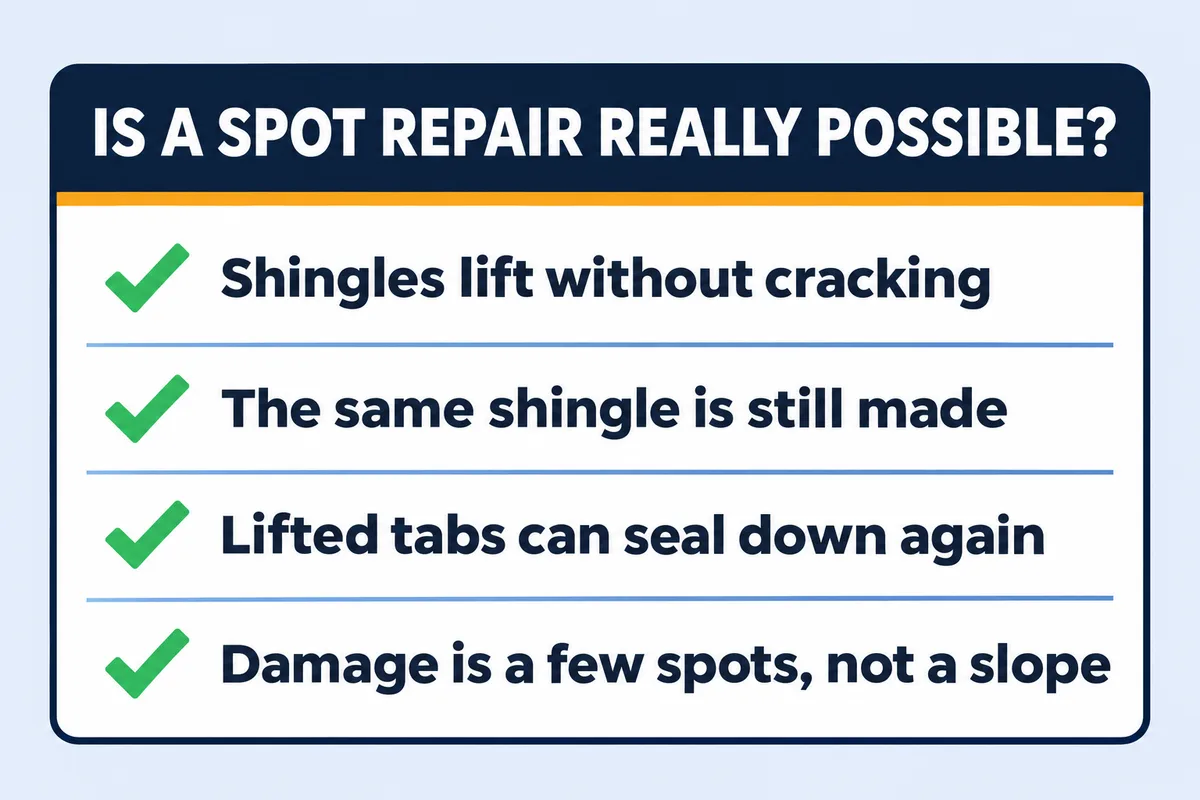
When the insurance says repair, not replace, on a roof that every roofer you call refuses to patch, the estimate is resting on an assumption, not a fact. A repair line takes four things for granted: the old shingles can be lifted without breaking, the same shingle can still be bought, the lifted shingles will seal back down, and the damage really sits in a few spots. If any one of those fails on your roof, the honest repair is the whole slope, and in Illinois there is a written path for showing the insurer why.
We are a family-owned roofing contractor in Lincolnshire, and we see these estimates every storm season across the north and northwest suburbs. Most of the time the adjuster is not being cheap on purpose. The adjuster saw nine bruised shingles, the software priced nine shingles, and nobody on that visit put a bar under a tab to see what happens.
Four things a repair line on your estimate takes for granted
Look at the estimate. If the roof section says something like "remove and replace shingles, 1 square" or a count of individual shingles, the adjuster priced a spot repair. For that repair to be done properly, four things have to be true, and we check each one before we agree or disagree with it.
| What the repair assumes | What we check on the roof | What goes in the file |
|---|---|---|
| The shingles around the damage can be lifted | We lift tabs in several places on the damaged slope, in mild weather, and watch for cracking, snapping or tearing at the nail line. | Short video of each lift, with the date, the temperature and which slope it was. |
| A matching shingle is still made | We pull a damaged piece, read the brand and style, and check whether the maker still sells that line in that color. | Photo of the sample next to the closest current product, plus the maker's discontinued notice if there is one. |
| Lifted shingles will seal down again | We check whether the sealant strips still bond. Old, dusty strips often do not grab again once they are broken loose. | Photos of the broken seal line and of tabs that stay loose after they are pressed down. |
| The damage is a few spots | We count hits on every slope, not only the one the adjuster walked. Spread-out hail marks are not a spot problem. | A chalked count per slope, photographed with a tape in the frame for scale. |
The second check has its own fight, and we wrote a separate guide on it: what happens when the insurer pays for one slope and the shingle no longer matches. This article stays with the other three, because they are the ones a homeowner can actually see and question.
The lift test, and why both sides argue about it
The check most of these disputes turn on is the so-called brittle test: lift a shingle and see whether it bends or breaks. It sounds simple. It is also the part of the claim where the insurer's people and the roofer's people most often talk past each other, so it helps to know what each side says in writing.
The lift should be done slowly, at 3 to 5 places, on a day between 55 and 85 degrees. A slope may not be fit for repair if shingles "Crack immediately when lifted" or "Can't be re-sealed securely after being lifted".
Paraphrased and quoted from the RepairLogic field check guide, a library written for the insurance claims side.
There is no recognized standard test with that name, and asphalt stiffens and softens with temperature. But if tabs can be lifted to look at the nailing, "they can certainly be lifted enough to facilitate repairs."
Paraphrased and quoted from engineer Lyle Hogan's article for IIBEC, the building enclosure consultants' institute.
Both are right about something. A shingle that snaps on a 20-degree morning may bend fine in May, so a test done in the cold proves very little. And a shingle that tears every time it is touched, in any weather, really cannot be patched without making three new holes for every one you fix. We run it this way so the result holds up with an adjuster who was not there:
- We test on a mild day and write the temperature down. In late fall that means waiting for an afternoon in the 50s, not forcing it in the morning frost.
- We test on the slope with the damage and on at least one other face, in sun, away from the eave and away from shade.
- We lift slowly with a flat bar, film every lift, and keep the pieces that broke.
- If the shingles bend and reseal, we say so, and the repair stands. Our job is the true answer about the roof, not the bigger invoice.
That last point is also where the out-of-town storm crews lose us. A crew that "fails" every roof with a yank on a cold morning is not testing anything, and adjusters learn to ignore their photos fast. That makes it harder for the next homeowner whose roof really is too far gone.
One sample slope, priced both ways
Numbers make the stakes clearer. Take a sample slope of about 800 square feet, or 8 squares, with hail hits spread across it. We use the ranges published on our own site: a repair of blown or broken shingles on one slope usually runs $350 to $750, and a full replacement runs $450 to $1,150 per square depending on the shingle and the roof.
| Sample slope, 8 squares | Low | High |
|---|---|---|
| Spot repair as written | $350 | $750 |
| Replace the whole slope | $3,600 | $9,200 |
| Paid on the repair, $1,000 deductible | $0 | $0 |
| Paid on the slope, $1,000 deductible | $2,600 | $8,200 |
| Paid on the slope, $2,500 deductible | $1,100 | $6,700 |
This is why a repair-only estimate often arrives with a check for nothing at all. The repair price sits under the deductible, so the claim closes with no payment, and you are left with a roof that cannot be patched the way the paper says. The slope numbers are before any depreciation the insurer holds back on a replacement cost policy, which you usually get back after the work is done.
What the Illinois rule says when your estimate is higher
Illinois has a claims rule written for exactly this gap between the insurer's estimate and the contractor's. It sits in the state's fair claims practices rules for fire and extended coverage policies, which is how most homeowners policies are classed. The key part reads:
"The estimate prepared by or for the company shall be reasonable, in accordance with applicable policy provisions, and of an amount which will allow for repairs to be made in a workmanlike manner."
"Failure of the company to so inform the insured of the name of a contractor shall require the company to provide written notice to the insured that any and all reasonable costs incurred for repair or replacement related to the partial loss in excess of the company's estimate will be reimbursed by the company."
50 Ill. Adm. Code 919.80(d)(7)(C), read on Cornell's copy of the Illinois rule.In plain words: a repair estimate that no competent roofer can actually perform is not "workmanlike". The rule turns that into a paper trail with a clear order:
- Ask the insurer, in writing, for a copy of the estimate the settlement is based on. The same rule says they must supply it on request.
- Get a written estimate from a roofer that prices the work that can really be done, with a short note on why a spot repair fails. Attach the videos and photos from the table above.
- Send it to the claim. The insurer has to review it and answer promptly in writing.
- If they still say repair, they have to name a contractor who will do that repair. If they do not name one, the rule requires them to say in writing that reasonable costs above their estimate will be reimbursed.
Step four is the quiet test of the whole estimate. If a contractor the insurer names looks at your brittle, unsealable, discontinued shingles and agrees to patch them properly at that price, fine. Often the reply changes once someone has to sign their name to the repair.
Where our part ends and the claim work begins
Illinois law does not let a roofing contractor negotiate an insurance claim for you, and we follow it. What we do is the roof side: inspect every slope, run the checks above, take the evidence, and write a code-compliant estimate for the work that can really be done. We answer the insurer's technical questions about that construction scope. You can read how our visits run on our process page, and what we look for on a hail or wind roof on our insurance claim help page.
If the insurer still will not move, the person who can argue the claim itself is a licensed public adjuster. Our partner, the licensed Illinois public adjuster State Adjusting Services, can represent you on the claim. They are a separate company. You choose whether to bring them in, and our estimate and evidence work the same either way.
One timing note for this time of year: if the slope does get replaced in cold weather, the new shingles may not seal until spring, which is normal and not a defect. We covered that in why new shingles stay unsealed through a Chicago winter. Related reading: roof insurance supplements in Illinois.
Frequently asked questions
Can my insurance company make me repair a roof instead of replacing it?
A policy pays to repair or replace the part of the building that was damaged, so a repair is a fair settlement when a repair can really be done. If it cannot be done in a workmanlike way, Illinois rule 919.80(d)(7)(C) lets you answer the insurer's estimate with your own written estimate, and the insurer must respond in writing and either name a contractor who will do the repair or agree to pay reasonable costs above its estimate.
Is the brittle test on shingles a real test?
It is a field check, not a standard laboratory test, and its result changes with temperature. Done fairly, on a mild day, on several slopes, slowly and on video, it is good evidence that shingles crack or tear when lifted. Done on a frosty morning with a hard yank, it proves very little.
What if the repair estimate is less than my deductible?
Then the claim usually closes with no payment. That is the moment to check whether the repair can actually be done, because if the honest scope is the whole slope, the total may be well above the deductible.
Got an estimate that says repair on a roof nobody will patch? Book a free inspection or call (866) 992-2982. We are open Monday to Friday, 7:00 AM to 7:00 PM, and Saturday and Sunday, 9:00 AM to 5:00 PM, across the north and northwest Chicago suburbs.