
 Volodymyr Lukaniuk
Rain chains in winter around Chicago do freeze, and on its own that is fine: the chain turns into a column of ice, and the real questions are whether the gutter outlet holding it can carry that weight and whether the meltwater lands somewhere safe. A third question applies all year. A rain chain drains far less water than a downspout, so a chain hung under a big roof plane spills in a summer thunderstorm and collects the most ice in January. Put a chain under a small piece of roof, hang the outlet for the load, tie down the bottom, and it can stay up through the season.
We install seamless gutters and downspouts across the north and northwest Chicago suburbs, so we look at rain chains from the gutter's side: the outlet hole, the hanger next to it, and the ground below.
What a Chicago winter does to a rain chain
Water runs down the links, the night drops below freezing, and the film on the metal freezes. Every thaw and freeze adds a layer, and by January a chain under a busy roof edge can be one solid sleeve of ice from the gutter to the ground. Ice weighs about 57 pounds per cubic foot, so the sleeve is easy to put a number on.
Thin sleeve, 2 inches across
An 8-foot chain, the usual drop from a one-story eave.
Ice: about 0.17 cubic feet.
Weight on the outlet: about 10 pounds.
Thick sleeve, 4 inches across
The same chain under a roof edge that drips all winter.
Ice: about 0.70 cubic feet.
Weight on the outlet: about 40 pounds.
Doubling the width of the sleeve makes it four times heavier, because the ice grows as a ring around the chain. A chain off a two-story eave is about twice as long, so double those figures again.
All of that weight hangs from one point, the bar or bracket across the gutter's outlet hole. The gutter at that spot is already full of its own ice, and the hanger nearest the outlet carries both. A gutter that tips forward or pulls off the fascia right beside a chain is showing you that load. The fix is the one in our article on gutters sagging and pulling away: a hanger on each side of the outlet, screwed into solid wood. Wind adds a sideways swing on top of the weight, which is why the bottom of a chain should be tied down.
Where the water goes once the chain is solid ice
A frozen chain still carries water on a thaw day, but it stops guiding it. Meltwater runs down the outside of the ice and drips off wherever the sleeve bulges, and at the bottom it builds an ice mound that gets a little wider with every freeze. Over a stoop, a sidewalk or the driveway, that mound is the slippery spot of the winter.
The other half is the foundation. Clemson University's Home and Garden Information Center says it plainly in its rain chain factsheet:
It is critical to make sure the water flowing from the chain is flowing away from the foundation of your home; rain chains offer little benefit otherwise.
A downspout can be piped several feet out into the yard. A chain drops its water right at the wall, so the ground under it has to slope away from the house. Our guide to where downspouts should drain covers how far out the water should land, and the same reasoning applies to the base of a chain.
A rain chain season in the north suburbs, month by month
- In November, before the first hard freeze, look at the outlet from a ladder. The bracket should sit flat across the hole, and the gutter on both sides should line up with the rest of the run. If the chain is coming down for winter, do it now, while the links are dry and easy to handle.
- From December to February, leave the ice alone while the gutter holds straight. Hitting a sleeve with a hammer dents an aluminum gutter faster than the ice ever would. If the gutter starts to tip forward at the outlet, that is the moment for a crew and new hangers, and our article on frozen gutters and downspouts explains what is safe to do from the ground.
- March thaw days are the test. Watch where the meltwater lands. If it pools against the wall, or runs across a walk and refreezes overnight, the chain is in the wrong place or the ground needs regrading.
- In April, check the bracket, the hangers and the anchor at the bottom, and clear leaves and shingle grit out of the outlet before the spring storms. This is also the month to decide whether that outlet keeps its chain or gets a downspout back.
How much roof one rain chain can drain in a Chicago storm
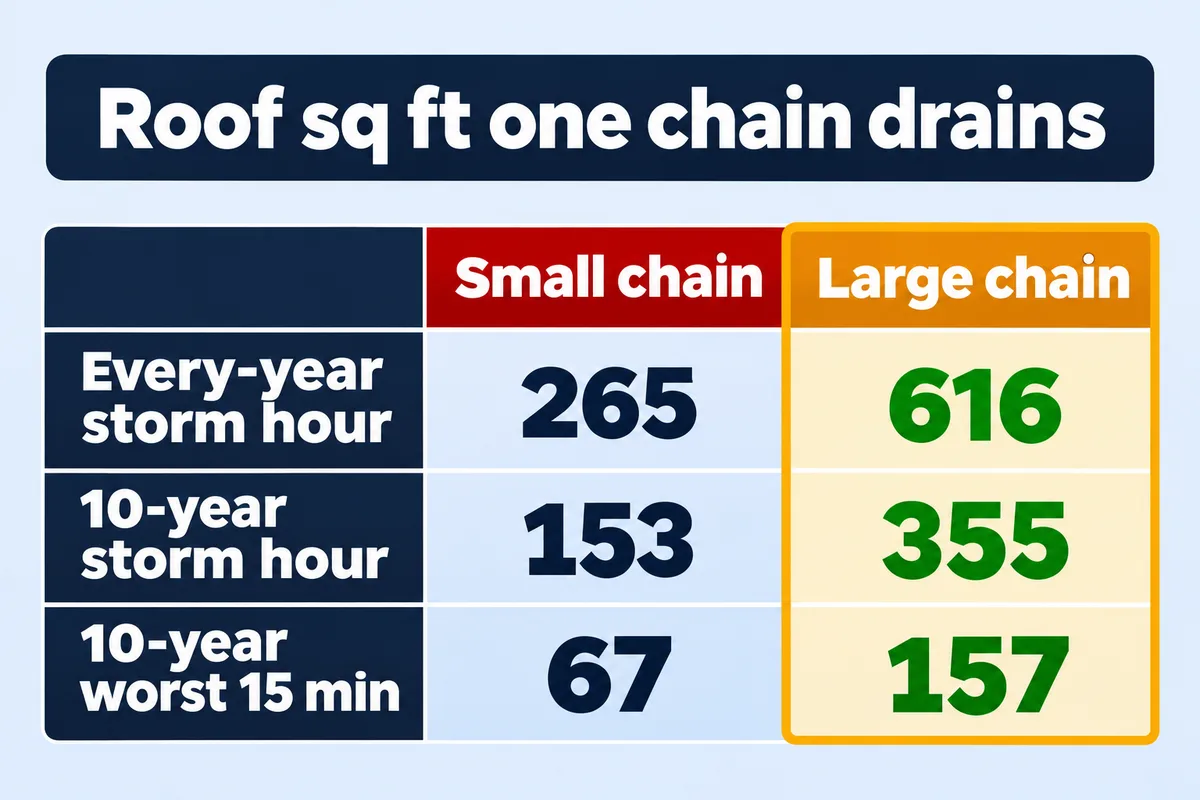
Rain chains are rated in water per hour. One Japanese maker, SEO Rain Chain, publishes its drainage capacities: 730 litres an hour for its standard models and 1,700 litres an hour for the large ones, and it says the water reaching each chain should not be more than that. That works out to about 193 and 449 gallons an hour. To turn those figures into roof, we took the rainfall rates for Lincolnshire from NOAA's Precipitation Frequency Data Server (Atlas 14) and divided, using 0.623 gallons for every inch of rain on a square foot of roof.
| Storm in Lincolnshire | Rain rate | Small chain, 730 L/h | Large chain, 1,700 L/h |
|---|---|---|---|
| Hardest hour of an ordinary year | 1.17 in/h | 265 sq ft | 616 sq ft |
| Hardest hour of a 10-year storm | 2.03 in/h | 153 sq ft | 355 sq ft |
| Worst 15 minutes of a 10-year storm | 4.60 in/h | 67 sq ft | 157 sq ft |
| Worst 15 minutes of a 100-year storm | 6.29 in/h | 49 sq ft | 115 sq ft |
Square feet here means the roof's footprint seen from above, so a steep roof does not count for more. For comparison, we size a plain 2x3 downspout for up to about 600 square feet of roof and a 3x4 for about 1,200, as our article on gutter pitch and downspout placement explains.
The 15-minute rows are the ones that count here. Our summer storms arrive as bursts, and a chain cannot store water: whatever it cannot carry that minute sprays off the links or spills over the gutter lip. A porch roof of 8 by 20 feet is 160 square feet, right at the limit of the large chain in a 10-year burst. So a chain belongs under a small roof, such as a porch, a bay window, a shed or the short end of a hip, while the long planes of the main roof keep their downspouts. If a run already overflows in heavy rain with a downspout on it, our article on why gutters overflow in heavy rain shows where to look first.

Where to hang a chain so winter does no harm
Before a chain goes up, or before you leave one up for the winter, check that all five of these hold for that spot:
- It drains the smallest piece of roof on that side of the house, ideally a porch, bay or shed roof.
- It does not hang over a door, a stoop, a walk or the driveway, where the ice mound at its base turns into a fall.
- The gutter has a hanger on each side of the outlet, fixed into solid fascia.
- The bottom is tied to an anchor, a basin or a stake, so wind cannot swing it into the siding or a window.
- The ground under it slopes away from the house, with gravel or a basin so the drip does not dig a hole.
If you are getting new seamless gutters, the outlet for a chain is easiest to plan before the gutter goes up. Ask us during the gutter installation estimate which outlet drains the least roof; that is the spot for it. Every other outlet keeps a proper downspout.
Frequently asked questions
Should I take my rain chain down for the winter?
Take it down in November if it hangs under a large roof plane, over a walkway, or from a gutter that already sags, and hang it back in April. If it drains a small roof, hangs over a planting bed and the outlet has a hanger on each side, it can stay up.
Can a rain chain replace all my downspouts?
Not on a typical house around Chicago. In the worst 15 minutes of a 10-year storm, even a large chain keeps up with only about 157 square feet of roof, while a 2x3 downspout handles up to about 600. Use chains on small roofs and keep downspouts on the main roof planes.
Will a frozen rain chain damage the gutter?
It can. A 4-inch sleeve of ice on an 8-foot chain weighs about 40 pounds, and all of it hangs from the outlet. With a hanger on each side of the outlet the gutter usually carries it; without them the gutter can tip forward or pull away from the fascia.
Want a second look at where your chain hangs, or at the gutter holding it? Book a free inspection and we will check the outlet, the hangers and the ground below.